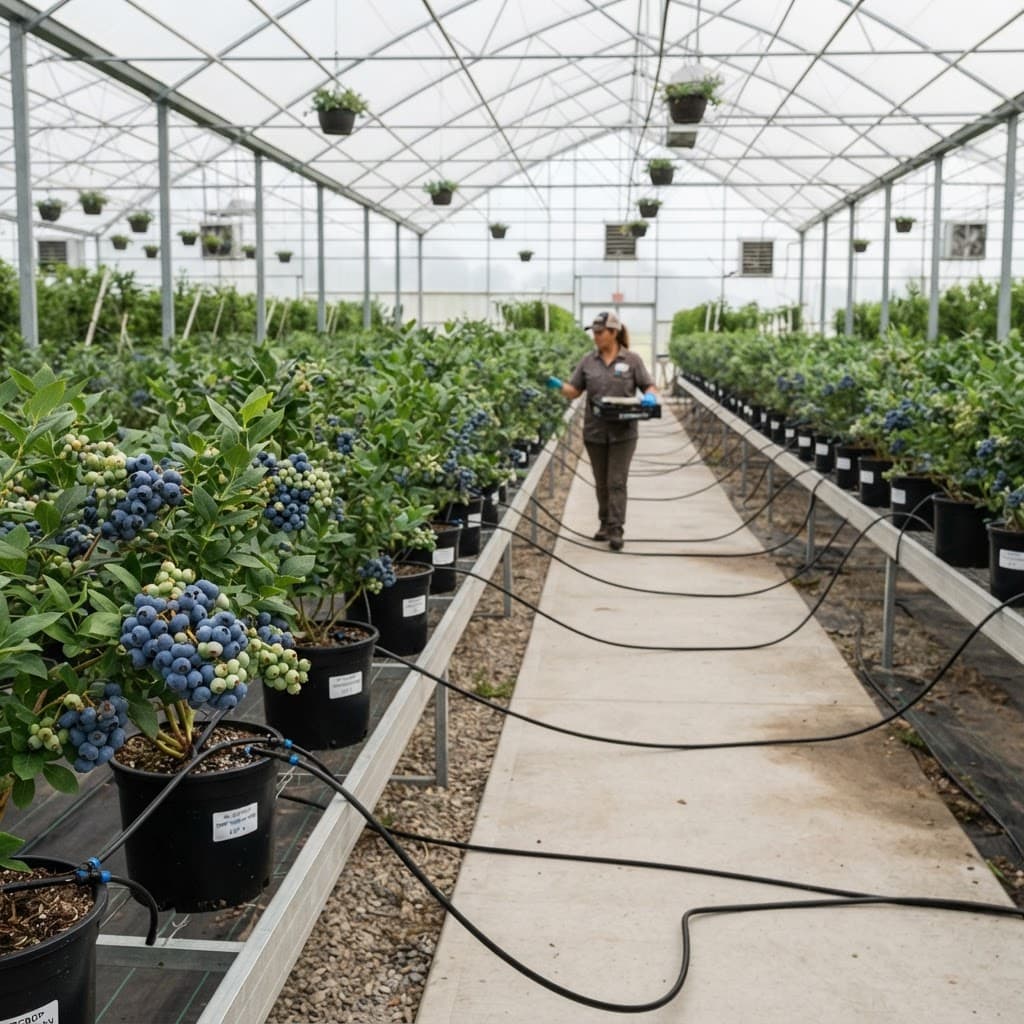
Substrate pots on ground or gutters
Pots of 25 to 65 litres give full control of pH and drainage, and allow production on unsuitable native soils.
Greenhouse project consulting, engineering and supply coordination worldwide
projects@aegisgreenhouse.com
Blueberry
Blueberry has become a high-value protected crop because early and late fruit commands premium pricing. A blueberry greenhouse is fundamentally an acidic-substrate irrigation project: water chemistry, pot volume and pH control matter more than structural sophistication.
01
| Parameter | Target | Notes |
|---|---|---|
| Substrate pH | 4.5 – 5.5 | Non-negotiable; drives iron and manganese availability |
| Irrigation water EC | < 0.5 mS/cm | Blueberry is highly sensitive to chloride and sodium |
| Day temperature | 18 – 25 °C | Excess heat during flowering reduces fruit set |
| Chilling requirement | Variety dependent | Cultivar choice must match local winter chill hours |
| Substrate mix | Pine bark, peat, coir blends | Free-draining, acidic, high air porosity |
| Pollination | Bumblebees or honeybees | Determines berry size and cluster fill |
02
Pots of 25 to 65 litres give full control of pH and drainage, and allow production on unsuitable native soils.
Automated acid injection with continuous pH monitoring holds the root zone in the narrow band blueberry requires.
Rain protection and season extension are the objectives; a well-ventilated multi-span often gives the best return on capital.
Netting protects against birds and pests while shade screens temper radiation during flowering and ripening.
High-frequency, low-volume irrigation with measured drain prevents both salt accumulation and waterlogging.
Early, mid and late cultivars are combined to extend the harvest window and smooth labour demand.
03
Source water is analysed before design. High bicarbonate or sodium levels usually require reverse osmosis or blending to make substrate pH control possible.
Acid dosing, fertiliser form selection and drain pH monitoring keep the root zone between 4.5 and 5.5 throughout the season.
Ventilation and shading protect flowering and early fruit set from heat stress, which is the main yield loss mechanism in warm regions.
Airflow through the canopy limits Botrytis and anthracnose, particularly during ripening.
Where climate allows, controlled dormancy and pruning strategy are used to place harvest in the highest-price window.
04
Protected production delivers fruit outside the local field window, when prices are typically two to four times higher.
Rain and hail protection with clean substrate culture reduces splitting, disease and field rejects.
Substrate pots make blueberry viable on alkaline or heavy soils where field planting would fail.
Controlled root volume and nutrition bring plants into commercial production faster than field establishment.
FAQ
Common technical and commercial questions about blueberry greenhouse.
Yes. Commercial protected blueberry production uses acidic substrate in pots or gutters under multi-span or glass structures. The greenhouse provides rain, hail and bird protection plus season extension, while the substrate system delivers the low pH and free drainage blueberry requires.
Greenhouse blueberries need a free-draining acidic substrate — typically pine bark, peat and coco blends — held at pH 4.5 to 5.5. Achieving this consistently usually requires low-alkalinity irrigation water, acid dosing and continuous pH monitoring of both supply and drain water.
Mature protected blueberry systems typically produce 2 to 5 kg/m² per year, reaching full production in the third or fourth year. Yield depends on cultivar, plant density, pot volume, pruning strategy, pollination and climate management during flowering.
Usually not. Blueberry economics are driven by water chemistry, substrate management and harvest timing rather than climate precision. A well-ventilated multi-span structure with netting, shading and an accurate acid-dosing fertigation system generally delivers the best return on invested capital.
Continue
Explore the connected technical and commercial topics for this project stage.
Send your location, target crop and planned growing area. You will receive a technical response with a suitable greenhouse configuration and an indicative budget range.
Independent greenhouse solution provider · Response within one business day