NFT channel systems
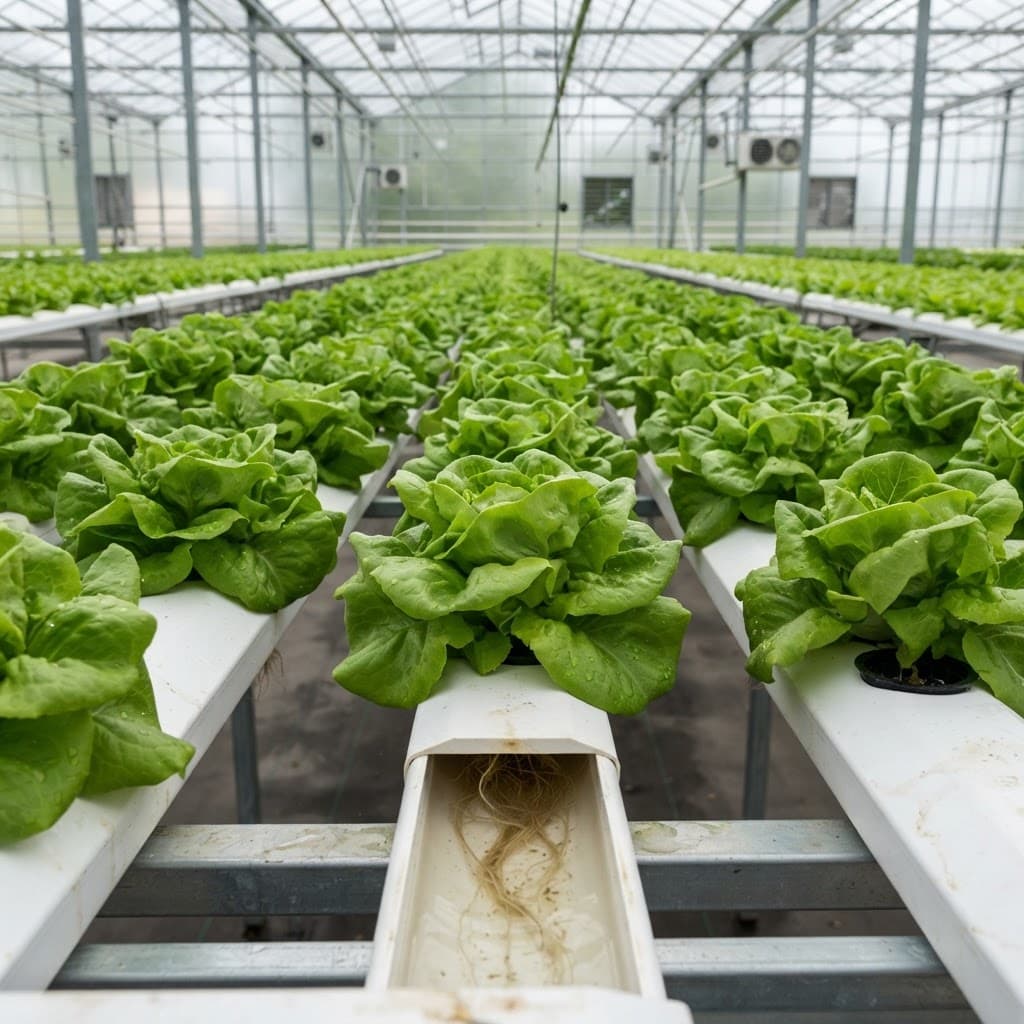
Sloped channels with a thin nutrient film give fast growth, low water volume and simple mechanised transplanting and harvest.
Greenhouse project consulting, engineering and supply coordination worldwide
projects@aegisgreenhouse.com
Lettuce & Leafy Greens
Lettuce and leafy greens are the fastest-cycling greenhouse crops, which makes them the most sensitive to throughput and labour efficiency. A lettuce greenhouse succeeds on cycle discipline, uniform light and reliable root zone temperature rather than on maximum technology.
01
| Parameter | Target | Notes |
|---|---|---|
| Day temperature | 18 – 22 °C | Above 25 °C triggers bolting and bitterness |
| Night temperature | 12 – 16 °C | Supports firm heads and good leaf texture |
| Root zone temperature | 18 – 22 °C | The single biggest driver of tipburn risk |
| Nutrient EC | 1.2 – 1.8 mS/cm | Adjusted by season and light level |
| pH | 5.5 – 6.2 | Keeps micronutrients available |
| Relative humidity | 65 – 75% RH | Excess humidity causes tipburn and downy mildew |
02
Sloped channels with a thin nutrient film give fast growth, low water volume and simple mechanised transplanting and harvest.
Large solution volume buffers root temperature, which is a decisive advantage in hot climates.
Leafy greens need air exchange more than insulation; ventilation area and screening drive summer viability.
Pad-and-fan or fogging with movable shade holds the crop below the bolting threshold through summer.
Closed-loop nutrient reuse with disinfection reduces water and fertiliser cost and limits root disease spread.
A dedicated propagation zone keeps the main greenhouse in production and makes weekly cycle planning reliable.
03
Ventilation capacity, shading and evaporative cooling are sized against summer peak conditions, because bolting eliminates crop value outright.
Solution cooling, tank shading and pipe insulation hold the nutrient solution in range and prevent oxygen depletion.
Air movement, humidity control and calcium availability are managed together — tipburn is a transpiration problem, not a fertiliser problem.
Diffuse glazing and shade give uniform light for uniform head weight; supplemental lighting stabilises winter cycle length.
Fixed weekly sowing, transplanting and harvesting slots with channel cleaning between cycles keep throughput and food safety consistent.
04
Short cycles turn capital quickly and allow production to be matched closely to contracted demand.
Uniform hydroponic conditions produce the specification consistency retail and food service buyers require.
Recirculating systems use a fraction of field water use, which is decisive in water-constrained regions.
Soil-free production with recorded inputs supports premium pricing and simplifies food safety certification.
FAQ
Common technical and commercial questions about lettuce greenhouse.
NFT channel hydroponics is the most widely used commercial system for greenhouse lettuce because of fast growth, low water volume and easy mechanisation. Deep water culture is preferred in hot climates where the large solution volume helps stabilise root zone temperature.
A commercial hydroponic lettuce greenhouse produces 8 to 12 crops per year, with cycles of 28 to 45 days depending on season, light level and target head weight. A separate nursery area is essential to maintain a consistent weekly harvest schedule.
Bolting is caused by excessive temperature, typically above 25 °C, or by high root zone temperature. Tipburn is caused by rapid growth combined with insufficient calcium transport, driven by low air movement and high humidity. Both are climate and irrigation design problems rather than variety problems.
Hydroponic lettuce greenhouses typically cost 110 to 200 USD per square metre delivered and installed, including structure, cooling, NFT or DWC system, water treatment and controls. In hot climates the cooling package is often the largest single cost component.
Continue
Explore the connected technical and commercial topics for this project stage.
Send your location, target crop and planned growing area. You will receive a technical response with a suitable greenhouse configuration and an indicative budget range.
Independent greenhouse solution provider · Response within one business day