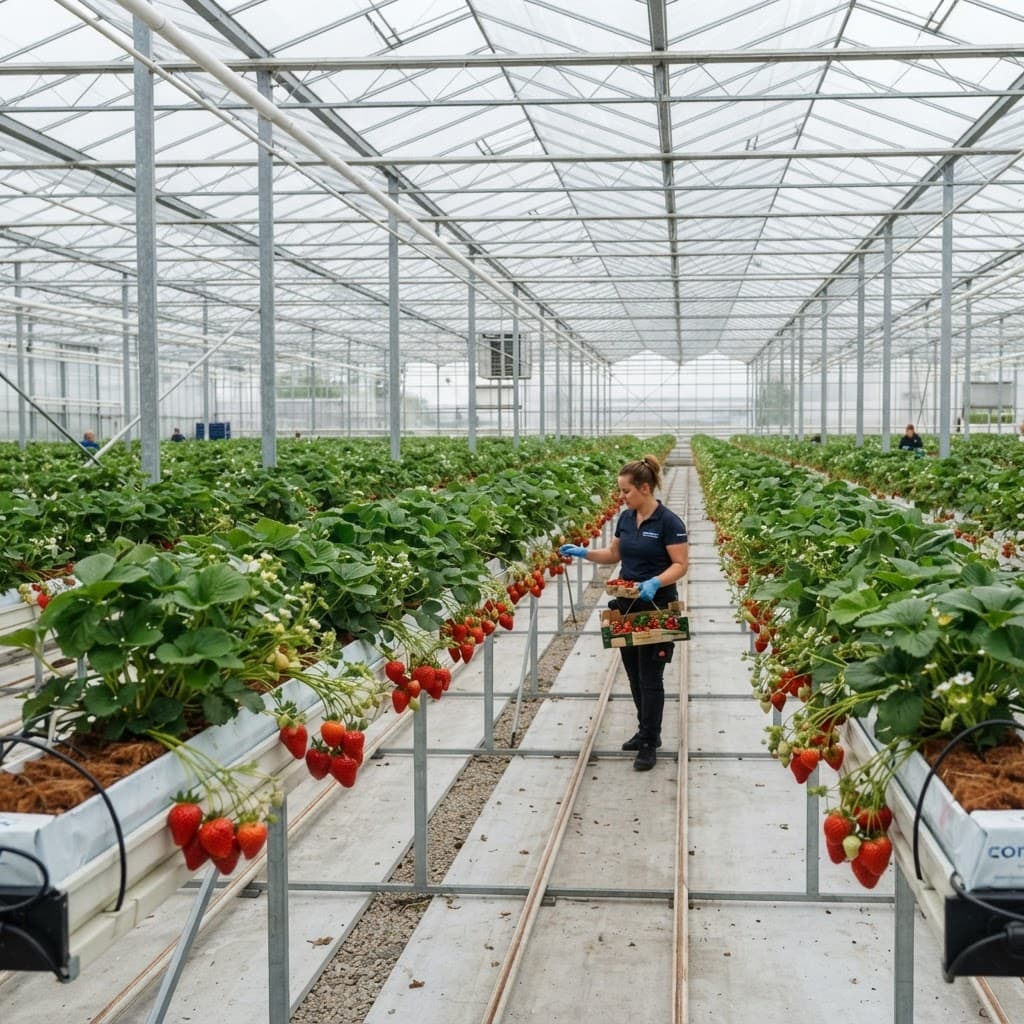
Elevated gutters at 1.2 – 1.4 m
Table-top growing raises picking to waist height, cutting harvest labour time by 20 to 40 percent and improving fruit hygiene.
Greenhouse project consulting, engineering and supply coordination worldwide
projects@aegisgreenhouse.com
Strawberry
Protected strawberry production has moved decisively to elevated gutter systems under glass and film. A strawberry greenhouse extends the season, protects fruit quality and cuts harvest labour cost per kilogram — the three variables that decide profitability in soft fruit.
01
| Parameter | Target | Notes |
|---|---|---|
| Day temperature | 18 – 22 °C | Higher temperatures reduce fruit firmness and shelf life |
| Night temperature | 8 – 12 °C | Cool nights support sugar accumulation and flavour |
| Relative humidity | 60 – 75% RH | Critical for Botrytis and powdery mildew control |
| Root zone temperature | 12 – 18 °C | Elevated gutters need buffering in hot climates |
| Pollination | Bumblebee hives | Directly determines fruit shape and class-one percentage |
| Water EC | < 0.7 mS/cm source | Strawberry is salt sensitive |
02
Table-top growing raises picking to waist height, cutting harvest labour time by 20 to 40 percent and improving fruit hygiene.
Coir provides consistent air-water balance, and slab volume per plant is matched to the planting density and irrigation strategy.
Per-gutter drip lines with drain measurement allow precise EC steering for flavour and firmness.
Rigid glazing supports year-round or extended-season programmes and better rain and hail protection than film.
Screens control night heat loss, temper radiation peaks and help hold humidity within the disease-safe band.
Variety and planting strategy are selected around the target market window rather than adopted by default.
03
Botrytis is the primary economic risk. Minimum pipe temperature, screen gapping and staged ventilation keep the canopy dry through the night transition.
Warm days with distinctly cooler nights build sugars and firmness; a flat 24-hour temperature produces soft, bland fruit.
Elevated gutters heat and cool quickly, so irrigation frequency and shading are used to hold the root zone in range.
Diffuse glazing and shade screens prevent radiation stress; supplemental lighting extends production in low-light winters.
Bumblebee activity requires controlled temperature, humidity and airflow, so climate strategy is set with pollination in mind.
04
Two to four times typical open field yields, with a much higher proportion of class-one fruit.
Protected production supplies the shoulder seasons when prices are highest and field fruit is unavailable.
Waist-height picking and clean walkways significantly increase picker productivity.
Rain and soil contact are eliminated, reducing rejects, returns and post-harvest losses.
FAQ
Common technical and commercial questions about strawberry greenhouse.
Commercial strawberry greenhouses using elevated gutters and coco substrate typically produce 6 to 12 kg/m² per year, compared with 2 to 4 kg/m² in open field. Yield depends on variety, planting programme, light availability, climate control and pollination quality.
Glass or polycarbonate is preferred for year-round and extended-season programmes because of light transmission, durability and better humidity control. Film multi-span structures are commercially viable for season extension in mild climates at significantly lower capital cost.
Elevated gutters raise the crop to waist height, which reduces harvest labour cost, keeps fruit off the soil, improves airflow around the canopy to limit Botrytis, and allows precise control of root zone volume, drainage and nutrition.
Strawberry greenhouse projects typically cost 120 to 220 USD per square metre delivered and installed, including structure, climate control, elevated gutter system, substrate and fertigation. The gutter and substrate system alone is usually 25 to 45 USD per square metre.
Continue
Explore the connected technical and commercial topics for this project stage.
Send your location, target crop and planned growing area. You will receive a technical response with a suitable greenhouse configuration and an indicative budget range.
Independent greenhouse solution provider · Response within one business day