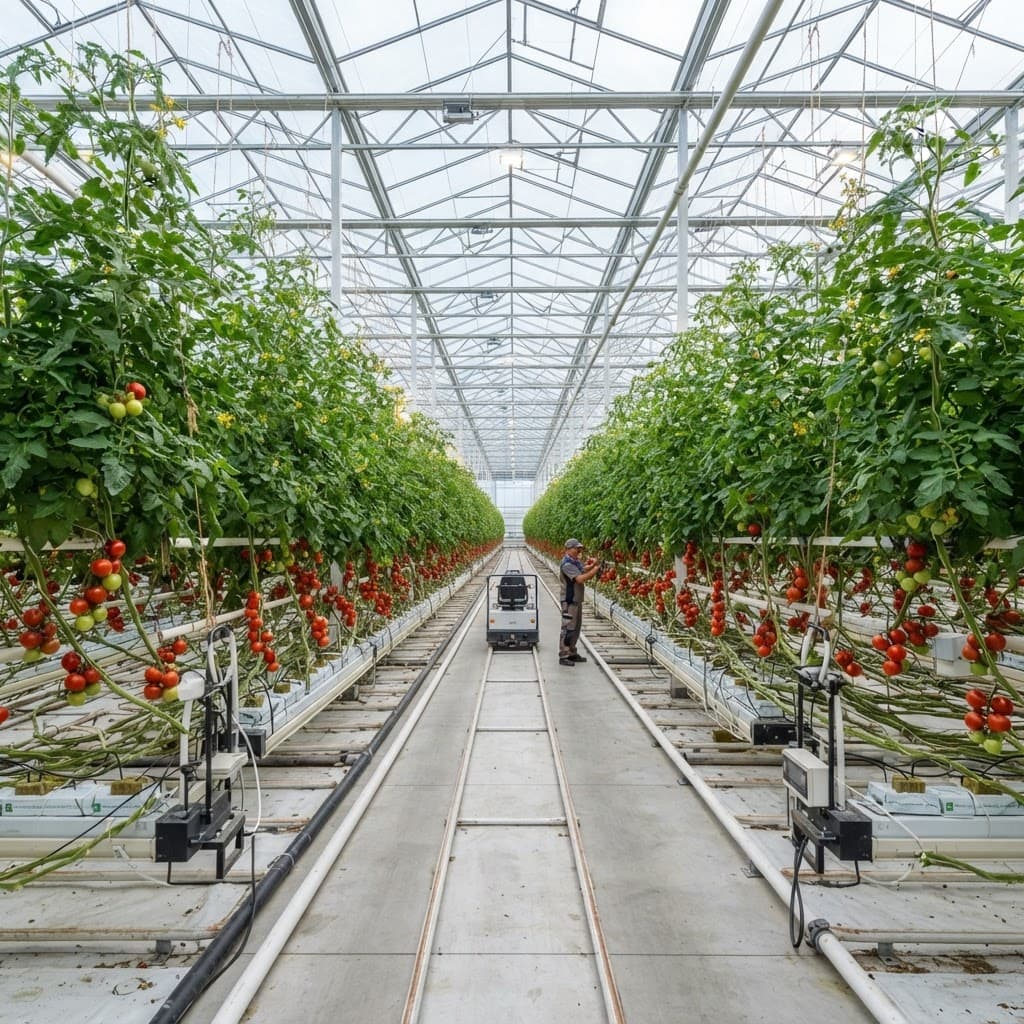
Venlo glass greenhouse, 6 – 8 m gutter
High light and large air volume support high-wire cropping, screens and CO₂ dosing. The standard for year-round contract supply.
Greenhouse project consulting, engineering and supply coordination worldwide
projects@aegisgreenhouse.com
Tomato
Tomato is the most widely grown protected crop in the world and the benchmark for greenhouse investment returns. A greenhouse for tomato must deliver high light, generous internal height, precise humidity control and a substrate system that supports a nine to eleven month high-wire cycle.
01
Target conditions that the greenhouse design has to make achievable.
| Parameter | Target | Why it matters |
|---|---|---|
| Day temperature | 20 – 24 °C | Drives photosynthesis and fruit set |
| Night temperature | 16 – 18 °C | Controls generative and vegetative balance |
| Relative humidity | 65 – 80% RH | Prevents Botrytis and calcium disorders |
| Light sum | > 1,000 J/cm²/day preferred | Directly correlates with yield potential |
| CO₂ concentration | 700 – 1,000 ppm | Adds 15 – 25% production when enriched |
| Irrigation water EC | < 0.5 mS/cm source | Enables accurate nutrient steering |
02
High light and large air volume support high-wire cropping, screens and CO₂ dosing. The standard for year-round contract supply.
Gutter-mounted slabs give root zone control, drain collection and clean crop rotation between cycles.
Layering the crop extends the cycle to 9 to 11 months, maximising output from each planting and each square metre.
Automated dosing, drain collection, UV or heat disinfection and reuse cut water and fertiliser cost while stabilising quality.
Energy screen plus movable shade reduces heating demand and controls radiation peaks and humidity at night.
Pipe-rail delivers heat where the crop needs it and doubles as the trolley track for harvest and crop work.
03
Tomato climate management is about steering the plant, not just holding a setpoint.
A 24-hour average temperature target with controlled pre-night and morning ramps steers fruit set, truss development and ripening speed.
Managing vapour pressure deficit with minimum pipe temperature, screen gapping and staged ventilation prevents condensation on fruit and reduces disease pressure.
Shade screens cap radiation peaks that cause stress and fruit quality loss, while diffuse glazing improves light penetration into the lower canopy.
Dosing to 700 to 1,000 ppm during photosynthetically active hours raises production, and requires coordination with ventilation strategy.
Start time, cycle frequency, drain percentage and EC adjustments through the day steer plant balance and fruit quality.
04
Compared with 5 to 10 kg/m² in open field, protected high-wire production transforms revenue per hectare.
Predictable weekly volumes let growers hold retail and wholesale contracts rather than sell into spot markets.
Heated, screened production captures the seasonal price window when field supply is unavailable.
Recirculating fertigation and integrated pest management reduce water, fertiliser and chemical cost per unit produced.
FAQ
Common technical and commercial questions about greenhouse for tomato.
A Venlo glass greenhouse with 6 to 8 metre gutter height, roof ventilation, energy and shade screens, pipe-rail heating and substrate gutters is the commercial standard for tomato. In mild climates a well-specified multi-span structure with good ventilation and Dutch bucket or gutter systems can be commercially viable at lower capital cost.
Simple film greenhouses with basic climate control typically produce 20 to 40 kg/m² per year. Modern glass greenhouses with heating, screens and CO₂ reach 60 to 80 kg/m², and top facilities with supplemental lighting exceed 100 kg/m². Yield depends on light, climate control, variety, crop management and labour skill.
A high-tech tomato greenhouse typically costs 180 to 280 USD per square metre delivered and installed, including structure, heating, screens, CO₂, substrate gutters, fertigation and controls. Lower-technology film-based tomato projects can be built for 45 to 90 USD per square metre with correspondingly lower yields.
High-wire tomato requires 6 to 8 metres of gutter height. This provides room for the trellis and layering system, allows screens to be installed above the crop, and creates the air volume needed to buffer temperature and humidity swings.
Continue
Explore the connected technical and commercial topics for this project stage.
Send your location, target crop and planned growing area. You will receive a technical response with a suitable greenhouse configuration and an indicative budget range.
Independent greenhouse solution provider · Response within one business day