Highest light transmission
Horticultural float glass transmits 82 to 89 percent of light, and diffuse glass with anti-reflective coating reaches around 91 percent — directly supporting yield in low-light seasons.
Greenhouse project consulting, engineering and supply coordination worldwide
projects@aegisgreenhouse.com
Glass Structures
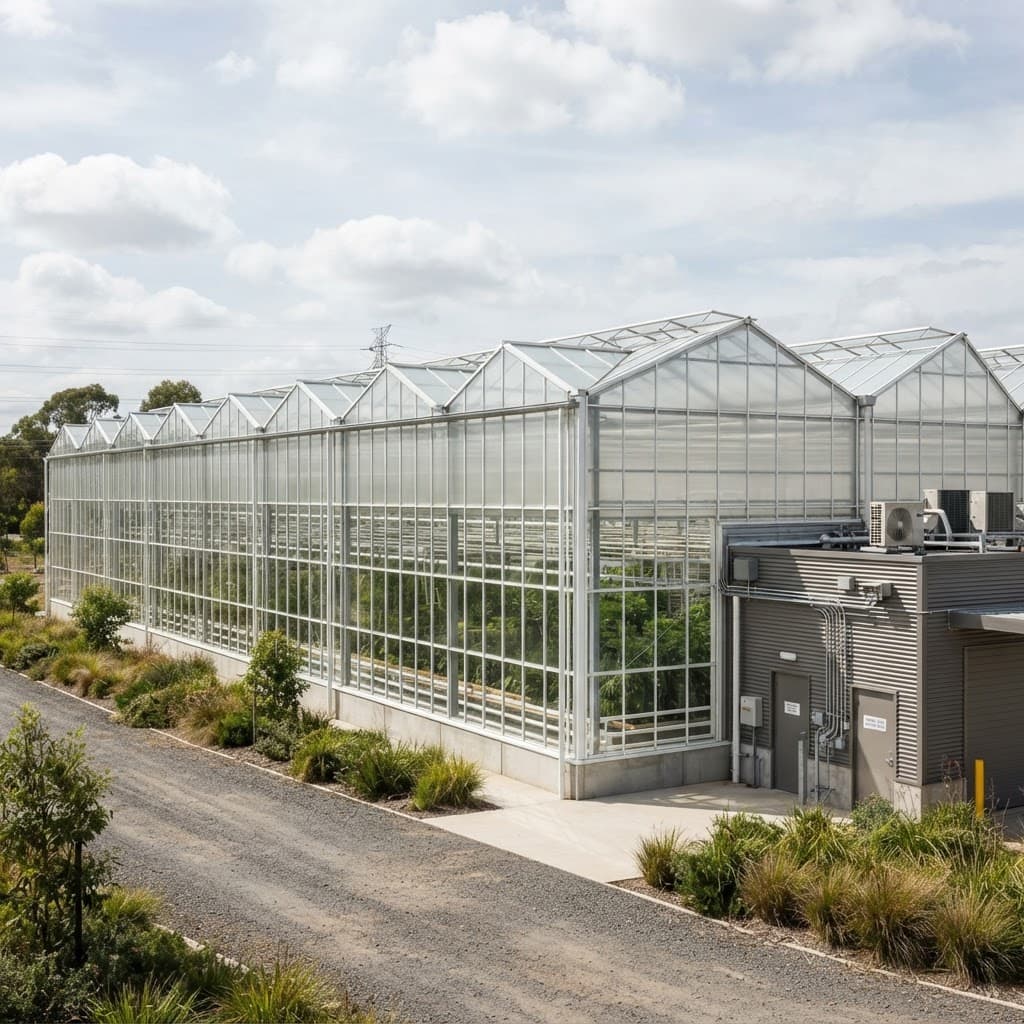
A commercial glass greenhouse offers the highest light transmission, the longest service life and the tightest climate control of any greenhouse structure. It is the reference choice for high-value crops where yield per square metre must justify a higher capital cost.
01
Horticultural float glass transmits 82 to 89 percent of light, and diffuse glass with anti-reflective coating reaches around 91 percent — directly supporting yield in low-light seasons.
Glass does not yellow or degrade like film. A hot-dip galvanised steel frame with glass cladding is a 20 to 30 year asset, which changes depreciation and financing terms.
A rigid, airtight envelope allows accurate heating, screening, humidity and CO₂ management, which is what makes year-round production planning possible.
Gutter heights of 4 to 8 metres buffer temperature swings, support high-wire cropping and allow screens, lighting and irrigation to be installed above the crop.
Rigid geometry and predictable loads make it straightforward to add internal transport, screens, supplemental lighting and full climate automation.
Glass greenhouses retain resale and collateral value better than film structures, which matters for financed or institutionally owned projects.
02
Where a commercial glass greenhouse is the right technical answer.
Tomato, cucumber and pepper grown on high wire for continuous supply contracts with retailers.
Regions with hard winters where heating, screening and airtightness determine whether winter production is economic.
Nurseries requiring uniform light, strict hygiene and tight temperature and humidity control.
Compartmentalised glasshouses where repeatable, measurable climate conditions are the primary requirement.
03
| Crop | Typical system | Why glass suits it |
|---|---|---|
| Tomato | High-wire substrate gutters | Light-hungry, long cycle, premium winter pricing |
| Cucumber | High-wire substrate | Fast cycles reward high light and stable humidity |
| Sweet pepper | Substrate slabs | Long cycle needs consistent heat and radiation |
| Strawberry | Elevated gutters | Out-of-season production depends on climate control |
| Leafy greens | NFT or gutter hydroponics | Uniform light gives uniform head weight |
| Cut flowers | Soil beds or benches | Quality and stem length are light-driven |
04
Two glass greenhouse quotations can differ by 60 percent for defensible engineering reasons. These are the variables that move the number.
Standard float, low-iron, diffuse and anti-reflective coated glass carry very different prices and different yield effects.
Wind and snow load requirements drive steel weight, column grid and foundation size — the single largest structural cost driver.
Higher gutters and wider spans improve the growing climate but increase steel, glass area and installation complexity.
Heating, screens, cooling, dehumidification, CO₂ and supplemental lighting often exceed the cost of the structure itself.
Gutters, substrate, water treatment, dosing units and recirculation typically add 20 to 45 USD per square metre.
Distance from factory, container count, duties, local labour rates and site access can add 15 to 30 percent to ex-works pricing.
FAQ
Common technical and commercial questions about commercial glass greenhouse.
A commercial glass greenhouse typically costs 150 to 250 USD per square metre delivered and installed, and can exceed 300 USD per square metre with supplemental lighting, full automation and heavy climate equipment. Structure alone is usually 60 to 110 USD per square metre; the balance is climate systems, growing system, irrigation, controls and installation.
Glass is better for light transmission, lifespan and climate precision, but it costs two to five times more than film. Glass is justified for high-value crops, cold climates and year-round contract supply. For large-area, cost-led production in mild climates, a multi-span film greenhouse often gives a better return on capital.
Commercial greenhouses commonly use 4 mm horticultural float glass for standard Venlo widths, and toughened or laminated 4 to 6 mm glass for wider panes, hail-prone regions or high-load roof designs. Diffuse and anti-reflective coated glass are specified where light quality drives crop value.
Yes, with the correct cooling strategy. Large roof ventilation area, movable shade and energy screens, pad-and-fan or high-pressure fogging, and correct orientation make glass viable in hot regions. In extremely hot and dusty environments a semi-closed design with air treatment is often more effective than passive ventilation.
Continue
Explore the connected technical and commercial topics for this project stage.
Send your location, target crop and planned growing area. You will receive a technical response with a suitable greenhouse configuration and an indicative budget range.
Independent greenhouse solution provider · Response within one business day