Radical water efficiency
Closed and semi-closed systems reuse drain water, cutting consumption 70 to 90 percent versus open field — decisive in arid regions.
Greenhouse project consulting, engineering and supply coordination worldwide
projects@aegisgreenhouse.com
Hydroponics
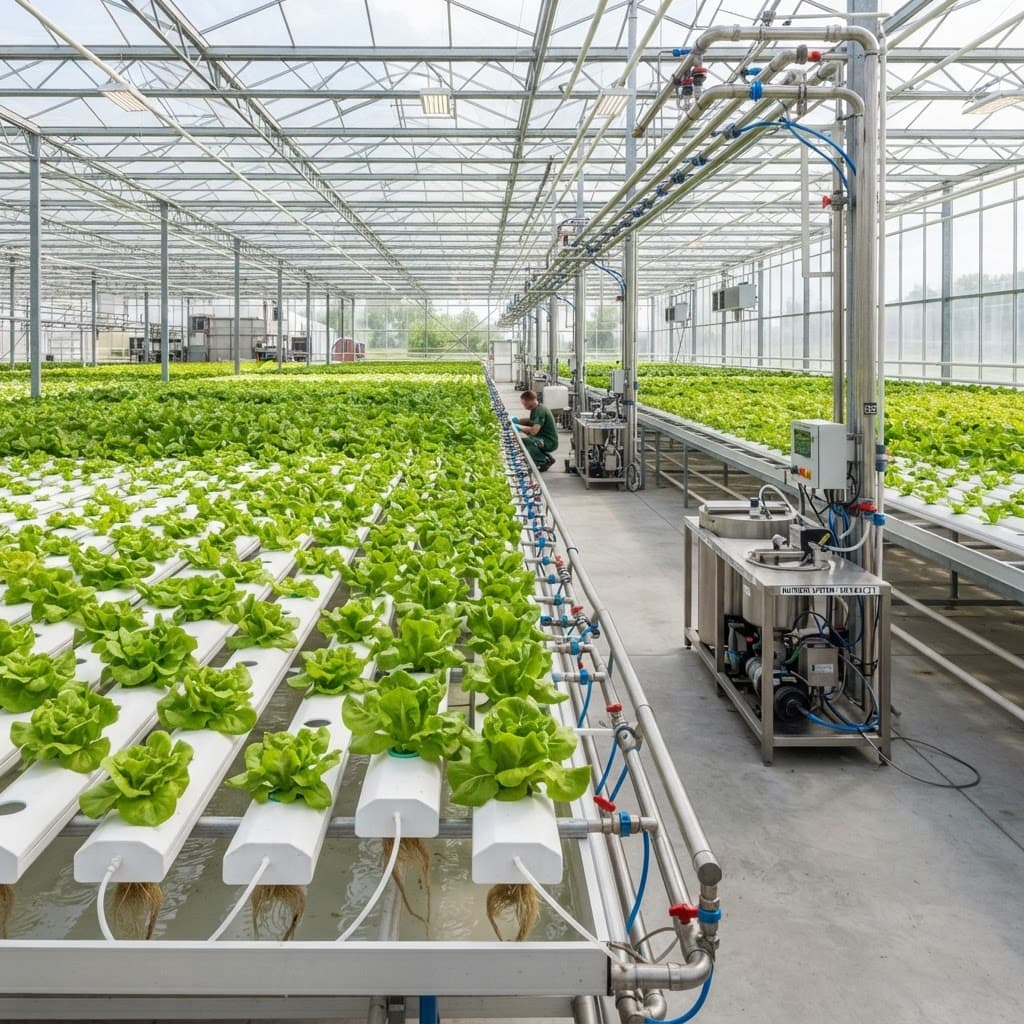
A hydroponic greenhouse system replaces soil with a controlled root environment, giving higher yields, predictable quality and dramatically lower water use. Selecting the right system depends on crop, water quality, labour cost and climate — not on which system is most fashionable.
01
Each hydroponic system suits a different crop architecture and operating model.
| System | Principle | Best crops | Notes |
|---|---|---|---|
| NFT channels | Thin nutrient film in sloped channels | Lettuce, herbs, leafy greens | Low water volume, fast cycles, needs power reliability |
| Deep water culture | Roots suspended in aerated solution | Lettuce, basil | Stable root temperature, heavier infrastructure |
| Substrate gutters | Coco or stone wool slabs on gutters | Tomato, cucumber, pepper | Standard for high-wire vine crops |
| Dutch bucket | Individual containers with drip and drain | Tomato, cucumber, melon, eggplant | Flexible, lower cost, easy phased expansion |
| Elevated gutters | Raised troughs with substrate | Strawberry, blueberry | Ergonomic harvesting, good drainage control |
| Vertical towers | Stacked planting positions | Herbs, small leafy crops | High density, light distribution is the constraint |
02
Closed and semi-closed systems reuse drain water, cutting consumption 70 to 90 percent versus open field — decisive in arid regions.
EC, pH, temperature and oxygen are managed directly, allowing steering of vegetative and generative crop balance.
Uniform root conditions produce uniform plants, which raises pack-out rates and simplifies harvest labour planning.
Projects can be built on poor, saline or rocky land, or on sites where soil-borne disease has made field production unviable.
Eliminating soil removes many pathogens and nematodes, reducing chemical use and supporting residue-sensitive markets.
Recorded nutrient and water data supports food safety certification and retailer audit requirements.
03
Hydroponics is unforgiving of design shortcuts. These items decide whether the system performs.
04
Poor source water can require reverse osmosis, which adds significant capital and ongoing energy cost.
NFT channel systems, substrate gutters and elevated berry gutters carry very different material costs per square metre.
Manual dosing versus fully automated fertigation with recirculation and UV disinfection is a major cost step.
Stone wool, coco coir and perlite differ in price, lifespan, disposal cost and irrigation behaviour.
Hydroponic crops demand tighter climate control, so cooling, screening and humidity management costs rise with the system.
Nutrients, substrate replacement, filters and water testing are recurring costs that belong in the OPEX model.
FAQ
Common technical and commercial questions about hydroponic greenhouse system.
A hydroponic greenhouse system grows crops without soil, delivering water and nutrients directly to the root zone through channels, substrate slabs, containers or gutters inside a climate-controlled greenhouse. It gives precise control of EC, pH, irrigation frequency and root temperature, which raises yield and product uniformity.
Commercial hydroponic greenhouses typically cost 110 to 220 USD per square metre delivered and installed, including structure, climate control, growing system, irrigation and controls. The hydroponic components themselves usually represent 20 to 45 USD per square metre; the balance is the greenhouse and climate systems.
For leafy greens and herbs, NFT channels or deep water culture give the fastest cycles and lowest labour. For tomato, cucumber and pepper, substrate gutters or Dutch buckets are the commercial standard. For strawberry and blueberry, elevated gutters combine drainage control with ergonomic harvesting.
A recirculating hydroponic greenhouse typically uses 70 to 90 percent less water than open field production of the same crop, and can reuse up to 95 percent of drain water when disinfection is installed. Actual consumption depends on climate, crop transpiration and whether the system is open or closed.
Continue
Explore the connected technical and commercial topics for this project stage.
Send your location, target crop and planned growing area. You will receive a technical response with a suitable greenhouse configuration and an indicative budget range.
Independent greenhouse solution provider · Response within one business day