Lowest cost per square metre
Multi-span film structures typically cost one third to one fifth of a comparable glass greenhouse, letting projects reach commercial scale sooner.
Greenhouse project consulting, engineering and supply coordination worldwide
projects@aegisgreenhouse.com
Multi-Span
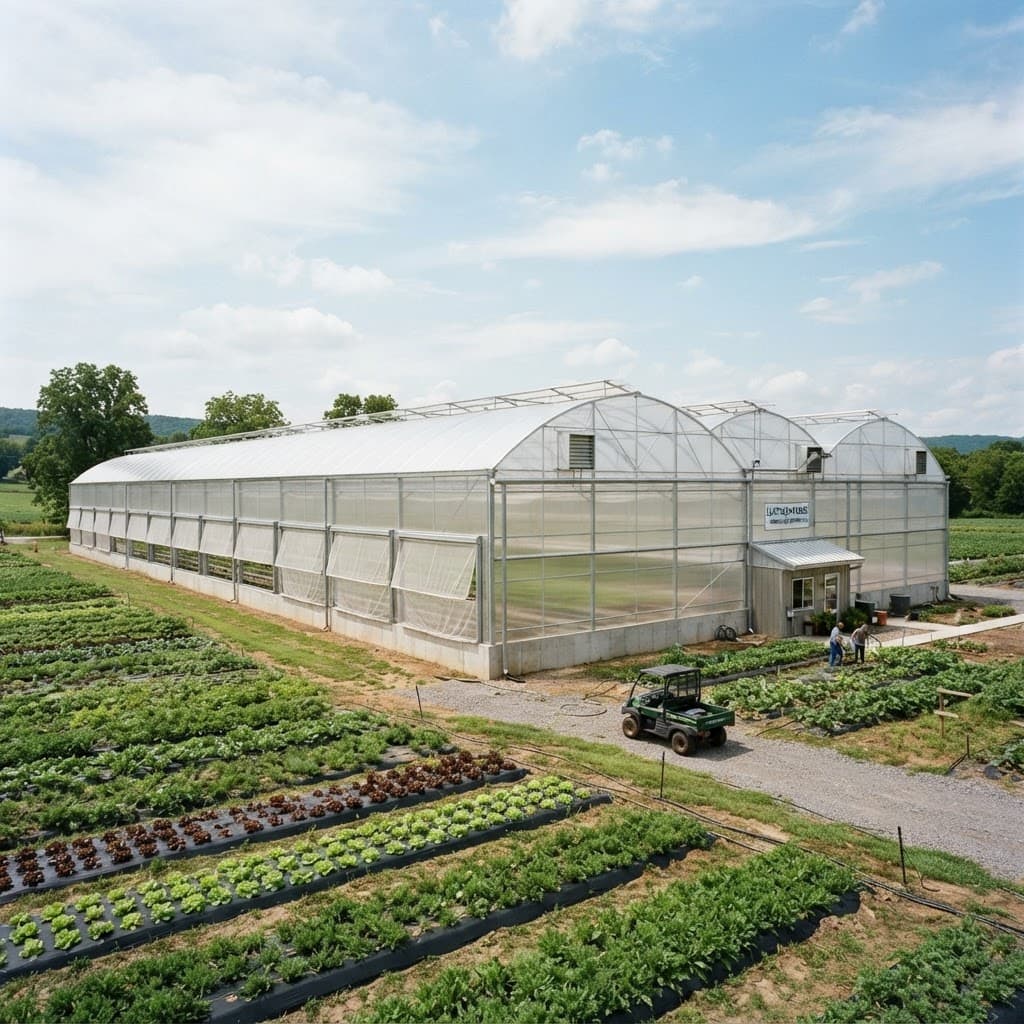
A multi-span greenhouse connects arched or gothic bays under continuous gutters, giving large contiguous growing area at a fraction of glass CAPEX. It is the most capital-efficient way to reach scale in mild and moderate climates.
01
Multi-span greenhouses use repeated arched or gothic-arch bays joined at gutter level, creating one large climate volume instead of separate tunnels. Compared with standalone polytunnels, the connected layout improves land use, allows shared climate equipment and supports mechanised internal logistics.
Cladding is normally double-layer inflated film, single-layer film with anti-drip and diffusion additives, or polycarbonate sheet on the roof with film or polycarbonate walls. Gothic profiles shed condensation and snow better than circular arches, which matters in wetter or colder regions.
Because the structure is lighter, foundations and installation are simpler and faster. The trade-off is a shorter cladding life, slightly lower light transmission over time, and less precise climate control than a glass envelope.
02
Multi-span film structures typically cost one third to one fifth of a comparable glass greenhouse, letting projects reach commercial scale sooner.
Lighter steel, simpler foundations and film cladding shorten installation, so planting can start months earlier.
Diffusing film spreads light evenly through the canopy, which benefits leafy crops and reduces leaf burn in high-radiation regions.
Blocks can be added incrementally as market channels and cash flow develop, without redesigning the master layout.
Roll-up sides, roof vents and open-ridge designs deliver high air exchange without mechanical cooling in mild climates.
Vegetables, berries, melons, herbs and cut flowers all perform well under correctly specified multi-span structures.
03
| Cladding | Light transmission | Service life | Best fit |
|---|---|---|---|
| Single-layer film | 85 – 88% when new | 3 – 5 years | Mild climates, cost-led projects |
| Double inflated film | 78 – 82% | 4 – 6 years | Cooler climates needing insulation |
| Polycarbonate roof | 78 – 84% | 10 – 15 years | Hail risk, high wind, longer horizon |
| Film roof + insect net walls | 85 – 88% | 3 – 5 years | Hot climates, pest pressure |
04
Film thickness, UV stabilisation, anti-drip and diffusion additives change both price and replacement frequency, which drives lifetime cost.
Wind and snow loads determine arch spacing and tube gauge — the difference between a 3 year and a 20 year structure.
Roll-up sides, roof vents, open ridge and exhaust fans all carry different capital and running costs.
Pad-and-fan, fogging and shade screens are often required in hot climates and can double a basic structure budget.
Soil, substrate bags, gutters or hydroponic channels change both capital cost and expected yield per square metre.
Levelling, drainage, reservoirs and access roads are frequently underestimated on large-area multi-span developments.
FAQ
Common technical and commercial questions about multi span greenhouse.
A multi span greenhouse is a structure made of several arched or gothic bays connected at gutter level, forming one continuous growing area under a shared climate. It is usually clad with plastic film or polycarbonate and is the most common structure type for large-area commercial vegetable and berry production.
Multi span greenhouses typically cost 25 to 90 USD per square metre delivered and installed. Basic film structures with natural ventilation sit at the lower end, while polycarbonate cladding, pad-and-fan cooling, shade screens and hydroponic growing systems move projects toward the upper end.
Quality UV-stabilised horticultural film lasts 3 to 5 years depending on radiation, temperature and chemical exposure. Budget film may fail in a single season. Film replacement should be modelled as a recurring operating cost, not a one-off capital item.
Yes. Screens, fogging, heating, insect nets, hydroponic systems and climate controllers can all be retrofitted if the original structure was specified with the required load capacity and internal height. Planning the upgrade path at design stage is much cheaper than reinforcing later.
Continue
Explore the connected technical and commercial topics for this project stage.
Send your location, target crop and planned growing area. You will receive a technical response with a suitable greenhouse configuration and an indicative budget range.
Independent greenhouse solution provider · Response within one business day