Greenhouse Buying Guides
Glass vs Polycarbonate vs Film Greenhouse: How to Choose Cladding
Cladding decides light, insulation, lifespan and roughly a third of your structural cost. This comparison sets out where each material genuinely wins, and the climates in which each one is the wrong choice.
- Last updated
- Updated
- Reading time
- 9 min read
Short answer
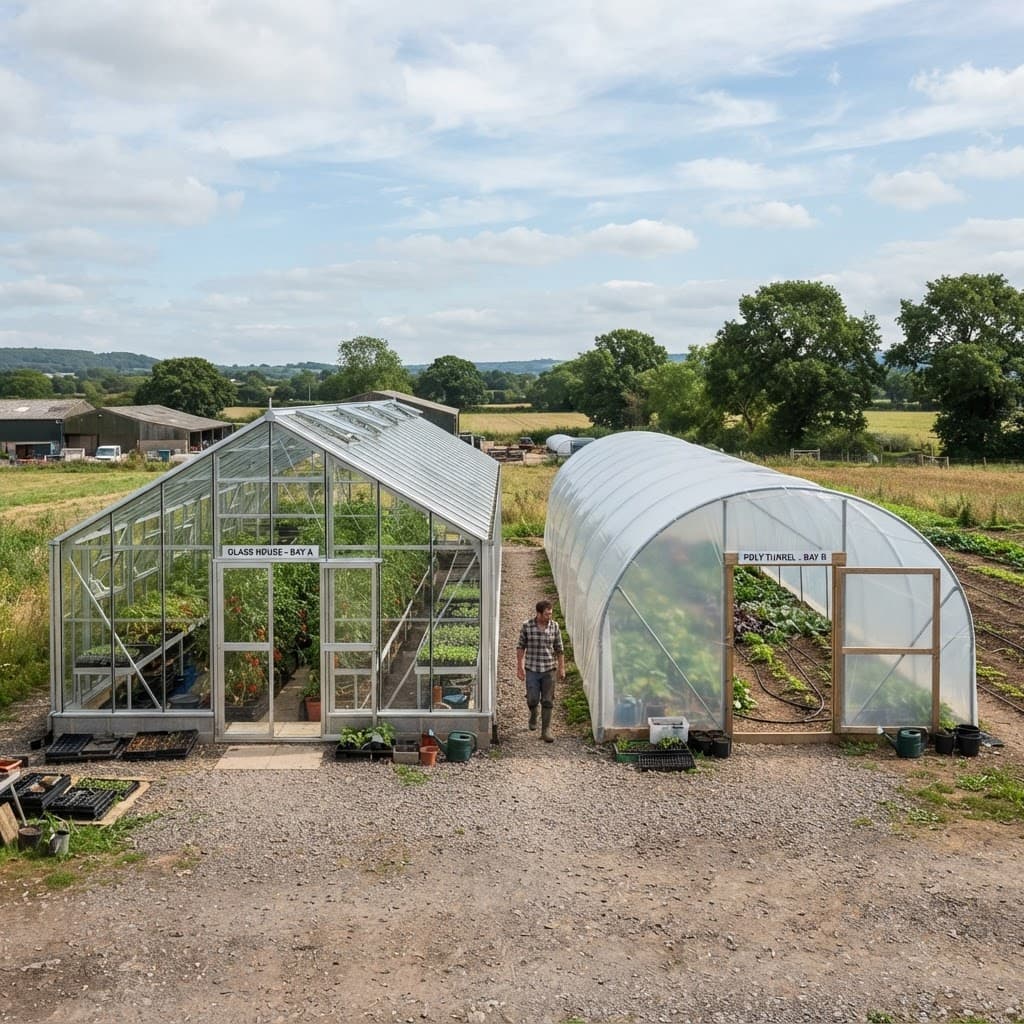
Glass gives the highest light transmission and the longest life, and suits high-value year-round production where light is the limiting factor. Polycarbonate gives better insulation than single glass and high impact resistance, and suits cold climates, hail-prone sites and hygiene-critical facilities. Polyethylene film has the lowest capital cost and suits mild climates, seasonal cropping and phased projects — accepting recladding every three to five years.
Key takeaways
- Choose cladding from your light sum and heating season, not from the price per square metre.
- Diffuse glass improves canopy light distribution and is often worth its premium in tall fruit crops.
- Polycarbonate insulates better than single glass but yellows and loses transmission over time.
- Film is the rational choice in mild climates, provided the recladding cycle is in the operating budget.
01
Cladding comparison at a glance
Indicative values for commercial structures. Exact figures depend on product grade, thickness and glazing bar design.
| Property | Horticultural glass | Polycarbonate | PE film (double) |
|---|---|---|---|
| Light transmission (new) | 89 – 92 % | 78 – 84 % | 82 – 88 % single, lower double |
| Diffusion options | Wide range of diffuse grades | Limited | Available in film grades |
| Insulation (U-value) | Poor as single glass, good as double | Good in multiwall sheet | Good when inflated double layer |
| Service life | 25 years or more | 10 – 15 years | 3 – 5 years |
| Impact / hail resistance | Low, panes break | Very high | Moderate, punctures repairable |
| Relative capital cost | Highest | Medium to high | Lowest |
| Recladding in operating budget | Not required | Occasional panel replacement | Required every 3 – 5 years |
| Best fit | High-value year-round production | Cold or hail-prone climates | Mild climates, seasonal or phased projects |
02
Light is usually the deciding factor
In most climates, cladding is a light decision before it is a cost decision.
The working rule in horticulture is that one percent more light gives roughly one percent more yield in light-limited conditions. In a winter-production facility at high latitude, the three to eight percent transmission difference between glass and an alternative cladding is not a detail — it is the difference between meeting a supply contract and missing it. This is why glass dominates year-round tomato, pepper and cucumber production in northern Europe and in continental climates with dark winters.
Diffuse glass changes the argument further. Rather than only raising total transmission, it scatters direct light so it penetrates deeper into the canopy instead of saturating the top leaves. In tall fruiting crops this typically improves the yield response beyond what the transmission number alone suggests, and it reduces leaf temperature peaks in high radiation. Where light is the limiting factor and the crop is high value, the premium is usually recovered.
In high-radiation climates the logic inverts. If summer light is already in surplus and the constraint is heat load, maximum transmission is not an advantage. Here a diffusing film or a shaded structure can produce a better growing climate at a fraction of the capital cost, and the money saved is better spent on cooling capacity and screening.
03
Where each material is the right answer
Match the material to the climate constraint that actually limits your production.
Glass — light-limited, year-round
High-latitude or continental sites producing through winter under contract. Highest transmission, 25-year-plus life, and the only practical option where every percent of winter light matters.
Polycarbonate — cold or hail exposed
Multiwall sheet gives strong insulation and near-unbreakable impact resistance. Suits cold climates where heating cost dominates, hail-prone regions, and sidewalls or gables of glass houses.
Film — mild climate or phased build
Lowest capital cost per square metre, fast to install and easy to repair. Suits mild climates, seasonal cropping and investors proving a market before committing to a permanent structure.
Mixed cladding — the common outcome
Many commercial projects use diffuse glass on the roof, polycarbonate on gables and sidewalls for impact resistance, and film only on service or nursery spans.
04
Questions to answer before selecting cladding
- What is the annual light sum, and is winter light limiting?
- How long is the heating season and what does energy cost locally?
- Is hail, sand abrasion or high UV a documented risk on this site?
- Does the crop benefit measurably from diffuse light?
- Is recladding every three to five years acceptable operationally?
- Does the structure carry the extra dead load of glass or multiwall sheet?
- Are replacement panels or film grades available locally?
FAQ
Frequently asked questions
Direct answers to the questions investors and growers ask most often.
Is a glass greenhouse always better than film?
No. Glass is better where light is the limiting factor and production runs year-round, because transmission and lifespan justify the capital cost. In a mild climate with seasonal cropping, a film greenhouse can deliver a materially better return on capital, since the light advantage of glass is not converted into extra revenue.
How long does polycarbonate last in a commercial greenhouse?
Quality UV-protected multiwall polycarbonate typically performs for 10 to 15 years, with gradual transmission loss and some yellowing towards the end of that period. Lifespan is shortened by high UV intensity, abrasive dust and mechanical stress at fixing points, so climate matters as much as sheet grade.
What does double-layer inflated film actually achieve?
Two film layers with an air gap maintained by a blower create an insulating cavity, reducing heat loss substantially compared with a single layer and improving condensation behaviour. The trade-off is lower light transmission than a single layer, so it is used where heating cost outweighs the light penalty.
Can cladding be changed later?
Only if the structure was designed for it. Glass and multiwall polycarbonate impose higher dead loads and need different glazing bars from film, so a film structure usually cannot simply be reclad in glass. If a future upgrade is intended, the structural grade and glazing system must be specified for it from the start.