Greenhouse Buying Guides
How to Choose a Greenhouse Solution Provider or Supplier
Two quotations for the same greenhouse can differ by 40 percent and describe entirely different facilities. This guide explains how to make them comparable and what to verify before contracting.
- Last updated
- Updated
- Reading time
- 10 min read
Short answer
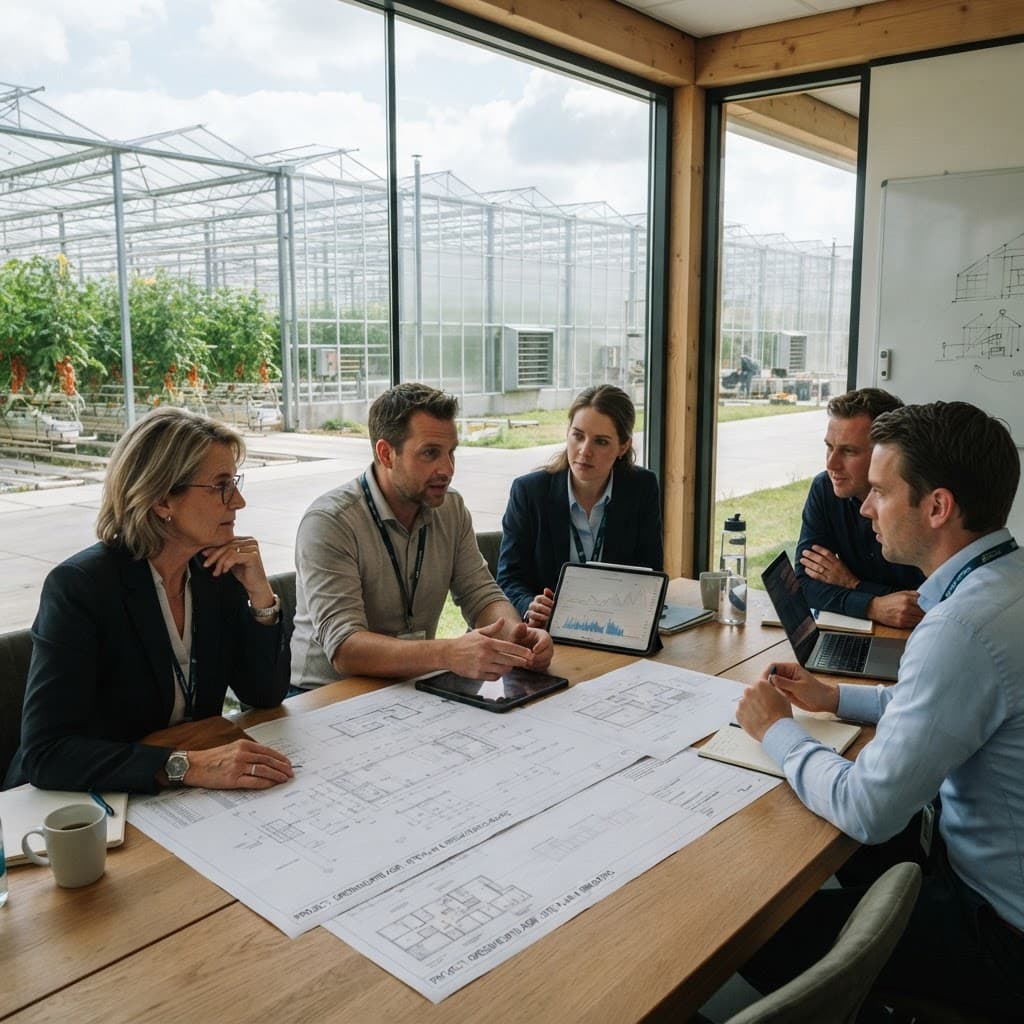
Evaluate a greenhouse supplier on evidence, not presentation: a structural calculation against your local design loads, a complete equipment list with brands and capacities, a written list of exclusions, and references at comparable scale in a comparable climate. Then normalise every quotation onto one comparison sheet so the price you compare covers the same facility.
Key takeaways
- The cheapest quotation is usually the least complete, not the most efficient.
- Demand structural calculations against your national load standard, not a generic datasheet.
- Exclusions — foundations, site works, treatment, commissioning — are where budgets break.
- A manufacturer sells its own product; an independent provider selects across the market.
01
Manufacturer, contractor or independent provider
These three roles have different incentives, and the difference matters at specification stage.
A greenhouse manufacturer produces and sells its own structures and equipment. That brings genuine engineering depth in its own product line, but the recommendation will always resolve to something in that catalogue. If the manufacturer builds high-specification glass, the proposal will be glass, whether or not your climate and crop justify it.
A construction contractor executes an existing design well but is generally not the right party to decide whether that design suits your crop, your water or your market window. Handing specification authority to the installer typically produces a structurally sound facility optimised for buildability rather than for production economics.
An independent solution provider works for the investor and holds no product to sell. Its output is the specification, the supplier shortlist and the normalised comparison, which means it can recommend a simpler structure when the climate allows it. The relevant question to ask any provider is direct: what do you earn on, and does that change if I choose a cheaper structure?
02
A five-step evaluation process
Run every candidate through the same process, and do it before prices are discussed.
Issue one unified scope of work
Write the specification once — area, structure, loads, cladding, climate equipment, growing system, irrigation, controls, scope boundaries — and send the identical document to every candidate. Without this, quotation differences reflect scope, not capability or price.
Test engineering evidence, not brochures
Ask for the structural calculation referencing your national snow and wind loads, the cooling or heating capacity calculation for your design temperatures, and the irrigation design based on your peak crop water demand. A capable partner produces these; a reseller sends a datasheet.
Force exclusions into writing
Require an explicit exclusion list: foundations, earthworks, water treatment, power distribution, internal transport, packhouse, commissioning, spare parts, training. Most budget overruns live in this list, not in the quoted line items.
Normalise the quotations
Rebuild every offer onto one comparison sheet with identical line items, adding the cost of each supplier’s exclusions so the totals describe the same finished facility. Differences of 40 percent routinely fall below 10 percent after normalisation.
Check references at comparable scale and climate
Ask for projects of similar area, similar crop and similar climate, then contact the growers directly. Ask what was late, what was changed after commissioning, and what they would specify differently.
03
Signals to weigh during evaluation
| Signal | What it usually indicates |
|---|---|
| Quotes before asking for climate data | Pricing from a catalogue rather than engineering for your site. |
| Refers to your national load standard | Structural engineering is being done, not assumed. |
| Equipment list without brands or capacities | Substitution risk after contract signature. |
| Detailed written exclusion list | Experienced with real projects; expects scope discipline. |
| Price far below the field | Missing scope, lighter structural grade, or both. |
| References at similar scale and climate | Relevant experience rather than general capability. |
| Willingness to recommend a simpler structure | Advice aligned with your economics rather than product margin. |
04
Minimum documentation to require from every bidder
- Structural calculation against local design snow and wind loads
- Cladding specification with transmission and thickness data
- Climate equipment capacities tied to your design temperatures
- Irrigation and fertigation design based on peak crop water demand
- Complete bill of materials with brands and models
- Written exclusion list and scope boundary drawing
- Delivery schedule, Incoterms and packing list
- Installation supervision scope, commissioning protocol and warranty terms
FAQ
Frequently asked questions
Direct answers to the questions investors and growers ask most often.
Should I buy directly from a greenhouse manufacturer?
Buying directly can work well when your specification is already fixed and you have the in-house engineering capacity to verify it. The risk is that the manufacturer both defines the technical solution and profits from it. Where the specification is still open, an independent party should write it and run the comparison, after which direct purchase from the selected manufacturer is entirely reasonable.
Why do greenhouse quotations differ so much for the same project?
Because they usually describe different facilities. Differences come from structural grade, cladding specification, climate equipment capacity, growing system, and above all from what is excluded — foundations, site works, water treatment, commissioning. Normalising the offers onto identical line items typically reduces a 40 percent spread to under 10 percent.
What references should I ask for?
Ask for projects at comparable area, comparable crop and comparable climate, and speak to the grower rather than the sales contact. The most useful questions are what slipped in the schedule, what was modified after commissioning and what they would specify differently — those answers reveal how the supplier behaves when a project deviates.
How much does independent greenhouse consulting cost?
Independent consulting is normally a small share of project capital cost, and it is justified when it changes the specification or the supplier decision. On projects we review, normalising quotations and correcting over-specified equipment typically identifies savings larger than the consulting fee, while also removing the exclusions that would otherwise appear as variations later.