Technology Articles
Greenhouse Climate Control Systems Explained
Climate control is a set of trade-offs between temperature, humidity, light and CO₂. This article explains what each subsystem does and how to size them against local design conditions.
- Last updated
- Updated
- Reading time
- 10 min read
Short answer
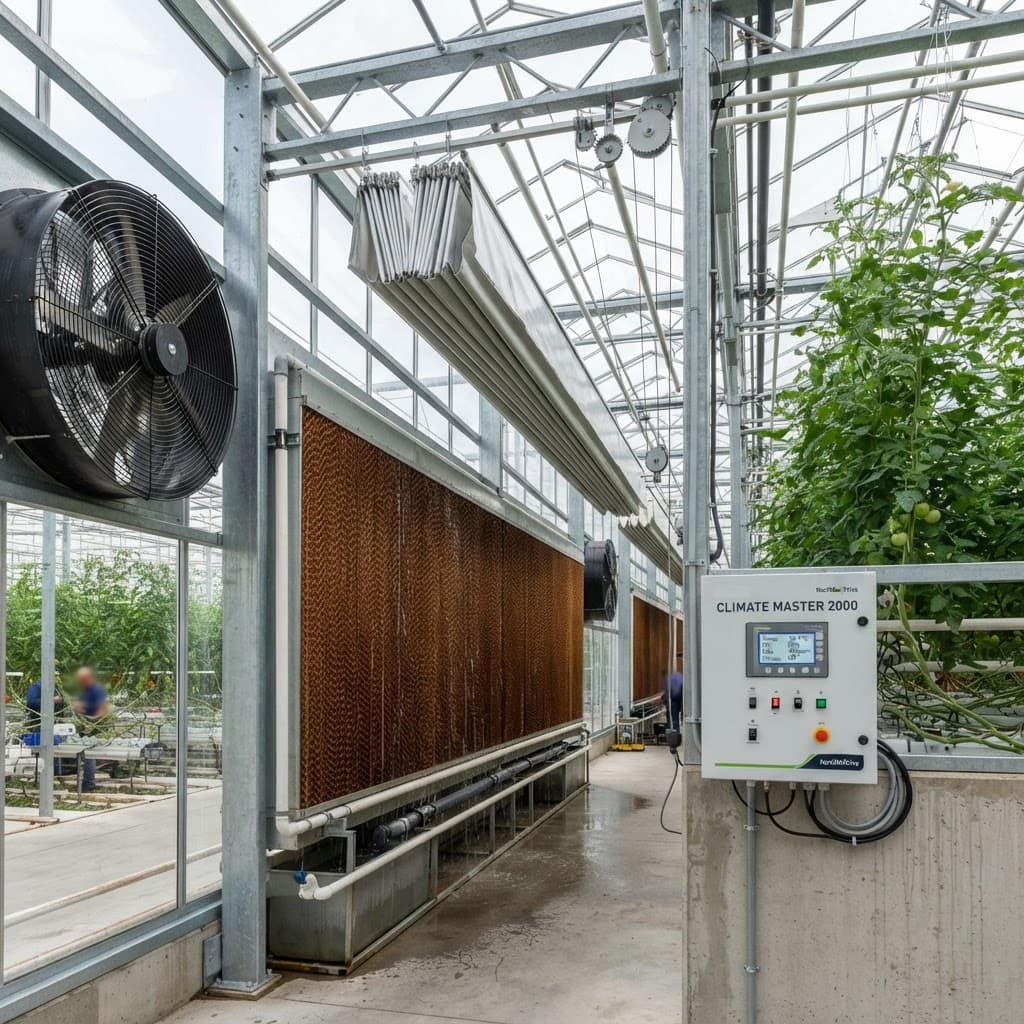
A greenhouse climate control system manages temperature, humidity, light and CO₂ together. Natural or forced ventilation handles most cooling in mild climates; evaporative pad-and-fan or high-pressure fogging is needed where summer wet-bulb temperature is low enough for it to work; heating and thermal screens control winter energy loss; and a climate computer coordinates all of it against measured conditions rather than fixed schedules.
Key takeaways
- Size cooling from wet-bulb temperature, not dry-bulb — evaporative systems fail in humid climates.
- Thermal screens are usually the highest-return energy investment in a cold climate.
- Humidity control, not temperature, is what prevents most fungal disease pressure.
- CO₂ enrichment only pays where the greenhouse can stay closed enough to hold it.
01
The subsystems and what each one actually does
Each subsystem addresses a specific constraint. Specifying one without the others produces an unbalanced climate.
Natural ventilation
Roof and side vents driven by buoyancy and wind. The cheapest cooling available and sufficient in mild climates. Effectiveness depends on total vent area relative to floor area and on greenhouse height.
Forced ventilation
Exhaust fans creating defined air exchange, used where natural ventilation cannot keep up or where insect screens restrict airflow. Predictable but adds continuous electrical cost.
Evaporative cooling
Pad-and-fan or high-pressure fogging cools by evaporating water into incoming air. Capacity is governed by the gap between dry-bulb and wet-bulb temperature, so it excels in arid climates and underperforms in humid ones.
Heating
Hot water pipe rail, air heaters, or heat pumps. Pipe rail systems also drive air movement and help control humidity at the crop, which air heaters do not.
Thermal and shade screens
Movable screens that cut night-time heat loss substantially and reduce daytime radiation load. In cold climates the energy saving typically pays back faster than any other climate investment.
CO₂ enrichment
Raises photosynthesis when light is sufficient and the greenhouse can remain relatively closed. Wasted in structures that must ventilate continuously to control temperature.
02
Why wet-bulb temperature decides your cooling strategy
The single most common specification error in hot climates.
Evaporative cooling works by converting sensible heat into latent heat as water evaporates into the incoming air stream. The theoretical limit of that cooling is the wet-bulb temperature: no evaporative system can cool air below it. In an arid climate where the air is 42 °C dry-bulb at 20 °C wet-bulb, a pad wall can deliver a very large temperature drop. In a coastal humid climate at 34 °C dry-bulb and 30 °C wet-bulb, the same equipment achieves only a few degrees and adds humidity the crop does not need.
This is why identical cooling packages perform brilliantly in one country and disappoint in another. In humid climates the effective strategy is usually a taller structure with large ventilation area, aggressive shading or diffuse cladding to reduce radiation load, good air movement, and in high-value cases mechanical dehumidification or semi-closed designs — not a bigger pad wall.
Always specify cooling against local design wet-bulb data taken from a recognised climate dataset, and state the target internal temperature you expect the system to hold at those conditions. If a supplier will not commit to a performance point at your design conditions, the capacity has not been calculated.
03
Matching strategy to climate
| Climate | Primary strategy | Also required | Commonly over-specified |
|---|---|---|---|
| Continental, cold winter | Pipe rail heating with thermal screen | Roof ventilation, dehumidification strategy, CO₂ if closed | Evaporative cooling that is used a few weeks per year |
| Arid, hot summer | Pad-and-fan or fogging with large ventilation area | Shade screen, water treatment for pads, insect screens | Heating capacity beyond the short cool season |
| Humid tropical | Tall structure with maximum natural ventilation | Diffuse or shaded cladding, strong air circulation, drainage | Evaporative cooling, which cannot work at high wet-bulb |
| Mediterranean, mild | Natural ventilation with movable shade screen | Modest heating for winter night temperature | Full climate automation beyond crop requirement |
| Temperate maritime | Moderate heating with energy screen | Humidity control, diffuse glass for light distribution | High-capacity cooling for rare heat peaks |
04
Specification data to fix before pricing climate equipment
- Design summer dry-bulb and wet-bulb temperature
- Design winter minimum temperature and heating degree days
- Target internal temperature and humidity band per crop stage
- Total ventilation area as a percentage of floor area
- Screen type, position and expected energy saving
- Water quality for evaporative pads or fogging nozzles
- Available electrical capacity for fans, pumps and screens
- Control strategy and sensor positions, including redundancy
FAQ
Frequently asked questions
Direct answers to the questions investors and growers ask most often.
What is the most important part of a greenhouse climate control system?
Ventilation capacity. It is the cheapest way to remove heat and excess humidity, and no cooling, heating or screening package compensates for a structure with insufficient vent area. Ventilation area relative to floor area, and greenhouse height, should be settled before equipment is selected.
Does evaporative cooling work in humid climates?
Only marginally. Evaporative cooling cannot cool below the wet-bulb temperature, so in humid climates where wet-bulb sits close to dry-bulb the achievable drop is a few degrees, at the cost of added humidity. Tall structures with large ventilation area, shading and strong air movement are more effective there.
Are thermal screens worth the investment?
In any climate with a meaningful heating season, usually yes. A single energy screen commonly reduces night-time heat loss substantially, and in cold climates it is frequently the fastest-payback item in the climate package. Screens also allow daytime shading and improved humidity management.
Do I need a climate computer?
For any facility with heating, screens or active cooling, yes. Coordinating vents, heating, screens and cooling manually leads to conflicting actions — such as heating while venting — that waste energy and destabilise the crop climate. A controller acting on measured conditions is what makes the equipment worth its cost.