Technology Articles
Greenhouse Irrigation and Fertigation Systems Explained
Water quality sets the limits of what a growing system can do. This article covers treatment, dosing, EC and pH control, recirculation and the analysis to run before specifying equipment.
- Last updated
- Updated
- Reading time
- 10 min read
Short answer
A greenhouse fertigation system takes raw water, treats it to a usable quality, mixes nutrients to a target EC and pH, distributes it through drip or channel irrigation, and in closed systems collects, disinfects and reuses the drain. The specification is set by a feed water analysis: sodium, chloride, bicarbonate and boron decide whether recirculation is possible and whether reverse osmosis is required.
Key takeaways
- Run a full water analysis before selecting any growing or irrigation system.
- High sodium forces drain-to-waste, permanently raising water and nutrient cost.
- Uniformity across the irrigation block matters as much as total volume delivered.
- Recirculation saves water and nutrients but requires disinfection and monitoring discipline.
01
How water moves through a commercial system
Each stage constrains the next, which is why the sequence must be designed as one system.
Source and storage
Borehole, surface water, mains or collected rainwater buffered in a reservoir or tanks. Storage must cover peak crop demand plus a safety margin for supply interruption.
Treatment
Sand or screen filtration, iron removal, softening or reverse osmosis where sodium and chloride are high, and pH pre-correction where bicarbonate is elevated. Treatment scope comes directly from the water analysis.
Nutrient dosing
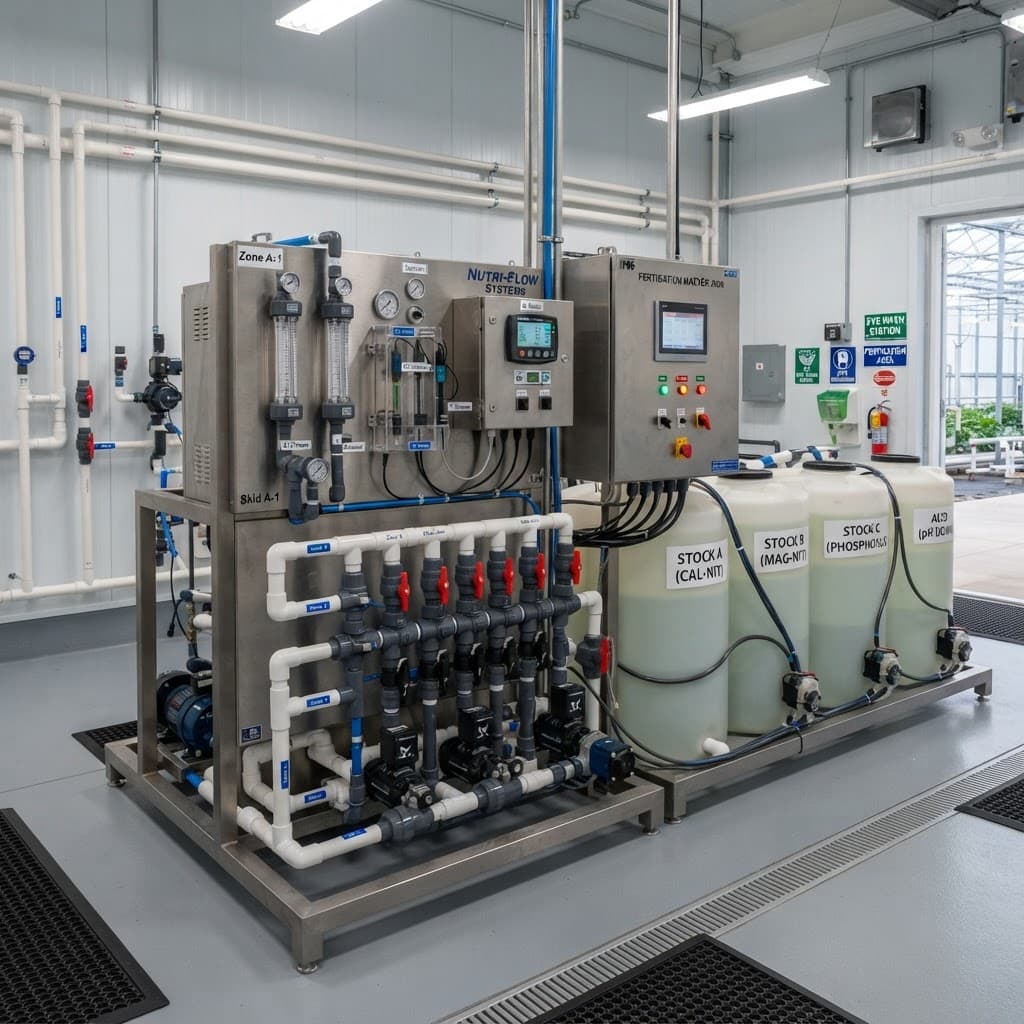
A dosing unit injects concentrated stock solutions and acid to reach target EC and pH, verified by inline sensors. Multi-channel units allow different recipes per irrigation section and per crop stage.
Distribution
Pumps, mains and valves feed drip lines, gutters or NFT channels. Pipe sizing and pressure compensation determine whether every plant receives the same volume.
Drain collection
Gutters or channels return unused solution to a drain tank, where volume and EC are measured to verify that irrigation strategy matches crop uptake.
Disinfection and reuse
UV or heat treatment removes pathogens before drain water is blended back into the feed. Sodium accumulation is monitored, since it eventually forces a partial discharge.
02
Water quality parameters that change the specification
Indicative thresholds for commercial substrate and hydroponic growing. Crop sensitivity varies, so interpret against the intended crop.
| Parameter | Preferred range | Consequence when exceeded |
|---|---|---|
| EC of raw water | Below 0.5 mS/cm | Limits nutrient dosing headroom and recirculation potential |
| Sodium (Na) | Below 30 mg/l | Accumulates in closed systems; forces drain-to-waste or reverse osmosis |
| Chloride (Cl) | Below 50 mg/l | Ion antagonism and salinity stress, particularly in fruit crops |
| Bicarbonate (HCO₃) | Below 100 mg/l | Drives high pH; requires continuous acid dosing |
| Iron and manganese | Low, fully oxidised | Blocks drip emitters and fouls filters |
| Boron | Below 0.5 mg/l | Toxicity in sensitive crops, with no simple removal option |
| Biological load | Low | Biofilm in lines and emitters; pathogen spread in recirculated systems |
03
Open versus closed systems
The choice is usually made by water chemistry rather than by preference.
In an open, drain-to-waste system the surplus nutrient solution is discharged after passing the root zone. It is simpler, tolerates poorer water quality and carries lower disinfection risk, at the cost of higher water and fertiliser consumption and a discharge stream that may face regulatory limits.
A closed, recirculating system collects the drain, disinfects it and blends it back into the feed. Water and nutrient savings are substantial, and in water-scarce regions this is often the deciding factor for project viability. The requirements are real: reliable disinfection, continuous EC and pH monitoring, periodic full analysis, and a plan for the ions that accumulate.
Sodium is the usual reason a project cannot close its loop. Because plants take up little of it relative to water, sodium concentrates in the recirculated solution until it becomes a stress factor. If feed water sodium is high, either reverse osmosis is added upstream or the system runs open — and that decision changes both the capital cost and the operating cost model, so it must be settled before the growing system is specified.
04
Fertigation design checklist
- Full water analysis including sodium, chloride, bicarbonate and boron
- Peak crop water demand per square metre for the design month
- Storage volume covering peak demand plus supply interruption margin
- Irrigation sections matched to crop, substrate and light zones
- Emitter uniformity target and pressure compensation strategy
- Dosing channels for the required nutrient recipes and acid
- Drain collection with volume and EC measurement
- Disinfection method sized to peak recirculation flow
FAQ
Frequently asked questions
Direct answers to the questions investors and growers ask most often.
What water quality is required for a hydroponic greenhouse?
As a working guide, raw water EC below 0.5 mS/cm, sodium below 30 mg/l, chloride below 50 mg/l and bicarbonate below 100 mg/l allow flexible nutrient management and recirculation. Water outside these ranges is often still usable, but it requires treatment or an open system, both of which change the cost model.
Do I need reverse osmosis for my greenhouse?
Reverse osmosis is needed when sodium, chloride or total salinity are high enough to prevent recirculation or to stress the crop. It adds capital cost, energy consumption and a reject stream to manage, so it should be justified by an actual water analysis rather than installed as a precaution.
How much water does a commercial greenhouse use?
Fruit-vegetable crops typically use in the region of 700 to 1,200 litres per square metre per year, with peak summer demand of 4 to 8 litres per square metre per day. Closed recirculating systems reduce net consumption considerably. Storage must be sized against the peak day, not the annual average.
How is drain water disinfected?
UV treatment sized to the flow and the target dose is the most common method in commercial greenhouses, with slow sand filtration and heat treatment also used. Whichever method is chosen, it must be sized for peak recirculation flow and monitored, since an undersized unit gives a false sense of biological security.