Skip to content
AEGIS Greenhouse Systems

Cost guides / 10-12 minutes / Aegis Project Engineering

Commercial Greenhouse Project Budget: What Investors and Growers Should Budget For

An evergreen investment guide explaining how to structure a commercial greenhouse project budget, evaluate capex categories, and define planning assumptions before requesting supplier quotes.

By Aegis Project Engineering

Published /Updated

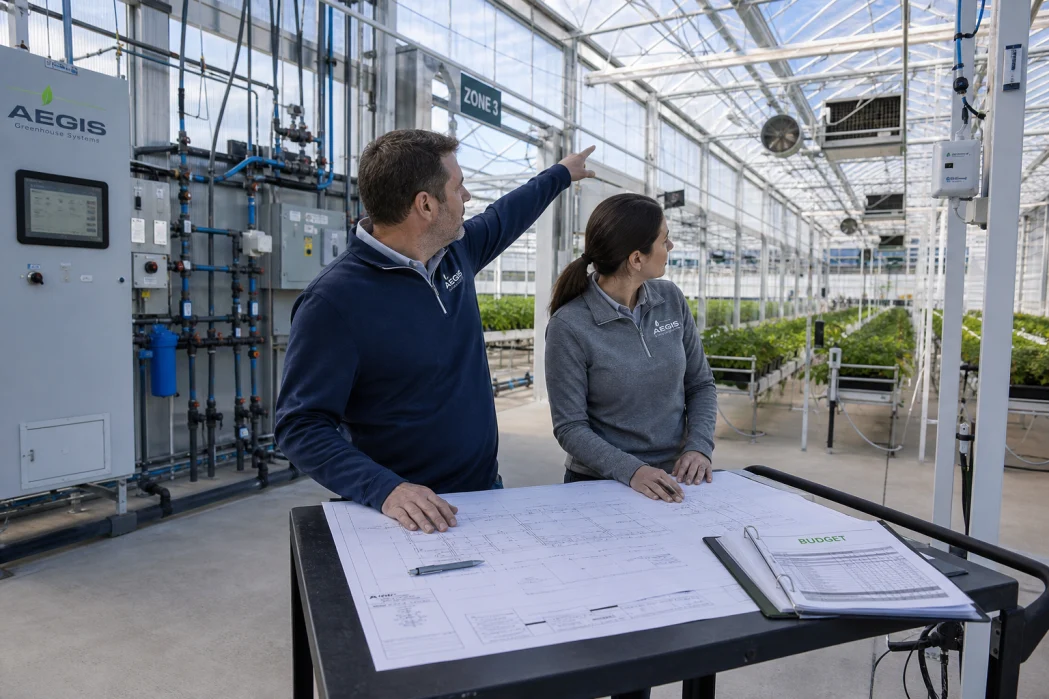
Project team reviewing a commercial greenhouse budget and infrastructure scope inside a modern greenhouse.

Key takeaways

  • A commercial greenhouse project budget should be built from production requirements and site realities before supplier quoting starts.
  • A greenhouse capex breakdown must separate structure, systems, infrastructure, and site-development costs to avoid under-budgeting.
  • Crop type, greenhouse type, climate, and site conditions materially change budget priorities and total capital needs.
  • Pre-quote assumptions are essential for making supplier proposals comparable and decision-useful.
  • A project-specific budget framework review can reduce scope gaps before procurement moves forward.

Overview

A commercial greenhouse project budget should be built from project requirements, not from the first supplier quote that lands in your inbox. For investors and growers, that difference matters. A quote may cover a greenhouse package, but a full capital plan must also account for crop requirements, climate-control strategy, infrastructure, site conditions, owner-scope items, and integration risks.

The core budgeting mistake is treating greenhouse procurement like a simple building purchase. In practice, a commercial greenhouse cost breakdown only becomes decision-useful when the budget is organized around production goals and the site realities that will shape final scope. A lower quoted package can still lead to a higher total project budget if utilities, drainage, electrical upgrades, water treatment, access roads, or controls integration were never defined up front.

This resource is designed to help you structure a commercial greenhouse project budget before supplier quoting begins. It stays focused on capital scope and planning assumptions rather than broader viability analysis. If you also need a go/no-go framework, market review, or wider feasibility process, see commercial greenhouse feasibility study.
Key takeaways for commercial greenhouse budget planning

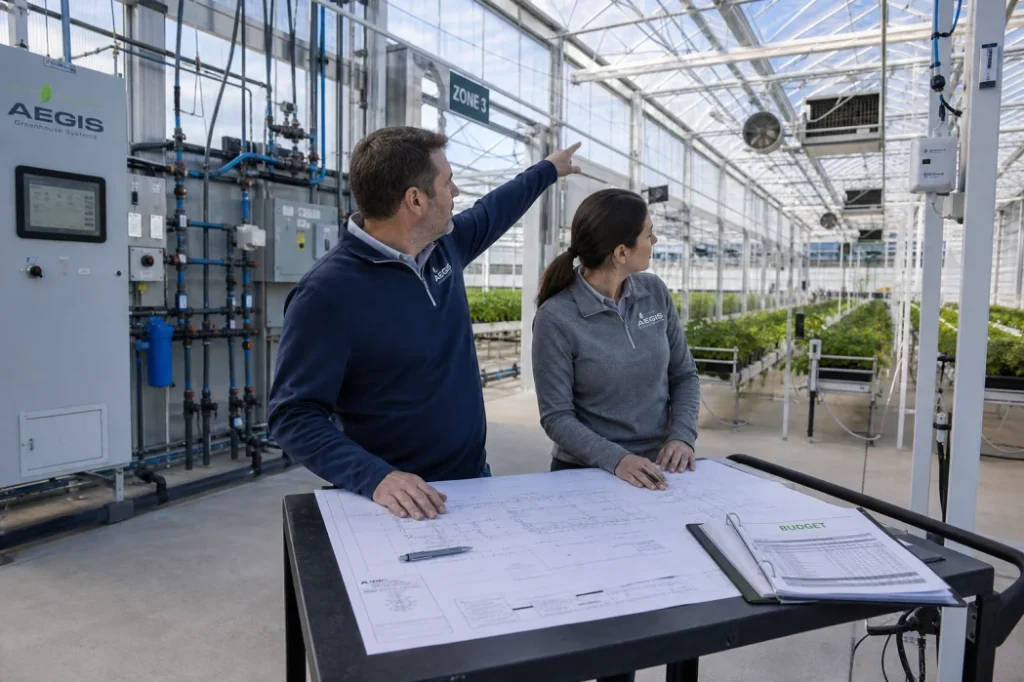
Project team reviewing a commercial greenhouse budget and infrastructure scope inside a modern greenhouse.
Requirement-led budgeting starts with crop, system, and infrastructure needs before supplier quote comparison.
  • A commercial greenhouse project budget should start with crop strategy, production targets, and operating requirements before any quote comparison begins.
  • A greenhouse capex breakdown should separate structure, environmental systems, crop systems, infrastructure, and site-development costs.
  • Two projects with similar footprint can require very different capital scope because budget drivers are not area alone. They are driven by operating intent, climate response, and site burden.
  • Supplier proposals are only comparable when assumptions, inclusions, exclusions, and owner-scope responsibilities are normalized in advance.
  • Quote-readiness is a planning milestone. If assumptions are still vague, the project is not ready for meaningful price comparison.

Why requirement-led budgeting matters before supplier quotes

Requirement-led budgeting means defining what the greenhouse must do before asking what it costs. That sequence sounds simple, but it changes the quality of every later decision. Instead of starting with a structure type or a vendor preference, the process starts with crop, environmental targets, workflow needs, utility demands, and site constraints.

Original insight: The most expensive budgeting mistake is often not overpaying for a greenhouse package, but under-defining the project before prices are requested.

[Industry Pattern] Many budget overruns begin as scope omissions rather than pricing errors. A quote can appear competitive because it excludes infrastructure, integration items, or owner-supplied systems that another quote includes. If those assumptions are not visible, investors and growers can be anchored to the wrong number very early.

Requirement-led budgeting improves procurement planning because it creates a better basis for supplier coordination. It also gives internal stakeholders a more defensible framework for capital review, especially when comparing multiple greenhouse types or regions.

What is included in a commercial greenhouse project budget?

A full commercial greenhouse project budget includes more than the greenhouse structure. It should cover the interacting systems needed to support production and the enabling works needed to make those systems function on the selected site.

Original insight: A commercial greenhouse budget should be organized as interacting systems plus enabling infrastructure, not as a single construction line item.

At a minimum, a budget framework should distinguish between:

  • Greenhouse structure and envelope
  • Climate control and environmental systems
  • Irrigation, fertigation, and water-related systems
  • Controls integration and automation scope
  • Post-harvest or workflow interface items where relevant
  • Electrical, water, drainage, and other infrastructure
  • Site civil works and access requirements
  • Owner-scope items, soft costs, and coordination allowances

This distinction matters because a structure-only number is not the same as a total delivered project budget. Investors should be especially careful when early numbers are presented without clear boundaries around supplier scope and owner scope.

Greenhouse capex breakdown by major cost category

Cost category What it typically covers What changes the budget logic Common risk if under-defined
Structure and envelope Structural system, glazing or covering, vents, screens, base building elements Span layout, greenhouse type, crop needs, local design criteria, ventilation strategy Comparing shell pricing without matching design assumptions
Climate control Heating strategy, cooling strategy, ventilation, dehumidification-related scope, air movement Crop sensitivity, local weather, target growing environment, seasonal operating model Adding critical systems later as if they were optional upgrades
Irrigation and fertigation Irrigation system, dosing, storage, distribution, water treatment interfaces Crop type, irrigation precision, water source quality, recirculation approach Budgeting for structure while leaving crop delivery systems vague
Controls and automation Environmental controls, sensors, equipment integration, workflow automation interfaces Production consistency goals, labor model, data needs, expansion plans Hidden interface costs between suppliers and owner scope
Crop handling and workflow Benching, growing systems, internal movement, packing interfaces where required Crop format, throughput, harvest method, labor strategy Assuming production workflow can be solved after construction
Infrastructure Electrical infrastructure, water supply, storage, drainage, utility connections, fuel or energy interfaces Existing site capacity, distance to services, treatment requirements, utility upgrades Low package quote but major unbudgeted greenhouse infrastructure cost
Site civil works Grading, roads, drainage works, pads, access, logistics preparation Topography, soil conditions, runoff management, heavy vehicle access Late discovery of site-prep scope that delays procurement
Coordination and delivery Project planning, integration review, procurement support, interface management Project complexity, number of suppliers, owner team experience, schedule pressure Fragmented scope and disputes over responsibility

The value of this greenhouse capex breakdown is not that it predicts a universal price. Its value is that it shows where capital scope actually lives. Once these categories are visible, budget review becomes more accurate and quote comparison becomes more disciplined.

How crop strategy changes the budget

Crop strategy is one of the strongest drivers of capital structure. The greenhouse should be budgeted around what must be produced, under what environmental tolerances, and with what workflow expectations. A project designed for propagation, leafy greens, vine crops, ornamentals, or nursery production will not prioritize the same systems in the same way.

[Industry Pattern] Different crops can shift spend priorities more than many first-time buyers expect. The issue is not only total cost, but where cost must be allocated.

  • Propagation-focused projects may place greater emphasis on environmental uniformity, benching strategy, irrigation precision, and young-plant handling conditions.
  • Leafy green projects may prioritize irrigation design, workflow efficiency, hygiene interfaces, and tightly controlled growing conditions depending on the production model.
  • Vine crop projects can drive different expectations around structural layout, climate control intensity, crop-support interfaces, and harvest workflow.
  • Ornamental and nursery projects may require different ventilation priorities, seasonal flexibility, bench systems, or handling arrangements.

Original insight: Two greenhouse projects with similar size can justify very different budgets because capital decisions are shaped by operating intent, not footprint alone.

[Example] A project growing a relatively tolerant crop in a moderate climate may accept a simpler environmental-control package than a project targeting higher precision for sensitive propagation. Even if both projects occupy similar area, their budget logic differs because the production requirement differs.

How greenhouse type changes capital requirements

Greenhouse type should be selected as a response to project requirements, not as a starting assumption. Structure and envelope choices affect engineering demands, climate-control strategy, operating flexibility, and future integration scope.

[Industry Pattern] Many buyers compare greenhouse types on headline package pricing before fully assessing how each option fits the crop, climate, and operational model. That often leads to false comparisons.

  • Higher-spec glasshouse concepts may support different environmental-control strategies, light transmission considerations, durability expectations, and integrated system approaches, but the fit depends on the production objective and local conditions.
  • Poly-covered or lower-spec concepts may align with some crops and climates more effectively than others, especially where project goals do not require the same level of environmental precision.
  • Gutter-connected layouts can change workflow, mechanical integration, and infrastructure planning compared with smaller standalone arrangements.
  • More controlled-environment configurations may expand capital scope through additional systems integration, automation, and tighter environmental-control requirements.

Background planning guidance from university extension sources supports the principle that greenhouse design choices should align with production goals, but project-specific budgeting still requires a custom review of design criteria, systems scope, and site conditions.

The key tradeoff is not simply cheaper versus more expensive. It is fit versus mismatch. A lower-cost concept that does not support the required crop environment can become expensive through retrofits, operating inefficiency, or scope changes later in procurement.

How climate and geography affect greenhouse infrastructure cost

Climate changes both the greenhouse and the infrastructure around it. Wind exposure, snow conditions, heat load, humidity management needs, and seasonal operating expectations can all affect structural assumptions and systems scope.

[Verified] Site-specific structural load criteria matter. The American Society of Civil Engineers’ ASCE 7 standard establishes minimum design load criteria for buildings and other structures, reinforcing that wind and snow assumptions are location-specific rather than interchangeable across projects. See ASCE 7.

For budgeting purposes, that means climate should not be treated as a minor adjustment at the end of planning. It should be a core input early in commercial greenhouse budget planning.

  • Wind exposure can influence structural engineering assumptions and enclosure decisions.
  • Snow conditions can affect structural loading assumptions and design requirements.
  • Heat and solar conditions can change cooling strategy, shading, and ventilation needs.
  • Humidity conditions can affect environmental-control planning and integration scope.
  • Season length and production continuity targets can change the importance of heating strategy and energy interfaces.

[Industry Pattern] Climate-related budget differences often show up indirectly. They appear not just in the greenhouse package, but also in utility sizing, environmental equipment selection, and integration complexity.

Site conditions that can materially increase total budget

Site conditions are one of the most common reasons an early quote fails to represent the true capital requirement. A greenhouse package may look affordable until the project team accounts for what the site needs in order to support it.

Common site-driven budget factors include:

  • Grading and earthwork requirements
  • Drainage design and runoff management
  • Road access and construction logistics
  • Distance to power, water, gas, or other required utilities
  • Electrical service upgrades or distribution scope
  • Water sourcing, storage, or treatment requirements
  • Stormwater or site civil works interfaces
  • Site geometry and expansion limitations

[Industry Pattern] Growers and investors frequently underestimate owner-scope infrastructure because it sits outside the greenhouse package line item. That does not make it optional. It means it belongs in the total project budget from the start.

[Example] Consider two hypothetical sites for the same greenhouse concept. One has level access, nearby utilities, and workable drainage conditions. The other requires substantial grading, a longer utility extension, upgraded electrical service, and additional drainage work. The greenhouse package may be similar, but the total delivered budget can differ materially because the site burden is different.

Budget assumptions to define before requesting quotes

If assumptions are undefined, quotes will be inconsistent. That makes procurement slower and investor review weaker. Before requesting supplier proposals, define the assumptions that turn a general idea into a quote-ready scope.

  1. Crop and production model: What will be grown, at what quality target, and under what operating rhythm?
  2. Environmental targets: What climate control performance is required for successful production?
  3. Greenhouse concept: Which structure and envelope direction is being evaluated, and why?
  4. Site location and conditions: What are the physical, utility, and access constraints?
  5. Design criteria: What local climate and structural assumptions must suppliers use?
  6. Utility basis: What power, water, fuel, and drainage capacity already exists, and what must be added?
  7. Owner scope versus supplier scope: Which items are to be included in proposals and which are retained by the owner or civil team?
  8. Integration expectations: How should controls, irrigation, mechanical systems, and workflow items interface?
  9. Project phase assumptions: Is this the full build or a phased development?
  10. Comparison format: What proposal structure will be used so quotes can be reviewed on aligned terms?

Original insight: Quote-readiness is a planning milestone. If assumptions are not defined, the project is not truly ready for meaningful supplier comparison.

This is where a budget framework review can add value before procurement starts. The goal is not to lock in a final price too early. The goal is to define enough scope that supplier proposals become decision-useful instead of merely informative.

Commercial greenhouse budget planning: practical evaluation framework

Use the following framework to test whether your budget is mature enough for procurement discussion.

Evaluation factor What to ask Strong planning signal Warning sign
Production requirements Does the budget begin with crop and operating goals? Systems are selected based on production needs Structure type chosen before crop requirements were clarified
Greenhouse type fit Does the concept match climate and crop strategy? Technology direction is tied to performance requirements Concept selected on headline package price alone
Climate and design criteria Are local assumptions documented for suppliers? Wind, snow, and environmental assumptions are explicit Generic design template used across locations
Infrastructure readiness What utilities and civil works are already available? Existing capacity and required upgrades are clearly separated Infrastructure treated as a later detail
Quote comparability Will proposals use the same inclusions and exclusions? Owner scope and supplier scope are normalized Totals compared without reconciling missing categories

This framework helps shift discussion from “What does a greenhouse cost?” to “What does this project need to fund in order to perform as intended?” That is a better decision question for both growers and capital providers.

Common budgeting mistakes in commercial greenhouse projects

  • Using quote-led planning: Starting with supplier pricing before defining project requirements creates anchoring around incomplete scope.
  • Confusing package price with total project budget: The greenhouse structure is only one part of the capital plan.
  • Under-scoping infrastructure: Electrical, water, drainage, and civil works are often treated as secondary even though they can materially affect total budget.
  • Assuming all quotes are comparable: Proposals often differ in inclusions, exclusions, interfaces, and owner responsibilities.
  • Deferring crop decisions: Waiting too long to define crop strategy can force redesign of systems and capital priorities.
  • Ignoring climate-specific assumptions: Budgets built from generic templates may miss location-specific structural or environmental requirements.
  • Leaving integration unresolved: Controls, irrigation, mechanical systems, and automation can create cost and coordination gaps if responsibilities are unclear.

[Industry Pattern] Procurement friction often begins long before negotiation. It begins when the project team asks the market for pricing without first normalizing the scope.

When to use a budget framework review before procurement starts

A project-specific budget framework review is useful when the team has defined a greenhouse ambition but has not yet turned it into a disciplined capital structure. That review can help clarify scope boundaries, reveal missing infrastructure categories, and improve supplier quote comparability before procurement effort accelerates.

This is especially relevant when:

  • Multiple greenhouse types are still under consideration
  • Investors need a clearer capex structure before market engagement
  • The site has uncertain utility or civil conditions
  • The crop plan is defined, but system priorities are not yet translated into budget buckets
  • The team wants more useful supplier proposals, not just more proposals

Aegis Greenhouse Systems supports this stage through consulting, planning, technology selection support, supplier coordination, and project management assistance. The role is to improve decision quality before procurement complexity increases, not to sell a one-size-fits-all greenhouse package.

FAQ

Frequently asked questions

What is included in a commercial greenhouse project budget?+

A full project budget should include the greenhouse structure, envelope, climate-control systems, irrigation and fertigation scope, controls integration, crop-support or workflow systems where relevant, infrastructure, site civil works, and owner-scope coordination items. A structure quote alone is not the same as a complete capital plan.

How is a greenhouse capex breakdown different from a feasibility study?+

A greenhouse capex breakdown focuses on what capital categories belong in the project budget and what assumptions should be defined before procurement. A feasibility study is broader and may examine strategic fit, market considerations, operational assumptions, and full project viability. This resource stays focused on capex structure and planning assumptions.

Why can two commercial greenhouse quotes vary so much?+

Quotes often vary because suppliers are not pricing the same scope. Differences may include environmental systems, controls, irrigation, owner-scope exclusions, infrastructure assumptions, or design criteria. The variation is not always a pricing issue; it is often a scope-definition issue.

How do crop type and production goals affect greenhouse budget planning?+

Crop type and production goals influence environmental tolerances, irrigation precision, workflow design, structural layout, and automation priorities. Those choices affect which systems are essential and how capital should be allocated across the project.

What site factors most often increase greenhouse infrastructure cost?+

Common drivers include grading, drainage requirements, road access, distance to utilities, electrical upgrades, water sourcing, water treatment, and other civil works. These items are often outside a greenhouse package quote but still belong in the total budget.

Should investors build a budget before asking suppliers for quotes?+

Yes. A requirement-led budget framework helps investors and growers define what suppliers should price, what remains owner scope, and how proposals will be compared. Without that framework, quote comparison can create false confidence instead of real decision support.

Start Your Greenhouse Project With Aegis

Before supplier quoting begins, request a project-specific budget framework review from Aegis Greenhouse Systems. We can help you structure the commercial greenhouse project budget around crop requirements, greenhouse type, climate, site conditions, and procurement assumptions so proposals are easier to compare and capital planning is more defensible.