Skip to content
AEGIS Greenhouse Systems

/

Leafy Herb Greenhouse Project Scenario for Controlled Environment Production

A confidential modelled scenario for leafy herb greenhouse planning, focused on cooling, harvest cadence, post-harvest handling, and procurement decisions.

Indicative yield assumptions

Indicative/modelled

Harvest cadence

Indicative/modelled

Cooling demand sensitivity

Indicative/modelled

Post-harvest loss risk

Indicative/modelled

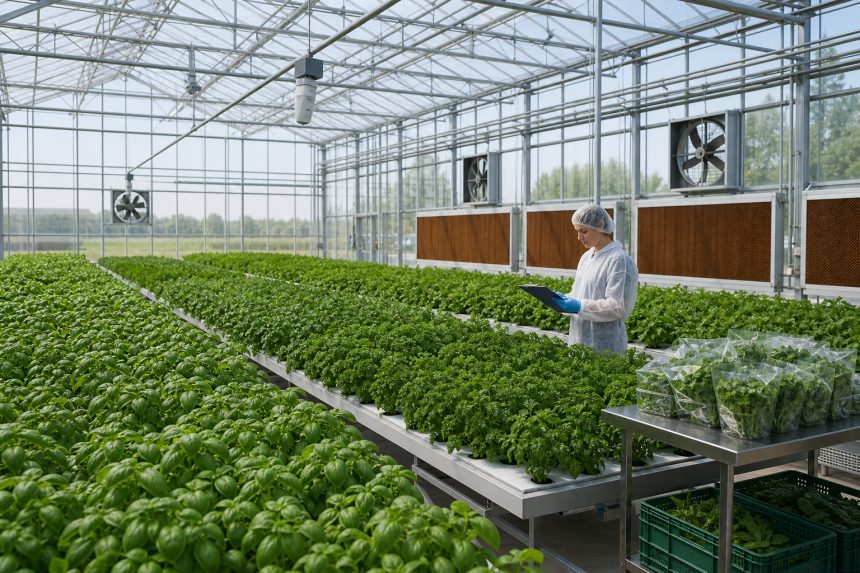
Commercial greenhouse interior with leafy herbs, cooling systems, and post-harvest staging for quality-focused production.

Confidentiality and scenario basis

This is a confidential reference scenario, not a named delivered client case. Site, budget, crop mix, and system details are modelled for planning purposes only.

Assumptions: All figures are modelled and indicative unless directly verified by supplied source data; the crop mix is quality-sensitive and fast-cycle rather than fruiting-vegetable oriented; cooling and post-harvest handling materially affect viability; scope must be validated against location, seasonality, labor availability, and service area.

Reference Scenario

Commercial greenhouse interior with leafy herbs, cooling systems, and post-harvest staging for quality-focused production.
Controlled-environment herb production depends on cooling, harvest cadence, and fast post-harvest handling.

This leafy herb greenhouse project is a modelled reference scenario for growers, developers, and investors evaluating controlled environment herb production. It is written to support early project planning and supplier discussions, not to present a named delivered client case.

Confidentiality note: this is a confidential reference scenario, not a named delivered client case. Site, budget, crop mix, and system details are modelled for planning purposes only, and any numbers in the article should be read as indicative/modelled unless directly verified.

Modelled Assumptions

All figures in this leafy herb greenhouse project scenario are indicative and modelled for planning. The crop profile assumes fast-cycle, quality-sensitive leafy herbs with basil as an optional sub-case only if the mix is basil-heavy, so the scenario stays focused on controlled environment herb production rather than fruiting-vegetable logic.

The planning envelope uses an indicative commercial area range of 10,000 to 50,000 sq ft and a provisional mid-six-figure to low-seven-figure budget band. Those inputs are placeholders for feasibility work, not published benchmarks, and they should be recalculated once the target location, delivery timing, and service area are known.

Before supplier outreach, the model still depends on three variables: local climate data, the intended market window, and the amount of area the project can support. Those inputs determine the final technology path, harvest cadence, and handling scope in later sections.

Location and Climate Context

This scenario is grounded in a warm-summer to hot-summer U.S. service-region profile, using public climate normals as the basis for a cooling-dominant greenhouse design assumption. The location is intentionally modelled rather than fixed, because temperature peaks, humidity patterns, and shoulder-season conditions change the equipment package and operating approach.

For controlled environment herb production, the climate question is not just average heat. Daily heat load, night recovery, and moisture accumulation shape whether the house depends more on natural ventilation, mechanical cooling, dehumidification, or a mixed strategy. In a herb greenhouse project, those conditions directly affect stability, uniformity, and the ability to hold quality through successive harvests.

That is why the scenario treats climate as a design input first and a site label second. Before supplier outreach, the project team should confirm the target service area, seasonal temperature range, and humidity profile so the cooling demand can be modelled against the intended operating window.

Crop Programme

This leafy herb greenhouse project assumes a fast-cycle, quality-sensitive crop mix built around repeated harvests rather than a single long production run. That makes the production plan more about consistency, leaf texture, color, aroma, and shelf-life control than about sheer biomass.

In a controlled environment herb production model, harvest cadence becomes a core operating variable because small delays can affect finish quality and marketability. Basil can be treated as an optional sub-case within the mix where the business model justifies it, but the scenario should still be read as a broader herb greenhouse scenario rather than a basil-only plan.

Post-harvest handling is part of the crop program itself: quick movement from harvest to cooling, low hold times, and a clean cold-chain handoff protect quality more effectively than simply increasing growing area. For planning, that means crop choice, harvest rhythm, and handling flow need to be designed together.

Facility Area Range

The planning range for this leafy herb greenhouse project is indicative and modelled rather than fixed: roughly 10,000 to 50,000 square feet, with the final footprint driven by target market, service model, and how much product must move through harvest, cooling, and dispatch each week. That range is useful for early scoping because it keeps the project large enough for commercial handling discipline without assuming a universal benchmark.

For a direct-to-distributor or regional wholesale model, a smaller footprint can be appropriate if the crop mix is tight and throughput is disciplined. For a broader service area or a mix that needs more sorting, staging, and cold handling, the area usually needs to expand with the operational footprint rather than with crop production alone.

Use the area as a planning envelope, not a commitment. The right size should be refined after the crop mix, timing, and market route are confirmed.

Technical System Breakdown

This leafy herb greenhouse project depends on tight control of temperature, humidity, and air movement more than on raw footprint alone. In a modelled controlled-environment herb production setup, that usually means coordinated climate control, cooling and ventilation sized for the warm season, and dehumidification where moisture loading would otherwise push crop quality off spec.

Irrigation and fertigation need to be tuned for fast-cycle leafy herbs rather than heavier fruiting crops, with uniform distribution and responsive control over EC and pH. Shade or screening is only justified where the climate and solar load support it; the purpose is to reduce heat stress and maintain leaf quality, not to add equipment by default.

Post-harvest handling should be designed into the system from the start. That includes rapid movement from harvest to cooling, short dwell time, and basic monitoring for temperature and handling conditions so the crop can hold its appearance and shelf life through packing and dispatch.

Budget and Cost Drivers

The budget for this leafy herb greenhouse project should be treated as indicative and modelled, not fixed. For a cooled, monitored herb system, the main cost drivers are the structure itself, the cooling and dehumidification package, irrigation and fertigation, controls and monitoring, and the post-harvest handling area needed to protect quality after harvest.

Complexity rises quickly when the project is designed around tight harvest cadence and short dwell time. A more demanding cooling strategy, stronger moisture control, and faster transfer into cold handling will usually increase both installed cost and operational complexity, even before labor and logistics are added.

In practice, the budget should be built from crop requirements and service-area conditions rather than from a generic greenhouse rate. That is why Aegis models the system stack first and then tests the commercial envelope against the available area, timing, and target crop mix.

Risk Matrix

The main feasibility checks in this modelled herb greenhouse scenario are operational, not abstract: cooling capacity has to match the local heat and humidity profile, and the harvest window has to survive handling without quality drift. Those two factors usually determine whether a leafy herb project stays consistent enough for commercial supply.

Risk Planning impact What to validate
Climate and cooling mismatch Can reduce plant quality, slow recovery after harvest, and raise energy demand. Target temperature, humidity control approach, ventilation strategy, and peak summer performance.
Post-harvest quality loss Can shorten usable shelf life and increase rejects before shipment. Harvest-to-cool time, packing workflow, cold storage access, and transfer logistics.
Labor underestimation Can disrupt cut, sort, pack, and sanitation routines in fast-cycle production. Harvest cadence, peak staffing profile, and handling time per batch.
Supplier lead-time risk Can delay installation or force substitutions in critical systems. Long-lead items, delivery windows, and alternate sourcing for key components.
Crop-mix mismatch Can produce an area or system design that does not match market demand or handling capacity. Required herb mix, basil share if applicable, and customer specifications.

The practical conclusion is simple: the scenario needs to be checked as a system, not as a single crop choice. Once the climate, harvest cadence, and cold-chain assumptions are aligned, the project becomes much easier to size and compare against available site options.

Supplier and Procurement Scope

The procurement boundary for this leafy herb greenhouse project should be built around climate systems, irrigation and fertigation, screening or shade where justified, post-harvest handling, monitoring, and the logistics needed to keep product moving quickly. Aegis does not manufacture equipment or act as a certification body; the role here is to help define the scope, compare supplier options, and align the package to the modeled crop requirement.

For supplier outreach, compare proposals against the same crop-driven criteria: cooling response, humidity control, ease of sanitation, harvest-area workflow, cold-chain integration, service coverage, and spare-parts access within the target service area. That keeps the review tied to controlled-environment herb production rather than generic greenhouse hardware.

A practical shortlist usually separates core systems from support services so you can evaluate each line item on its own terms:

  • Greenhouse structure and enclosure package
  • Cooling, ventilation, and dehumidification equipment
  • Irrigation, fertigation, and water treatment
  • Shade, screening, and crop protection components
  • Post-harvest wash, pack, and cold-storage interfaces
  • Controls, monitoring, and service support
  • Transport, installation, and commissioning logistics

Supplier comparisons should also test lead times, installation access, maintenance response, and whether the vendor can support the project’s area range and delivery timing without stretching the plan. For readers preparing outreach, the most useful next inputs are crop mix, location, available area, budget range, and target start date.

Related guidance: greenhouse crop selection, greenhouse technology comparison, and greenhouse investment guide.
Implementation Roadmap

Use the brief to lock four inputs first: crop mix, service area, target timing, and budget range. Those inputs determine whether the project should favor a simpler naturally ventilated package or a more controlled system set for tighter quality management.

From there, Aegis can refine the climate and area assumptions, compare candidate system packages, and align supplier scope around the actual production model rather than a generic greenhouse template. That keeps outreach focused on the equipment and logistics needed for controlled environment herb production, not on broad quotations that are hard to compare.

Submit your location, available area, target herb mix, timing, and budget range, and Aegis will model a project-specific path for greenhouse crop selection, technology comparison, and investment planning using the guides at greenhouse crop selection guide, greenhouse technology comparison, and greenhouse investment guide.

Turn this scenario into your own project plan

Send your location, available area, target crop and budget range. We will map the likely technology path, supplier scope, risks and next procurement questions.