Skip to content
AEGIS Greenhouse Systems

Year-round water-constrained production scenario / Hot-arid MENA inland climate

Desert Cucumber Greenhouse Project Scenario: Water-Efficient Year-Round Production

Explore a 20,000-40,000 m2 desert cucumber greenhouse scenario focused on water balance, summer cooling, recirculation, treatment, budget drivers, and supplier interfaces.

20,000-40,000 m2

Area

42-46°C dry-bulb planning context

peak summer condition

8-16 L/m2/day planning estimate

total peak make-up water

20-40% illustrative range versus comparable drain-to-waste practice

freshwater reduction from recirculation

By Aegis Greenhouse Systems Project Planning Desk

Published /Updated

Planning support

Is Year-Round Production Viable?

Start with verified peak-summer water allocation, storage autonomy, wet-bulb conditions, and target production months. If cooling water competes with crop irrigation at the seasonal peak, revise the operating model before pricing greenhouse packages.

Does Recirculation Fit Your Water Chemistry?

UV-treated drainage recovery can be valuable where make-up water is constrained, but sodium, chloride, pathogen control, filtration burden, and concentrate disposal must be tested together. A laboratory analysis and discharge route are decision inputs, not afterthoughts.

What Must Be Defined Before RFQs?

Request coordinated boundaries for the Gothic multi-span structure, cooling, water treatment, storage, drainage, electrical distribution, climate controls, installation, commissioning, training, spares, and warranty responsibilities.

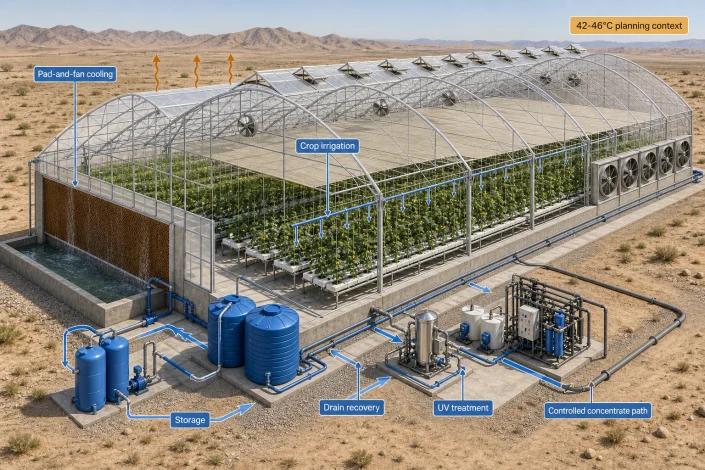
Conceptual cutaway of a water-efficient cucumber greenhouse showing pad-and-fan cooling, drainage recovery, UV treatment, storage and high-wire crop rows.

Confidentiality and scenario basis

This page is a confidential reference-scenario framework developed for planning discussion. While this generalized model is fully informed by the real-world data and verifiable experience derived from our actively operating projects, we hold a steadfast commitment to protecting our clients' intellectual property and commercial secrets. Consequently, we do not disclose specific named clients, proprietary site-specific results, or confidential vendor pricing. Final system sizing, structural loads, drainage design, utility requirements, local permits and commercial scope require site-specific verification.

Assumptions: Climate basis: hot-arid inland setting with 42-46°C summer dry-bulb planning conditions and high dust exposure; structure basis: Gothic multi-span frame with 4.5-5.0 m bays and 6.0-7.0 m ridge height; crop basis: hydroponic high-wire cucumber production targeting a defined year-round market window; irrigation basis: 4 L/h drip emitters, drain collection, EC/pH automatic dosing, and optional UV sterilization; cooling basis: pad-and-fan evaporative cooling with HAF fans and 30-50% movable shade; water basis: laboratory source-water analysis, confirmed allocation, storage calculation, and verified concentrate-disposal route required before design freeze.

Scenario overview

Confidentiality note: This page is a confidential-style, modelled reference scenario prepared to illustrate pre-investment planning logic for a 20,000-40,000 m2 water-constrained cucumber greenhouse. It is not a named customer case study, completed project record, supplier quotation, final engineering design, regulatory approval, or guarantee of yield, water use, budget, or operating performance. Planning ranges are conservative scenario inputs that require site climate data, laboratory water analysis, utility confirmation, local code review, supplier quotations, and qualified engineering verification.

Scenario Overview

Reference scenario: This is a modelled pre-investment scenario for a 20,000–40,000 m² water-efficient cucumber greenhouse in a hot-arid inland setting, not a named completed project, supplier quotation, final engineering design, regulatory approval, or performance guarantee. It tests the decisions that must be resolved before a year-round production programme proceeds to supplier pricing.

The first question is not how many kilograms a high-wire cucumber crop might produce. It is whether peak-summer water allocation can serve crop irrigation, evaporative cooling and essential cleaning at the same time. At 42–46°C dry-bulb conditions, a cooling strategy that appears workable on a monthly utility estimate can fail during the hours when cucumber transpiration and pad-wall evaporation coincide. If that balance does not close, a larger Gothic multi-span greenhouse only amplifies the shortfall. The greenhouse platform used in this scenario is outlined in hydroponic greenhouse systems.

This desert cucumber greenhouse project scenario therefore follows a deliberate decision order: confirm water availability and quality, test summer heat rejection, then decide whether drainage recovery is operationally viable before setting production and yield expectations. That sequence protects buyers from committing to a multi span greenhouse package whose cooling and irrigation systems compete for the same constrained resource.

It also answers the planning questions a generic case study usually leaves open: whether a 20,000–40,000 m² hydroponic cucumber programme needs a reduced-summer operating window, whether recirculation creates a manageable water-saving benefit or an unacceptable concentrate-disposal burden, and which technical interfaces must be verified before quotations. For broader system-path comparisons, use the greenhouse technology comparison; this page applies that choice to cucumber transpiration, arid-climate cooling and water constraint as one feasibility problem.

The Decision This Scenario Supports

  • Proceed with year-round production: appropriate only where verified peak allocation, storage autonomy and cooling-water demand remain compatible during the hottest operating period.
  • Use recovery selectively: appropriate where source-water chemistry, UV sterilization discipline and a controlled reject-water route can be maintained; it is not automatically preferable to controlled drain-to-waste.
  • Adopt a seasonal fallback: often the more defensible choice where summer water or electrical capacity cannot support pad-and-fan cooling without displacing crop irrigation.

Aegis can support the feasibility framing, technology-selection review, supplier coordination and project-management planning needed to turn these choices into a site-specific brief. The matching delivery scope is described in greenhouse consulting.

Location and Crop Assumptions

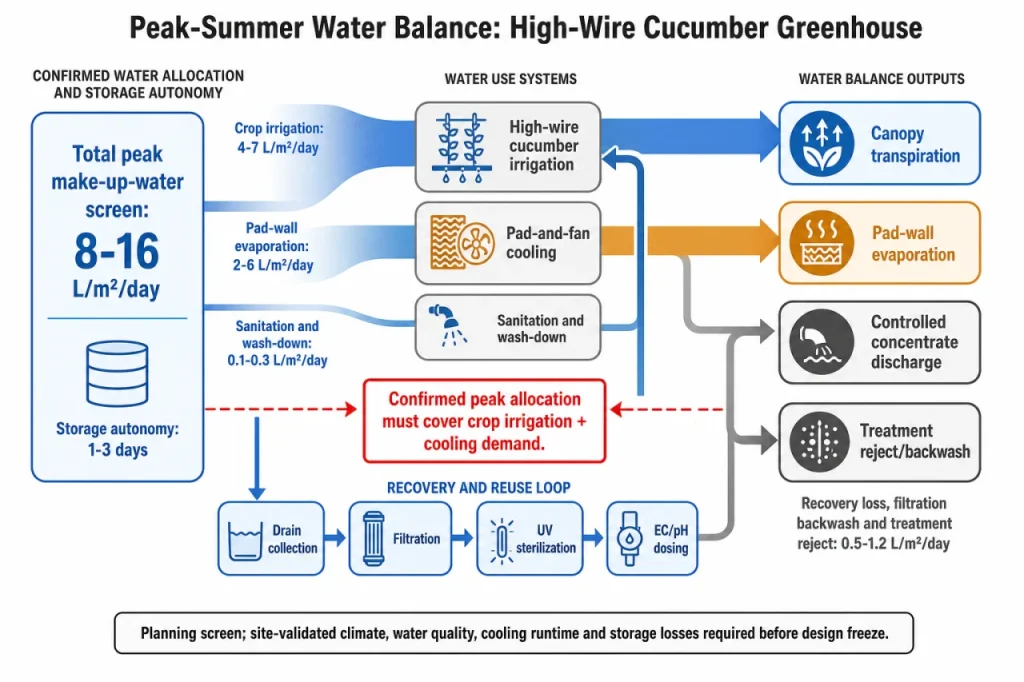
Peak-summer water-balance diagram for a cucumber greenhouse showing irrigation, pad cooling, drainage recovery, treatment reject and storage.
Peak-day feasibility depends on component demand, not irrigation alone: crop water, pad-wall evaporation, recovery losses and discharge must be tested against confirmed allocation.

The reference setting is a hot-arid inland location with peak summer dry-bulb conditions in the 42–46°C range, high solar exposure, and recurring dust load. For a 20,000–40,000 m² cucumber programme, the decisive climate input is not the seasonal average: it is the number of coincident hot, dry hours when evaporative demand, cooling operation, and irrigation demand rise together. Site coordinates, elevation, hourly temperature and humidity records, and prevailing-wind data should therefore replace regional averages before the production calendar is committed. The specification logic behind this scenario is outlined in greenhouse crop selection guide.

The crop basis is hydroponic high-wire cucumber grown for a defined year-round market window. Cucumber canopy transpiration and humidity sensitivity make this a different planning case from a tomato-led facility: a dense, actively fruiting cucumber crop can require rapid moisture removal while the greenhouse is simultaneously limiting heat stress. A Gothic multi-span envelope with a 6.0–7.0 m ridge height is a useful reference configuration because its air volume supports climate buffering, but the final operating window still depends on whether summer cooling can protect crop continuity without exhausting the water allocation. The specification logic behind this scenario is outlined in commercial greenhouse project budget.

Inputs That Change the Feasibility Answer

Planning input Why it changes the cucumber brief What to verify first
Summer climate profile At 42–46°C, dry-bulb temperature alone cannot predict pad-and-fan performance; coincident wet-bulb temperature determines the achievable cooling depression. Hourly temperature, relative humidity, wind, solar radiation, and dust-event records for the proposed coordinates.
Production window A continuous 12-month high-wire crop places its highest irrigation and cooling demand in the same summer period; a reduced-summer programme may lower peak utility exposure. Required harvest months, acceptable summer volume reduction, and market penalties for supply gaps.
Source-water chemistry With 4 L/h drip emitters and drainage collection, bicarbonate, sodium, chloride, EC, and microbiological status influence dosing stability, emitter fouling, and whether recovered drainage can be reused. A current laboratory panel against the relevant greenhouse water quality requirements, including seasonal source variation.
Crop-management capability High-wire cucumber needs disciplined crop steering, drainage monitoring, and humidity response; greater water recovery increases the sampling and corrective-action burden. Labour availability, agronomy supervision, crop-change schedule, and daily EC/pH monitoring responsibility.

The appropriate next decision is to define the production window before selecting a cooling or recovery concept. Year-round operation fits a site that can document peak-period water availability and maintain a stable cucumber climate; where those inputs are weak, a summer-adjusted programme can be more defensible than designing the whole facility around an unverified peak condition. A comparable reference scenario is available in high-wire tomato feasibility scenario.

Technical System Breakdown

The reference path uses a Gothic multi-span greenhouse with 4.5–5.0 m bays and a 6.0–7.0 m ridge height. That volume gives cucumber crops more usable air buffer than a low-roof structure during hot afternoons; however, ridge height alone does not solve heat stress if roof vents, exhaust fans and screen control are specified as separate, coordinated systems.

System Reference configuration Decision consequence
Cladding and structure Gothic multi-span frame, 200-micron diffuse anti-drip film or 4 mm tempered-glass comparison Film lowers initial capital and is simpler to replace; glass can support higher light transmission and longer service life, but increases structural, cleaning and capital requirements.
Heat rejection Pad-and-fan cooling, roof ventilation, HAF fans and 30–50% movable shade Pad-and-fan cooling is usually the stronger choice where 42–46°C dry-bulb periods coincide with workable wet-bulb conditions and reliable water treatment. Shade reduces solar load, but a 50% screen can also reduce crop light materially; screen selection must follow the production window, not peak temperature alone.
Alternative humidification 70 bar high-pressure fogging with filtration and HAF fan distribution Fogging can limit direct crop wetting compared with poorly controlled low-pressure misting, but nozzle scaling and uneven distribution become costly where source water has high hardness or inadequate filtration.
Irrigation and drainage Hydroponic substrate gutters, 4 L/h drip emitters, drain collection and EC/pH automatic dosing controller Collected drainage preserves the option for controlled recovery. Without segregated drain lines, sampling points and buffer capacity, UV sterilization cannot be added later without disruptive rework.
Water recovery Screen filtration, UV sterilization, buffer tanks and controlled concentrate handling UV-treated recovery fits sites with constrained make-up water and disciplined water monitoring. It is a poor fit where sodium or chloride accumulation cannot be managed, or where no verified route exists for treatment reject and concentrate.
Climate controls Priva-compatible climate computer, EC/pH dosing signals, pad pumps, exhaust fans, HAF fans and screen drives One control sequence is needed to prevent opposing commands—for example, operating pad pumps and roof vents without an agreed humidity and temperature hierarchy.

For a water-efficient cucumber greenhouse, the key technology choice is not simply whether to install UV or evaporative cooling; it is whether the drainage, treatment, cooling and controls packages can operate as one measured loop. General selection criteria for these alternatives are covered in the greenhouse technology comparison, while source-water screening should follow the greenhouse water quality requirements before any treatment train is frozen.

Experienced teams should ask for a single operating narrative: at a canopy-protection setpoint near 28–30°C, which device starts first, what water-quality interlock protects 70 bar fogging or pad pumps, and where does off-spec drainage go? If suppliers cannot show those signals, pipework and control points on one coordinated diagram, the system remains a collection of equipment rather than a workable hot-arid cucumber production platform.

Modelled assumptions and metrics

The useful metric is not a single water-use headline. For a 20,000-40,000 m2 high-wire cucumber programme, the feasibility test separates crop irrigation from pad-and-fan evaporation, sanitation, treatment losses and storage resilience. The 8-16 L/m2/day peak make-up envelope is a planning screen derived from an evapotranspiration-led water-balance method, not a design duty; final values require hourly weather, crop stage, drainage target and cooling run-time validation.

Peak-summer make-up-water screen

Water-balance component Planning input Decision consequence
Crop irrigation through 4 L/h drip emitters Approximately 4-7 L/m2/day Must be protected before cooling-water allocation; reducing drainage without controlling root-zone EC can create a false saving.
Pad-wall evaporation Approximately 2-6 L/m2/day when 42-46°C dry-bulb conditions coincide with pad-and-fan operation Usually drives the peak-day gap. Low wet-bulb temperature improves cooling potential but can increase evaporation demand.
Sanitation and wash-down Approximately 0.1-0.3 L/m2/day Small in volume but should remain visible; excluding it makes storage and abstraction calculations too optimistic.
Recovery loss, filtration backwash and treatment reject Approximately 0.5-1.2 L/m2/day Depends on UV sterilization, filtration configuration and source-water chemistry; it cannot be assumed away in a recirculating system.
Total peak make-up-water screen Approximately 8-16 L/m2/day Proceed only if confirmed allocation covers the combined peak, not irrigation alone.
Storage autonomy Separate volume calculation for 1-3 days of verified peak demand Storage does not reduce daily demand; it only protects continuity against supply interruption or power-restart delays.

Method basis: FAO-56 crop evapotranspiration guidance supports the water-balance approach. Site design should replace these planning inputs with measured allocation, hourly dry-bulb and wet-bulb data, and operating losses from the selected cooling package.

Operating model fit

Operating path Best-fit condition Water and operational trade-off Decision trigger
Controlled drain-to-waste Reliable water allocation with a manageable discharge route Lowest treatment complexity, but the 4-7 L/m2/day crop-irrigation component remains largely dependent on fresh water. Suitable when source-water EC and discharge conditions permit routine drainage management.
Partial drainage recovery Constrained allocation with stable laboratory water results Can reduce fresh-water draw while limiting the monitoring burden of full recirculation; blending and EC/pH automatic dosing remain essential. Use when sodium, chloride and bicarbonate trends can be monitored and a controlled reject route exists.
UV-treated recirculation Severe water constraint plus verified concentrate handling and trained operators May reduce fresh-water demand by an illustrative 20-40% versus comparable drain-to-waste practice, but UV validation, filtration maintenance and ion accumulation become operating-critical. Do not select solely for water savings if concentrate disposal, microbiological control or maintenance cover is unresolved.
Reduced-summer or seasonal programme Peak allocation cannot cover crop irrigation and pad-wall demand together Reduces exposure to the 2-6 L/m2/day cooling-water peak, but changes harvest continuity and market commitments. Prefer this path to undersizing water storage or forcing year-round operation on an unverified supply.

Before choosing recovery, compare the laboratory results against the operational burden described in greenhouse water quality requirements and test the electricity, water-storage and discharge interfaces through commercial greenhouse utility planning. The experienced-client question is straightforward: What peak-day allocation remains after cooling, sanitation, treatment reject and a 1-3 day storage reserve are accounted for?

Production metric that should follow the water test

An illustrative 60-100 kg/m2/year range is appropriate only after the water balance passes. High-wire cucumber output depends on cultivar, radiation, humidity control, labour response time and crop steering; a Priva-class climate-control strategy can coordinate targets, but it cannot compensate for a peak-summer water shortfall. Treat yield as a crop-management validation input, not as evidence that the selected water source is viable.

Budget and Cost Drivers

For this 20,000–40,000 m2 water-efficient cucumber greenhouse scenario, a preliminary capital-planning envelope of USD 220–420/m2 implies approximately USD 4.4–16.8 million. This is a feasibility allowance, not a supplier quotation or bankable estimate. The wide band is deliberate: in a 42–46°C summer design context, the water, cooling and electrical packages can change the commercial case more than the Gothic multi-span frame alone.

The practical budgeting decision is not whether to include water treatment, but whether the site conditions justify a simple make-up-water path, partial recovery, or a UV-treated recirculation train with controlled concentrate handling. A 20,000 m2 facility can sometimes absorb higher unit costs for storage and treatment when water allocation is tight; at 40,000 m2, undersizing a buffer tank, pad-wall supply line, or electrical distribution board can create a larger and more expensive correction after construction begins.

Cost driver Why it moves the range Budget decision to make early
Cooling and air movement Pad-and-fan cooling, HAF fans and a 30–50% movable shade screen add equipment, controls, filtration and electrical capacity. Their cost rises with the required peak heat-rejection duty and operating hours. Compare a full year-round cooling duty with a reduced-summer production window before fixing fan, pad and standby-power scope.
Water storage and treatment Raw-water storage, media or cartridge filtration, UV sterilization, EC/pH automatic dosing and concentrate handling are separate cost centres. Higher sodium or chloride risk can require more blending, monitoring and reject-water capacity. Price treatment against an actual laboratory analysis and a confirmed discharge or disposal route; do not use a generic hydroponic package allowance.
Drainage recovery Drain collection from substrate gutters, return piping, buffer tanks, filtration and instrumentation increase initial cost and maintenance requirements, while potentially reducing purchased or abstracted fresh water. Test partial recovery against full recirculation using the verified peak-day allocation, not an annual average water figure.
Cladding and structure A Gothic multi-span structure with 6.0–7.0 m ridge height carries a different structural, ventilation and lifecycle cost profile from a lower roof. Diffuse film and glass also change replacement, cleaning and frame requirements. Request comparable offers with identical bay geometry, vent configuration and design-load basis; otherwise low headline prices are not comparable.
Electrical and controls integration Exhaust fans, pumps, UV units, dosing equipment and climate control require coordinated distribution, motor control and control logic. A Priva-compatible climate-control interface may be valuable where alarms and water systems must respond together. Include incoming-power assumptions, backup-power interfaces and controls cabling as priced line items rather than allowances.

What the planning range excludes

The USD 220–420/m2 range excludes land, taxes, major off-site utility extensions and location-specific civil works unless a quotation explicitly includes them. Packing, cold chain, wells, external water conveyance, discharge infrastructure and market-side logistics should also be tested as separate investment decisions. For wider benchmarking and cost-definition guidance, review commercial greenhouse cost.

A lower initial figure is not automatically the lower-risk choice. Omitting 4 L/h emitter filtration, water-quality instrumentation or cooling-water storage may reduce the first offer but transfer cost into crop interruption, manual intervention and retrofit exposure. Before comparing totals, normalize each option to the same production window, water-treatment boundary, cooling duty, electrical interface and commissioning allowance.
Risk matrix

For this water-efficient cucumber greenhouse scenario, the highest-consequence failures occur when the same peak-summer water allocation is assumed to serve both 4 L/h drip irrigation and pad-and-fan evaporation. A 42-46°C dry-bulb period can turn a manageable annual supply into a peak-day shortfall; the decision is therefore to verify each constraint before the operating model is committed.

Risk Commercial consequence Early verification action Accountable interface
Peak cooling-water shortfall Pad-wall evaporation competes with cucumber irrigation during the hottest production weeks, forcing reduced cooling or crop stress. Test hourly dry-bulb and wet-bulb data, confirmed allocation, and storage autonomy against the 8-16 L/m²/day peak make-up-water planning envelope. Owner-side utility lead with cooling and irrigation designers
Source-water sodium, chloride, or bicarbonate load EC correction becomes unstable, recirculation recovery falls, and nutrient discharge may rise. Obtain laboratory results for EC, sodium, chloride, bicarbonate, alkalinity, and microbiological risk before selecting UV sterilization or blending. Water-treatment supplier and agronomy adviser
No verified concentrate-disposal route UV-supported recovery can become an operational liability even where freshwater savings appear attractive. Document the permitted discharge, hauling, reuse, or other disposal route before specifying reject-water tanks and reverse-osmosis pretreatment. Owner-side water and permitting lead
Dust fouling of pads, screens, and fans Airflow and cooling decline while cleaning labour and replacement frequency increase. Define intake filtration, pad wash-down water quality, access clearances, and a maintenance interval for the pad wall, HAF fans, and 30-50% movable shade screen. Cooling supplier with operations lead
Power interruption during heat events Exhaust fans, dosing pumps, and climate controls can stop together, creating rapid canopy-temperature escalation. Confirm incoming capacity, generator interface, restart sequence, and control priority for exhaust fans, circulation pumps, and the climate computer. Electrical contractor and controls integrator
Pathogen or ion accumulation in recovered drainage Water savings are offset by crop-health exposure, filter burden, or excessive concentrate bleed. Set sampling points before and after UV sterilization, define filtration duty, and confirm who adjusts EC/pH automatic dosing after recovered-water blending. Irrigation, treatment, controls, and crop-management interface
Year-round target exceeds summer operating capacity Capital is committed to a production window that cannot be cooled or watered reliably. Compare the year-round programme with a reduced-summer or seasonal alternative before finalizing the Gothic multi-span cooling package. Owner-side commercial lead with feasibility team

Decision rule before proceeding

Do not treat cucumber greenhouse water recirculation as the default answer to scarcity. It fits when source-water chemistry, UV validation, filter maintenance, and concentrate handling are all controllable. Where any one of those conditions is unresolved, partial recovery or a reduced-summer production window may protect crop continuity better than a higher-complexity closed loop. The next verification should be a coordinated review of water analysis, peak allocation, and the cooling-duty profile—not a supplier promise based on annual water consumption.

Supplier and Procurement Scope

For a 20,000–40,000 m² water-efficient cucumber greenhouse, the commercial failure point is often not the multi span greenhouse package itself; it is the unpriced connection between the Gothic frame, pad-and-fan cooling, drainage recovery and electrical controls. Each supplier can reasonably limit its own warranty to its equipment, so the owner’s RFQ must identify who delivers a functioning interface—not merely who supplies components.

Define the interfaces that affect operation

Package Scope that should be explicit Critical handover to verify
Structure and cladding Gothic multi-span frame, 4.5–5.0 m bays, roof vents, gutters, screen supports and access provisions. Confirm that pad-wall openings, exhaust-fan frames, shade-screen loads and drainage penetrations are included in the coordinated drawings.
Cooling and climate Pad wall, exhaust fans, HAF fans, 30–50% movable shade, filtration, sensors and climate-computer points. Specify fan motor electrical loads, cooling-water supply pressure, sump drainage, and the control sequence for pad-and-fan versus ventilation operation.
Irrigation and recovery 4 L/h drip emitters, substrate gutters, drain collection, buffer tanks, EC/pH automatic dosing controller, filters and UV sterilization where selected. Assign responsibility for the pipework from drain collection to treatment, treated-water return, sampling points and controlled concentrate discharge.
Electrical and controls Incoming-power interface, distribution boards, motor controls, field cabling, alarms and climate-control integration. Require an I/O schedule showing every fan, pump, valve, UV unit and level sensor, including which party supplies, wires, tests and commissions it.
Civil and water infrastructure Water-storage foundations, pad-wall trenches, drainage channels, treatment-room drainage and equipment plinths. Confirm tank capacities, pipe sleeves, fall gradients and discharge connections before civil works are poured; later changes are disruptive and expensive.

Procurement decision: use one interface register alongside every quotation. It should name the supplying party, installation party, commissioning party and warranty owner for each physical and control connection. A UV unit without validated flow interlocks, or a pad wall without an assigned wash-down drain, may be supplied correctly yet still prevent reliable operation.

Do not accept “by others” without a named owner

  • Installation: distinguish equipment delivery from mechanical installation, electrical termination and controls calibration.
  • Commissioning: require functional testing of EC/pH dosing, UV alarms, water-level protection, fan staging and Priva-compatible control points where a Priva integration is selected.
  • Operations handover: list filter media, UV lamps, pad maintenance materials, critical spares, training hours and response obligations rather than assuming they are included.
  • Future capacity: confirm whether manifolds, cable trays, treatment-room footprint and control-panel capacity allow a later phase; a 40,000 m² expansion can otherwise require replacement rather than extension.

A single integrated supplier can simplify accountability, but it may reduce equipment choice and price transparency. Multi-vendor procurement can improve specialist selection for water treatment or controls, but only when the owner has coordinated drawings, an agreed I/O schedule and a commissioning lead. Aegis can support this scope definition and supplier coordination within commercial greenhouse projects; broader comparisons of package options belong in the greenhouse technology comparison resource.

Request a Water-and-Climate Feasibility Review

Before issuing RFQs, submit the site coordinates, elevation, available greenhouse area, target cucumber production months, laboratory water analysis, confirmed peak-day water allocation, available storage volume, discharge route, preliminary budget range, and target start date. These inputs let Aegis frame the next feasibility decision around the connected water, cooling, controls, and supplier interfaces—not a generic equipment list.

Aegis can provide consulting, technology-selection support, supplier coordination, and project-management assistance for a site-specific review. If the water analysis or allocation evidence is incomplete, start with the greenhouse water quality requirements and commercial greenhouse utility planning resources so the feasibility brief identifies the missing decision data.

Request a Water-and-Climate Feasibility Review with the available documents and state whether the objective is year-round production, a reduced-summer programme, or a seasonal cucumber window. That operating choice determines whether UV recirculation, pad-and-fan cooling, 70 bar fogging, or a lower-complexity water path should remain under consideration.

Test This Scenario Against Your Site Conditions

Submit site coordinates, elevation, available area, water analysis, confirmed water allocation, target cucumber production window, and preliminary budget range. Aegis can help frame the water balance, climate-load checks, technology path, and supplier responsibility boundaries required for the next feasibility decision.