Skip to content
AEGISGreenhouse Systems

Comparisons — 11 min read

Glass Greenhouse Vs Poly Greenhouse

Glass vs poly greenhouse compared on light transmission, insulation, lifespan, capital cost and total cost of ownership, with guidance on which crops and climates justify each.

By Aegis Project Engineering

Published /Updated

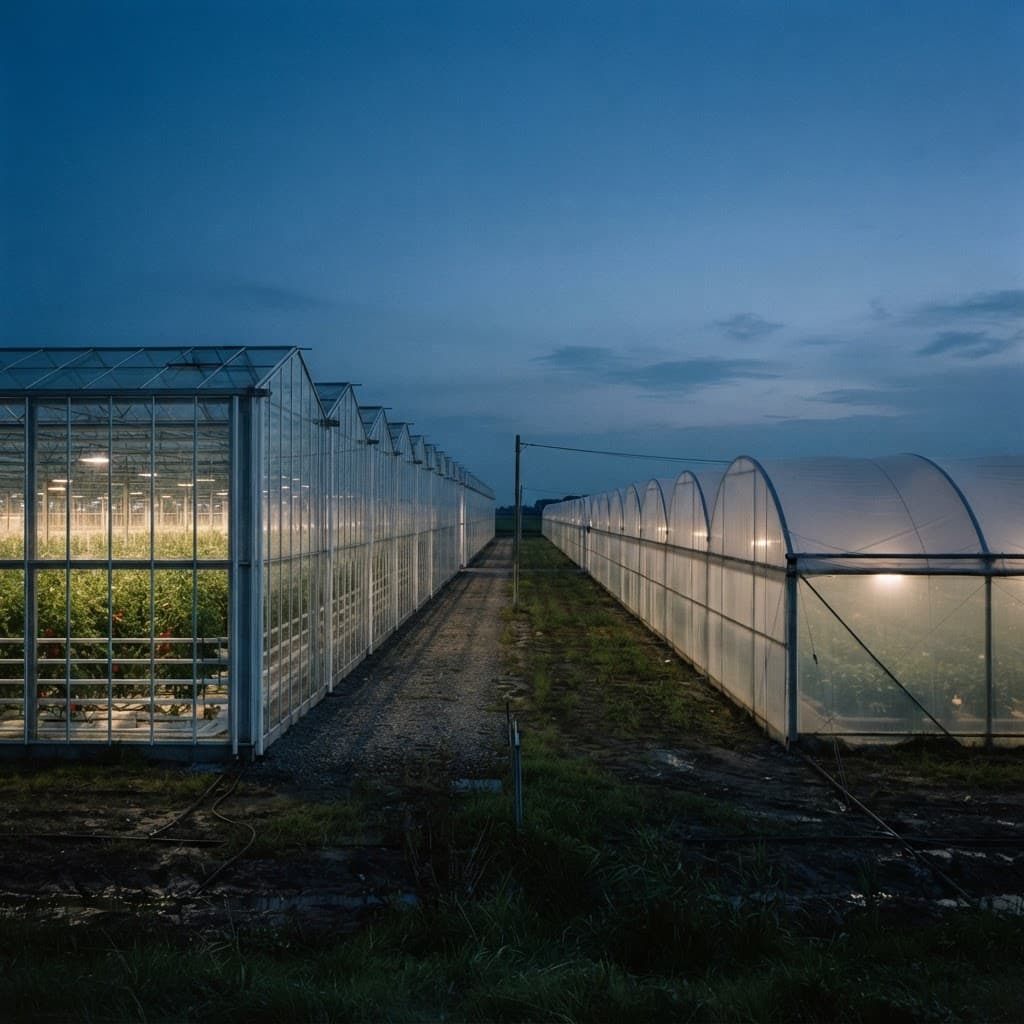
A rigid glass Venlo greenhouse standing beside an arched polyethylene film greenhouse at dusk, contrasting the two glazing materials

The core trade-off

Glass delivers higher light transmission and a twenty-five year service life at two to three times the capital cost of polyethylene film, which needs replacing every three to five years. Neither is universally correct. The decision turns on how light-limited your crop is, how cold your winters are, and how expensive your capital is.

Light transmission

Light is the primary yield driver in protected cultivation, and the common rule of thumb is that one percent more light produces roughly one percent more yield in light-limited conditions. Glass starts higher and, critically, degrades far less over time.

  • Diffuse glass: 82 – 92% transmission, minimal degradation over life
  • Single float glass: 88 – 90% when new
  • New double-inflated film: 85 – 88%
  • Film after three years: 70 – 78% as dust and UV degradation accumulate
  • Twin-wall polycarbonate: 78 – 82%, gradual yellowing over time

Insulation and energy

Single glass and single film insulate similarly, which surprises many buyers. The real energy differences come from double glazing and from screens, not from the choice between glass and film as such. Double-inflated film actually outperforms single glass because the air gap does the work.

Lifespan and replacement cost

Film replacement is the line item most often omitted from comparison. Recovering a hectare costs both materials and labour, and it recurs. Over a twenty-year horizon a film structure will be re-covered four to six times, which substantially narrows the apparent capital advantage.

Where glass is the right answer

Glass wins where light is the binding constraint and the facility must produce year-round. For high-wire tomato or cucumber in a temperate or cold climate serving a winter market, the yield difference compounds every season and the longer life amortises the premium.

  • Year-round high-wire vegetable production
  • Temperate and cold climates with low winter light
  • Facilities where supplemental lighting is installed
  • Long investment horizons with access to cheaper capital

Where film is the right answer

Film wins where the crop is less light-limited, the climate is mild, or capital is constrained. For strawberry and blueberry in mild climates, film captures most of the achievable yield at a fraction of the cost and typically shows a shorter payback.

  • Soft fruit and berry production in mild climates
  • Seasonal or shoulder-season production programmes
  • Projects where payback period matters more than asset life
  • Phased developments testing a market before committing capital

Total cost of ownership, not capital cost

The correct comparison runs both options over the same horizon including re-covering cycles, energy consumption and yield difference. Run on that basis, glass and film often converge much more closely than the headline capital numbers suggest — and the winner flips depending on crop and climate rather than being fixed.

Glass, film and polycarbonate compared on the criteria that decide projects
CriterionDiffuse glassDouble-inflated filmTwin-wall polycarbonate
Light transmission (new)82 – 92%85 – 88%78 – 82%
Transmission after 5 yearsNear original70 – 78%Gradual decline
Service life25+ years3 – 5 years10 – 15 years
Relative capital cost2.4 – 3.0x1.0x1.6x
InsulationLow (single)Moderate (air gap)Good
Hail and impact resistanceLowModerateHigh
Best suited toYear-round vegetablesBerries, mild climatesHail-exposed sites

About the author

Aegis Project Engineering

Structural and climate engineering desk

The engineering desk writes the technical specifications behind Aegis projects, covering structures, glazing, climate systems and irrigation. The team reviews supplier designs against local load codes and measured site climate data rather than reference-project assumptions.

  • Structural specification
  • Climate strategy
  • Glazing selection
  • Irrigation design

FAQ

Frequently asked questions

Is a glass greenhouse always better than a poly greenhouse?

No. Glass is better where light is the binding constraint and the facility runs year-round. For crops that are less light-limited, such as strawberry or blueberry in mild climates, a film structure delivers most of the achievable yield at a fraction of the capital cost and often a shorter payback.

How often does greenhouse film need replacing?

Every three to five years for quality double-inflated film, depending on UV exposure and handling. The replacement cost including labour must be included in any comparison against glass, because over twenty years it recurs four to six times.

Does film insulate worse than glass?

Not necessarily. Double-inflated film with an air gap typically insulates better than single glass. The larger energy differences come from double glazing and from energy screens rather than from the glass-versus-film choice itself.

What about polycarbonate?

Polycarbonate sits between the two: better insulation and impact resistance than glass, lower light transmission, and a ten to fifteen year life. It suits hail-exposed sites and applications where breakage risk carries a real cost.

Start Your Greenhouse Project With Aegis

Send us your location, available area and target crop. You will receive a structured first assessment with technology direction and an indicative investment range.