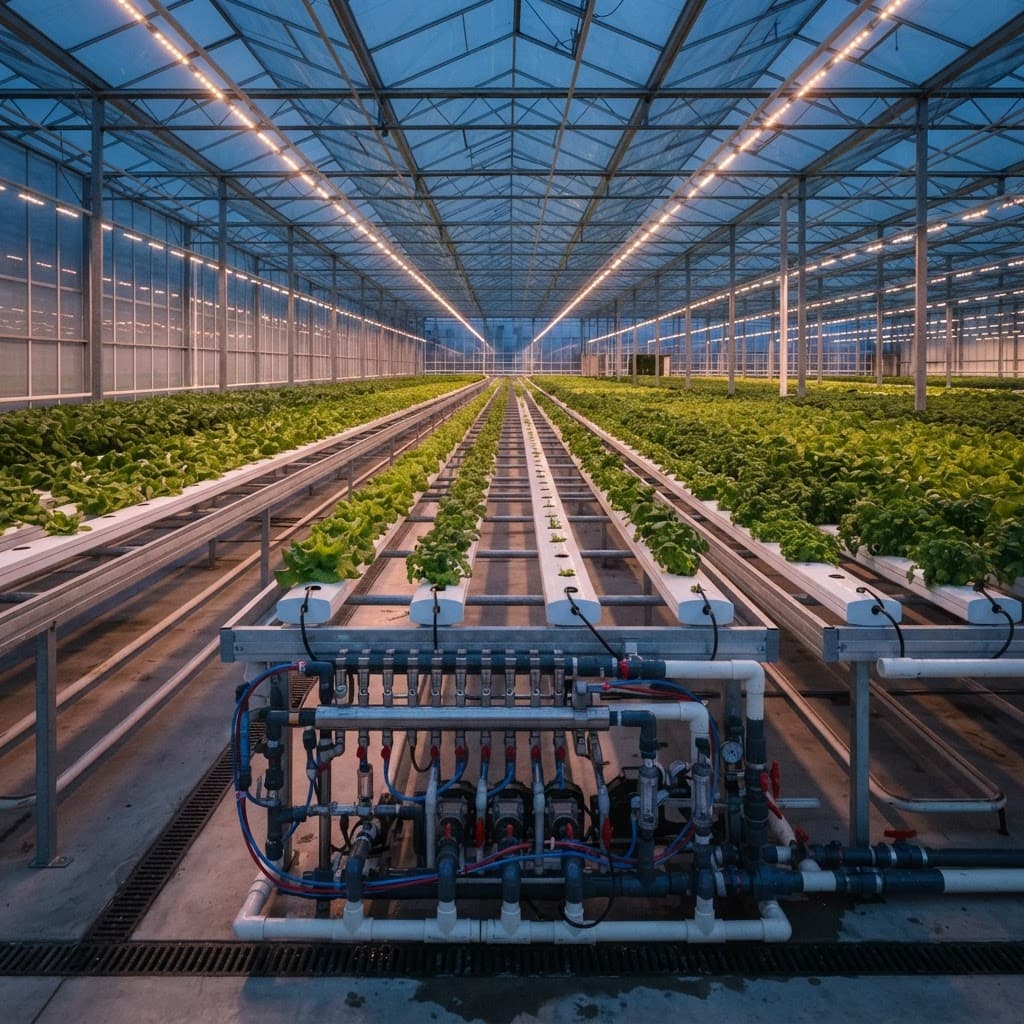
A practical guide to hydroponic greenhouse farming: comparing NFT, substrate and DWC systems, water treatment requirements, nutrient management, yields and capital cost.
Hydroponic cultivation replaces soil with an inert substrate or nutrient solution, giving direct control over water and nutrient delivery to the root zone. Yields rise substantially and water consumption falls by 70 to 90 percent against open-field irrigation. The trade is that soil provides a buffer against error, and hydroponics does not — an irrigation failure becomes a crop problem within hours.
Water analysis comes first
The most consequential decision in a hydroponic project is made before any system is selected. Source water pH, alkalinity, sodium and chloride determine what treatment is required and, for sensitive crops, whether a site is viable. Specifying a system before analysing the water is the most common and most expensive sequencing error we correct.
pH and alkalinity determine acid dosing requirements
Sodium and chloride accumulate in recirculating systems
High sodium usually requires reverse osmosis, not just acid dosing
Iron and manganese can foul emitters and require filtration
System types compared
System choice follows the crop rather than preference. Substrate culture suits fruiting crops that need root anchorage and a degree of steering; NFT suits fast leafy crops; deep water culture occupies a narrower niche in commercial production.
NFT channels: leafy greens and herbs, low water volume, fast cycles
Deep water culture: limited commercial use, high thermal buffering
Substrate pots: berries and perennials with engineered bark or coco mixes
Recirculation and disinfection
Closed recirculation recovers drain water and is what delivers the largest water and fertiliser savings. It also circulates pathogens, so disinfection is not optional. UV treatment is the most common approach; slow sand filtration and heat treatment are alternatives with different cost and throughput profiles.
Drain collection per block or per gutter for monitoring
UV disinfection sized to full recirculation flow
Continuous EC and pH monitoring with inline verification
Sodium monitoring to determine when a flush is required
Nutrient management in practice
Nutrient recipes are adjusted continuously against crop stage, light level and drain analysis rather than set once. Drain EC and volume are the primary feedback signals: they indicate whether the crop is taking up what is being supplied, and they are how growers steer between vegetative and generative development.
Capital cost of hydroponic systems
The hydroponic system itself is a modest share of total project cost — typically 8 to 15 percent — but the water treatment it requires can be considerably more where source water is poor. Budgeting the growing system without the treatment train produces a number that will not survive contact with a water analysis.
Operational capability is the real requirement
Hydroponics is less forgiving than soil. It rewards facilities with trained operators, monitoring routines and standard operating procedures, and it punishes those without them faster than soil-based cultivation would. For first-time operators, we plan training and procedures as part of project delivery rather than after handover.
Hydroponic system selection by crop and requirement
System
Suited crops
Water volume
Relative cost
Key requirement
Stone wool substrate
Tomato, cucumber, pepper
Low
Moderate
Drain monitoring and steering
Coco substrate
Tomato, berries
Low
Moderate
Buffering and pH control
NFT channels
Lettuce, herbs
Very low
Moderate
Pump redundancy, root-zone temperature
Substrate pots
Blueberry, perennials
Moderate
Low
Water treatment for pH and sodium
Deep water culture
Leafy greens
High
Low
Oxygenation and thermal control
About the author
Aegis Horticulture Advisory
Crop and production strategy desk
The horticulture desk matches crop programmes to climate, market window and the technology package each crop requires. The team plans first crop cycles, climate set points and operator training for facilities entering production.
Crop selection
Production planning
Hydroponic systems
Operator training
FAQ
Frequently asked questions
How much water does hydroponic farming save?
Typically 70 to 90 percent against open-field irrigation for the same output, because water is delivered directly to the root zone and drain is recovered. In closed systems with condensate recovery the saving is at the upper end of that range.
Is NFT or substrate better?
They serve different crops. NFT suits fast-cycling leafy greens where root anchorage is not required. Substrate suits fruiting crops that need anchorage and allow the grower to steer the crop through irrigation strategy. The crop decides, not the system.
Do we need reverse osmosis?
Only where source water sodium or chloride would accumulate beyond crop tolerance in a recirculating system. Acid dosing handles pH and alkalinity but does not remove sodium. A water analysis is the only way to determine which applies, and it should precede system selection.
Can hydroponics work without an experienced grower?
It can, but only with training and monitoring routines established before the first crop. Hydroponics removes the buffer soil provides, so errors surface within hours rather than weeks. We treat operator capability as part of project scope for first-time operators.
Start Your Greenhouse Project With Aegis
Send us your location, available area and target crop. You will receive a structured first assessment with technology direction and an indicative investment range.