Skip to content
AEGISGreenhouse Systems

Greenhouse knowledge / 12 min read

Venlo Greenhouse Complete Guide

A complete guide to Venlo greenhouses: structural design, span and gutter height options, climate systems, capital cost, suitable crops and how Venlo compares to multi span structures.

By Aegis Project Engineering

Published /Updated

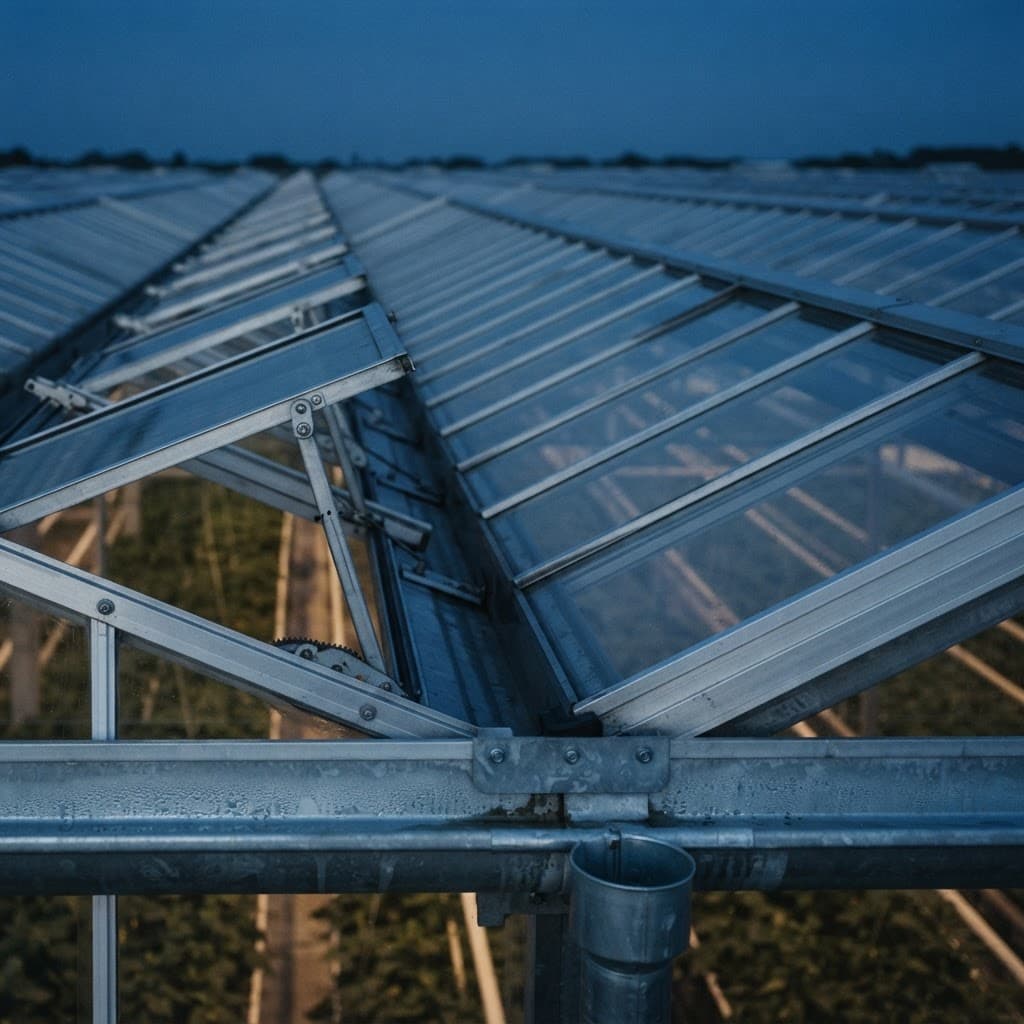
Close-up of a Venlo greenhouse roof at dusk showing the paired small-pitch glass panes, aluminium glazing bars, gutter and sequenced vent windows

What defines a Venlo greenhouse

The Venlo design originated in the Dutch horticultural region of the same name and has become the international standard for high-light commercial glass production. Its defining characteristic is narrow roof spans carried on slender trusses, which minimises the structural material blocking incoming light while supporting glass, screens and crop loads.

  • Narrow roof bays, typically 4.0 m or 4.8 m
  • Slender steel trusses minimising light obstruction
  • Gutter heights commonly 5.0 – 7.0 m for modern facilities
  • Alternating roof ventilation with mechanical rack-and-pinion drives
  • Glass panes carried in aluminium glazing bars

Why gutter height is the critical dimension

Buyers compare span width and glazing but frequently overlook gutter height, which is the specification most likely to constrain a facility permanently. Greater height increases the air volume above the canopy, which buffers temperature and humidity swings and gives high-wire crops the vertical space they need.

  • 4.0 – 4.5 m: adequate for leafy crops and propagation only
  • 5.0 – 5.5 m: workable for shorter fruiting crops
  • 6.0 – 6.5 m: standard for modern high-wire tomato and cucumber
  • 7.0 m+: maximum climate buffering, used with supplemental lighting

Climate systems in a Venlo facility

A Venlo structure is a platform; its performance comes from the systems installed in it. The same frame can be specified as a modest passive facility or as a fully controlled year-round production environment, and the difference in both capital and operating cost is substantial.

  • Heating: pipe rail or grow pipes, boiler, CHP or heat pump supply
  • Energy screens: single or dual, driving 30 – 50% heating reduction
  • Roof ventilation with wind and rain automated override
  • CO₂ dosing, frequently recovered from heating exhaust
  • Heat buffer tanks decoupling heat production from demand

Capital cost

A Venlo facility with single glass and an active climate package runs roughly €120 to €180 per square metre installed. Specifying double glass and a cold-climate package moves that to €170 to €220. These figures assume complete installed facilities excluding land and civil works.

Which crops justify a Venlo structure

Venlo makes economic sense where light is the binding yield constraint and production runs year-round. For crops that tolerate lower light or produce seasonally, the capital premium over a multi span film structure is difficult to recover.

  • Strong fit: tomato, cucumber, sweet pepper, aubergine
  • Good fit: high-value leafy greens and herbs, propagation
  • Usually not justified: strawberry and blueberry in mild climates

Venlo versus multi span

Multi span structures use wider spans and film or polycarbonate glazing, delivering a materially lower cost per square metre with somewhat lower light transmission and shorter glazing life. Where a crop is light-limited and runs year-round, Venlo generally wins on cost per kilogram despite the higher cost per square metre. Where it is not, multi span usually wins.

Specification points worth insisting on

Two items are commonly value-engineered out of Venlo quotes and both are expensive to retrofit: the screen package and adequate gutter height. Structural loads should also be recalculated against local snow and wind codes rather than adopted from a Dutch reference project, particularly for continental climates.

Venlo specification tiers and typical applications
SpecificationGutter heightGlazingIndicative costApplication
Passive Venlo4.5 mSingle glass€95 – 120 /m²Mild climate, seasonal
Active single glass6.0 mSingle glass€120 – 180 /m²Year-round vegetables
Cold climate package6.5 mDouble glass€170 – 220 /m²Continental winters
High-light lit facility7.0 mDiffuse glass€200 – 260 /m²Winter production with lighting

About the author

Aegis Project Engineering

Structural and climate engineering desk

The engineering desk writes the technical specifications behind Aegis projects, covering structures, glazing, climate systems and irrigation. The team reviews supplier designs against local load codes and measured site climate data rather than reference-project assumptions.

  • Structural specification
  • Climate strategy
  • Glazing selection
  • Irrigation design

FAQ

Frequently asked questions

Why is Venlo the standard for commercial vegetable production?

Because its narrow spans and slender trusses maximise light reaching the crop, and light is the primary yield driver for high-wire vegetables. Combined with a twenty-five year glass life, that light advantage compounds across every production cycle.

What gutter height should we specify?

For modern high-wire tomato or cucumber, 6.0 to 6.5 metres. Lower heights reduce capital cost marginally but permanently limit climate buffering and crop volume, and raising gutter height later is not practical.

Can a Venlo greenhouse work in a hot climate?

Yes, but it requires a cooling strategy — pad and fan, high-pressure fogging or a semi-closed configuration. In extreme heat a semi-closed Venlo with filtered ventilation and condensate recovery is often the only configuration that sustains summer production.

How long does a Venlo greenhouse last?

The steel structure and glass typically last twenty-five years or more with maintenance. Control systems, screens and moving parts have shorter lives and should be budgeted for replacement within the facility lifetime.

Start Your Greenhouse Project With Aegis

Send us your location, available area and target crop. You will receive a structured first assessment with technology direction and an indicative investment range.