Skip to content
AEGISGreenhouse Systems

Practical guides — 14 min read

Tomato Greenhouse Growing Guide

A commercial tomato greenhouse growing guide: facility requirements, climate set points, high-wire cultivation, yield benchmarks, energy strategy and labour planning.

By Aegis Horticulture Advisory

Published /Updated

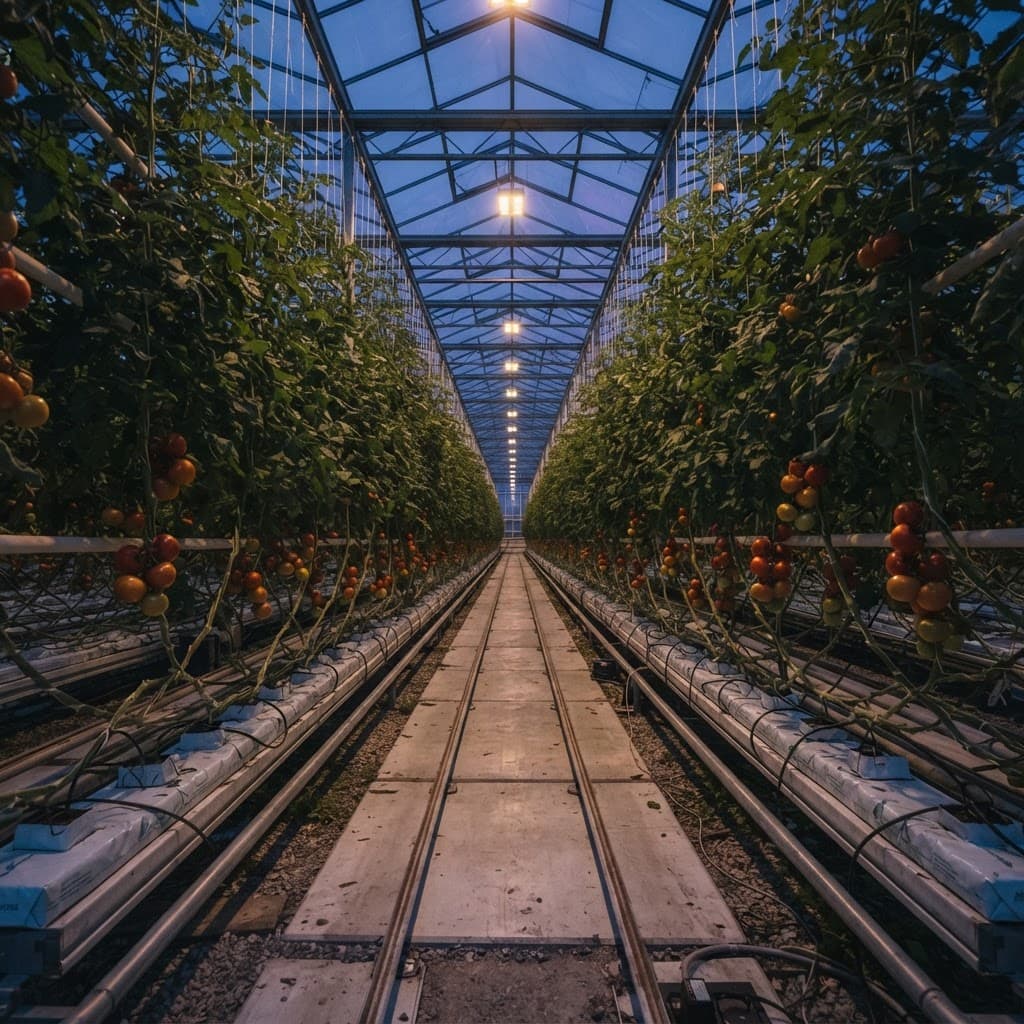
Aisle of a high-wire tomato greenhouse at dusk with vine rows on twine, ripening trusses, grow-bag substrate slabs and pipe-rail heating tubes

What commercial tomato production requires

Tomato is the benchmark protected crop: high yielding, well understood and unforgiving of a facility that was specified too cheaply. Modern high-wire production requires vertical space, light, humidity control and CO₂. A facility missing any of these will produce tomatoes, but not at the yields the business case assumed.

  • Gutter height of 6.0 m or more for high-wire canopy volume
  • High light transmission — diffuse glass where capital allows
  • Energy screens for humidity and heat management
  • CO₂ dosing, ideally recovered from heating exhaust
  • Substrate hydroponics with drain collection and recirculation

Climate set points

Tomato climate management balances vegetative and generative development through temperature strategy rather than holding a fixed set point. The 24-hour average temperature drives development rate, while the day-night differential steers the plant between growth and fruit setting.

  • Day temperature: 21 – 24 °C depending on light level
  • Night temperature: 16 – 18 °C
  • 24-hour average: 19 – 21 °C as the primary steering figure
  • Relative humidity: 70 – 85%, managed by deficit rather than absolute value
  • CO₂: 800 – 1,000 ppm when ventilation permits

High-wire cultivation in practice

High-wire systems train plants on vertical strings and lower them progressively as they grow, allowing a single planting to produce for ten to eleven months. Plant density, leaf removal and truss pruning are the levers growers use to balance vegetative growth against fruit load through the season.

Yield benchmarks

Yield varies with light, cultivar and facility specification more than with grower skill alone, which is why comparing a facility against regional benchmarks matters more than against a global figure.

  • Unheated, seasonal production: 25 – 40 kg/m²
  • Heated glass, year-round: 55 – 70 kg/m²
  • Heated glass with supplemental lighting: 75 – 100 kg/m²
  • First production cycle typically reaches 80 – 90% of mature yield

Energy is the decisive operating cost

In heated tomato production energy commonly accounts for 30 to 45 percent of operating cost, which makes it the factor most likely to determine whether the facility is profitable. The screen and buffering package is therefore not an optional upgrade — it is the specification that governs cost per kilogram for the life of the asset.

  • Dual energy screens: 30 – 50% heating reduction against no screens
  • Heat buffer tanks shift heating load away from peak tariff hours
  • Combined heat and power supplies heat, electricity and CO₂ together
  • Double glazing suits cold climates despite the light penalty

Labour planning

Tomato labour is moderate but continuous, spread across harvesting, leaf removal, truss work and lowering. Because the workload is steady rather than sharply peaked, it is easier to staff with a stable core team than berry crops are — which is often a decisive advantage where seasonal labour is scarce.

Where tomato projects underperform

The recurring causes of disappointing tomato facilities are consistent, and almost all of them are decided before the first plant arrives.

  • Gutter height too low, permanently limiting climate buffering
  • Screens omitted to reduce capital cost
  • No CO₂ dosing, capping achievable yield
  • Humidity control underestimated, driving disease pressure
  • No experienced grower contracted for the first cycle
Tomato facility specification against achievable yield
Facility specificationGutter heightYield rangeProduction window
Multi span film, unheated4.0 – 4.5 m25 – 40 kg/m²Seasonal
Multi span film, heated5.0 m40 – 55 kg/m²Extended season
Venlo glass, heated + screens6.0 – 6.5 m55 – 70 kg/m²Year-round
Venlo glass + supplemental lighting7.0 m75 – 100 kg/m²Year-round, winter priority

About the author

Aegis Horticulture Advisory

Crop and production strategy desk

The horticulture desk matches crop programmes to climate, market window and the technology package each crop requires. The team plans first crop cycles, climate set points and operator training for facilities entering production.

  • Crop selection
  • Production planning
  • Hydroponic systems
  • Operator training

FAQ

Frequently asked questions

What yield can a commercial tomato greenhouse achieve?

A heated glass facility with screens and CO₂ dosing typically achieves 55 to 70 kilograms per square metre per year. Adding supplemental lighting can raise that to 75 to 100, though the additional electricity cost only pays back where winter prices justify it.

What gutter height does high-wire tomato need?

At least 6.0 metres, and 6.5 is better. Lower heights restrict the air volume above the canopy, which limits humidity and temperature buffering and caps achievable yield permanently, since gutter height cannot practically be raised later.

How important is CO₂ dosing for tomato?

Very. Enriching to 800 to 1,000 ppm materially increases photosynthesis and yield. Where heating runs on gas or CHP, exhaust CO₂ can be recovered, which turns a waste stream into a yield input and improves the economics of the heating installation.

Can a first-time operator grow tomato commercially?

Yes, but not without an experienced grower contracted from the outset. High-wire tomato requires continuous steering decisions across a ten to eleven month cycle, and the first cycle is where most of the learning cost lands.

Start Your Greenhouse Project With Aegis

Send us your location, available area and target crop. You will receive a structured first assessment with technology direction and an indicative investment range.