Skip to content
AEGISGreenhouse Systems

Practical guides — 14 min read

How To Build A Commercial Greenhouse Farm

A step-by-step guide to building a commercial greenhouse farm: site and market assessment, feasibility modelling, specification, supplier tender, construction and first crop cycle.

By Aegis Project Engineering

Published /Updated

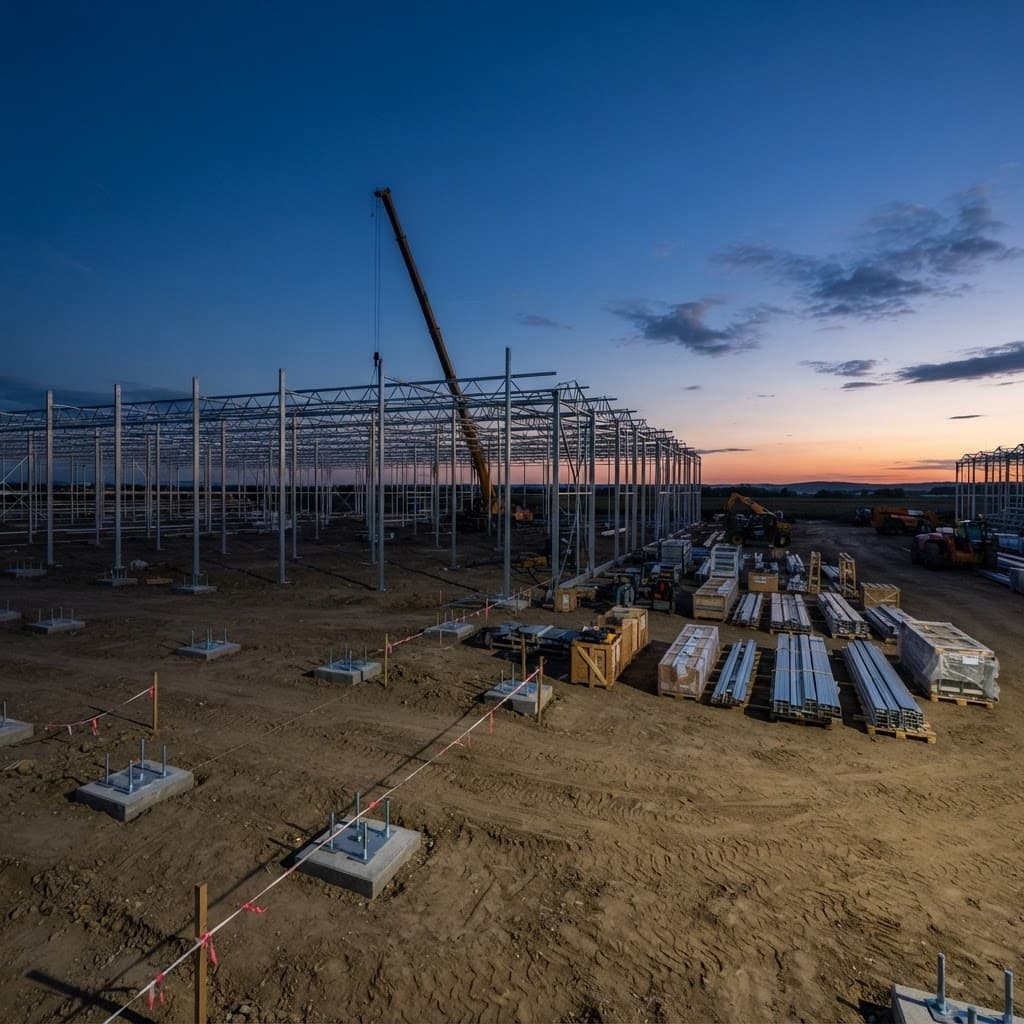
Commercial greenhouse construction site at dusk with concrete foundation pads, steel columns being erected and pallets of glazing bars

Start with the market, not the greenhouse

The most expensive mistake in greenhouse development is selecting a structure before establishing who buys the output. Every subsequent decision — glazing, climate strategy, crop, scale — follows from the market window you intend to serve. Projects that begin with a supplier catalogue rather than a buyer conversation tend to build the wrong facility competently.

Step 1: Assess the site honestly

Site conditions set hard limits that cannot be engineered away cheaply. Water quality in particular determines both the treatment budget and, for sensitive crops, whether the site is viable at all. Commission a full water analysis before committing to land.

  • Water source volume, pH, alkalinity, sodium and chloride
  • Measured local climate data, not regional averages
  • Grid capacity and gas or fuel availability
  • Snow, wind and seismic loading per local code
  • Road access for construction and outbound logistics
  • Labour availability within commuting distance

Step 2: Build the feasibility model before the design

A feasibility model tests whether the project can work before capital is committed to a specific configuration. It should be built on hourly climate data so energy demand is modelled rather than assumed, and it should include the sensitivity cases that will determine whether lenders participate.

  • Yield and revenue projection by month, not annually
  • Hourly energy model calibrated to local weather data
  • Labour requirement including harvest peaks
  • Sensitivity on energy price, yield shortfall and price realisation
  • Working capital through the establishment period

Step 3: Write a performance specification

The specification is the document that converts intent into an enforceable requirement. It should state what the facility must achieve, with measurable acceptance criteria, rather than listing components. This is what makes supplier offers comparable and warranties meaningful.

Step 4: Tender to a qualified shortlist

Qualify suppliers before pricing them. Three to five bidders with reference projects in a comparable climate is the practical range. Once offers arrive, level them by pricing every exclusion and deviation so all bids describe the same facility. Levelling frequently reverses the apparent ranking.

Step 5: Supervise construction against the specification

Construction supervision exists to verify that what was specified is what gets built. Structural tolerances, screen installation and irrigation uniformity are the items where deviations are cheap to fix during installation and expensive afterwards. Tie payment milestones to inspected verification rather than to dates.

Step 6: Plan the first crop cycle before handover

A commissioned greenhouse is not a producing greenhouse. Climate set points, irrigation recipes, crop registration routines and operator training should be planned before the structure is finished. Facilities that underperform in year one usually do so because operational capability was planned late, not because the engineering was wrong.

Realistic timeline

For a first commercial facility of five to ten hectares, eighteen to thirty months from decision to first harvest is normal. Compressing the planning phase rarely accelerates the project; it usually moves the delay into construction or into a disappointing first crop.

Typical development timeline for a 5 – 10 hectare first facility
PhaseDurationKey output
Market and site assessment1 – 3 monthsGo / no-go on site and crop
Feasibility and financial model2 – 3 monthsFinanceable business case
Specification and design2 – 4 monthsPerformance specification
Tender and contracting2 – 3 monthsLevelled bids, signed contract
Manufacturing and delivery4 – 8 monthsMaterials on site
Construction and commissioning5 – 9 monthsVerified handover
First crop cycle3 – 10 monthsProduction to model

About the author

Aegis Project Engineering

Structural and climate engineering desk

The engineering desk writes the technical specifications behind Aegis projects, covering structures, glazing, climate systems and irrigation. The team reviews supplier designs against local load codes and measured site climate data rather than reference-project assumptions.

  • Structural specification
  • Climate strategy
  • Glazing selection
  • Irrigation design

FAQ

Frequently asked questions

How long does it take to build a commercial greenhouse farm?

Eighteen to thirty months from investment decision to first harvest for a five to ten hectare first facility. Construction itself is often only five to nine months; the planning, tender and manufacturing lead times account for most of the schedule.

What is the most common reason greenhouse projects fail?

Underestimated operational capability. The structure is usually adequate. What is missing is a trained growing team, monitoring routines and a post-harvest chain, because those were treated as post-construction concerns rather than as part of the project.

Should a first project start small and expand?

Often yes, provided the first phase is large enough to be commercially meaningful and the infrastructure is sized for the eventual footprint. Building a first phase that cannot be expanded without replacing the head station is a false economy.

Do we need a consultant if we buy turnkey?

Turnkey concentrates delivery accountability with one supplier, but the supplier still writes the scope. Independent specification and supervision is what verifies that the turnkey scope matches what the business case assumed.

Start Your Greenhouse Project With Aegis

Send us your location, available area and target crop. You will receive a structured first assessment with technology direction and an indicative investment range.