Blog / 11 min read
Greenhouse Spare Parts List Before Handover: What Should Owners Hold On Site?
Use a risk-ranked greenhouse handover spare parts list to decide which irrigation, climate, heating, screen and control components should be held on site.
Published /Updated
Aegis supports commercial greenhouse owners with consulting, planning, technology-selection support, supplier coordination and project-management assistance. This guidance helps owners structure handover decisions; it does not replace OEM instructions, qualified servicing or site-specific engineering verification.
Decision support
Compare by outage consequence
Prioritize a spare when its failure can interrupt irrigation, ventilation, heating, screens or controls before a safe fallback can be used. Review the operational consequence after 2, 12 and 48 hours as planning prompts, not universal crop-tolerance limits.
Judge whether on-site stock is justified
On-site stock is most defensible when supplier-confirmed lead time exceeds the site’s exposure window, no duty-standby arrangement exists, and qualified local support cannot restore the function quickly.
Prepare the facts needed for validation
Bring the as-built BOM, OEM part numbers, panel drawings, voltage and signal details, firmware records, warranty terms, storage instructions and written supplier lead-time commitments to the review.
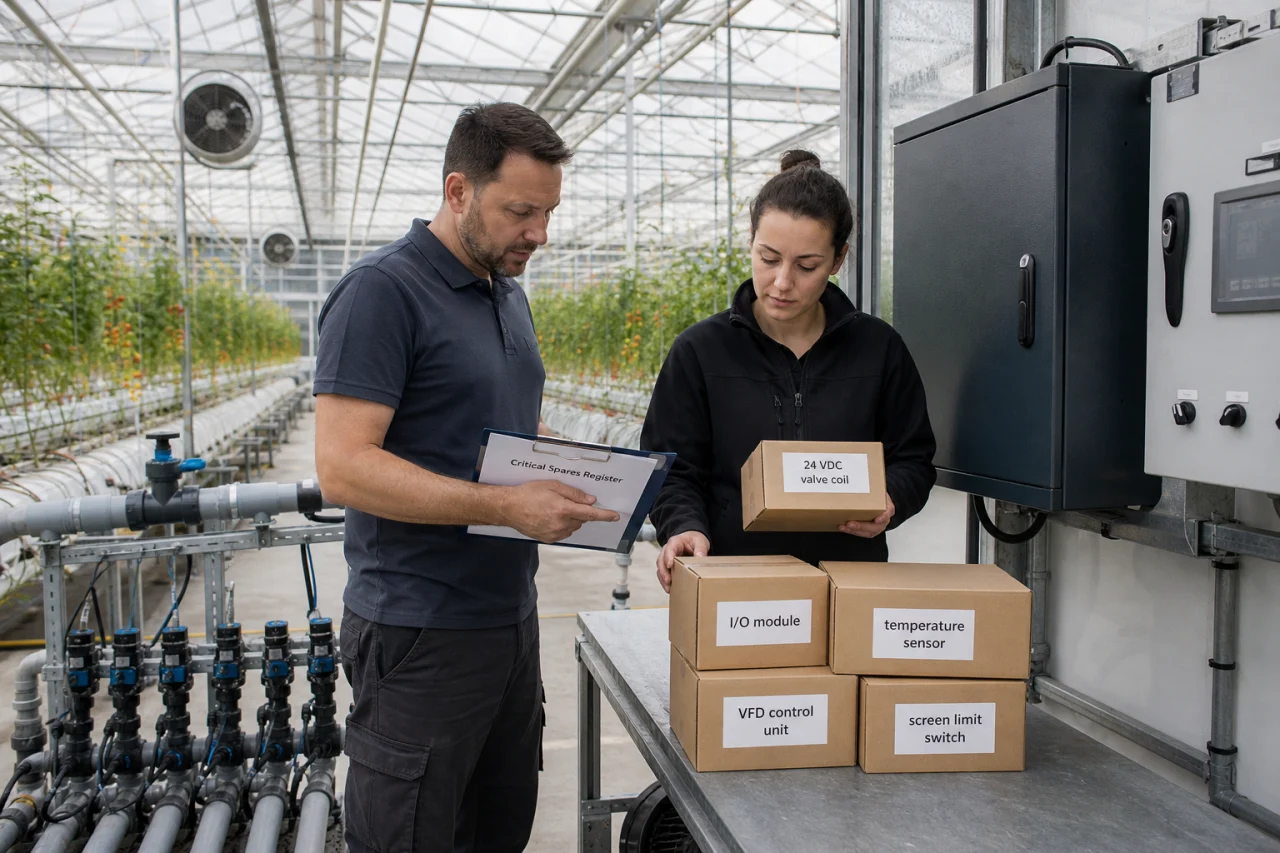
The Owner Rule: Stock Recovery Capacity, Not a Generic Parts Catalogue
A greenhouse handover spare parts list should protect the owner’s ability to recover a crop-critical function, not simply accept the supplier’s standard parts package. Approve on-site stock when a component’s failure could interrupt irrigation, ventilation, heating, screens or controls before a safe fallback and replacement route can restore operation. A 24 VDC control component serving an irrigation valve circuit may merit a very different decision from a low-consequence gutter fastener, even if both appear on the same supplier list.
Planning guidance: there is no universal commercial greenhouse spare-parts list. Final selections, part quantities, compatibility and safe handling requirements must be verified against the as-built bill of materials, panel drawings, OEM part numbers, warranty terms, supplier support arrangements and applicable local requirements. The installed-system record—not a generic catalogue—is the owner’s source of truth. For the decision framework behind this point, review greenhouse buying guide for supplier accountability.
The practical question is not “Which parts are normally supplied?” It is: if this exact component fails during the current crop and operating season, what stops, how quickly can a safe fallback be used, and can the confirmed supply path recover the function in time? That framing prevents two costly errors: buying dormant inventory that adds little resilience, and discovering after handover that one unavailable, configuration-specific part has become the weakest point in the operating system. The crop-specific production context is covered in high-wire tomato greenhouse operations.
Why Handover Stock Is Different From Routine Maintenance Inventory
At handover, the owner—not the project team—must manage the consequence of a failed variable-frequency drive (VFD), 24 VDC irrigation-valve coil or climate-control sensor. That is different from routine maintenance because operating history is limited, the first crop may already depend on the system, and the practical route through warranty or local service may not yet have been tested. For the decision framework behind this point, review greenhouse water quality requirements.
- Installed spare quantity: Components supplied as part of the installed system, such as a spare sensor supplied with a Priva or HortiMaX control package. Confirm whether it is physically present, identified by OEM part number and covered by the handover inventory.
- Handover resilience stock: A compatible part held to restore a crop-critical function when no tested fallback exists. A controller I/O module may justify immediate availability where one failed channel can stop fertigation or ventilation and replacement depends on remote supplier support.
- Planned-maintenance stock: Parts expected to wear or be replaced during scheduled service, such as a 230 VAC actuator motor or HAF fan belt. On-site stock may be unnecessary when an authorized provider has documented local availability and the affected function has safe redundancy.
The distinction prevents two common errors: treating consumables as critical protection, or accepting a standard commercial greenhouse spare parts package that omits the single item needed to recover a control function. Before sign-off, ask who authorizes warranty replacement, who can diagnose the 0-10 V or 4-20 mA interface, and whether the stated service route has been confirmed in writing. A supporting article on this narrower question is commissioning checklist before the first crop.
Assign a named owner for stock location, reorder action and escalation contact from day one. The wider question of SOP ownership, staffing and ramp-up responsibility belongs in the commercial greenhouse operations readiness guide; the handover decision here is narrower: which parts must be available before that operating model has proven itself.
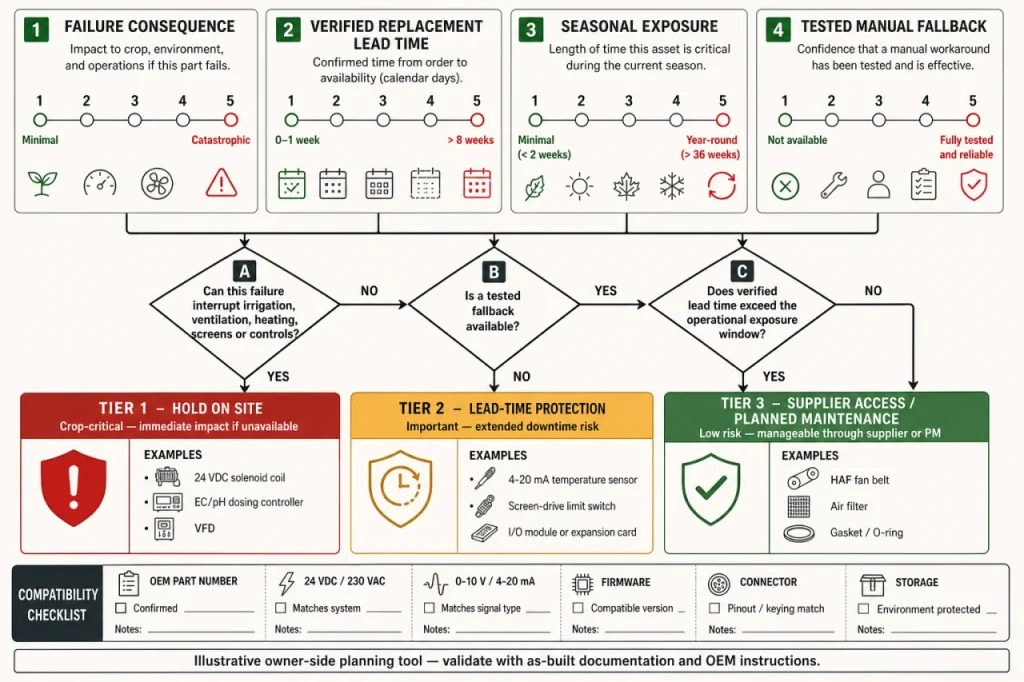
Use a Four-Factor Risk Score Before Approving the Register
If this component fails today, what is the crop and operating consequence before a replacement arrives? Use the four scores below as illustrative owner-side planning guidance, not as an OEM rule or crop-loss model. The purpose is to make a 24 VDC irrigation coil or VFD control unit compete for stock funding on evidence, rather than treating every installed item as equally urgent. When the question moves from research to delivery scope, the next step is owner-side greenhouse handover review.
| Factor | Score 1 | Score 3 | Score 5 | What to verify |
|---|---|---|---|---|
| Failure consequence | Minor inconvenience; no crop-critical function interrupted | Reduced capacity or local operational disruption | Irrigation, ventilation, heating, screen or control function can be interrupted | System drawings, duty-standby arrangement and safe manual operation |
| Verified replacement lead time | Available through a confirmed local route | Supplier-confirmed order and delivery path requires planning | Replacement depends on a long or uncertain OEM supply path | Written part-specific lead time and emergency-support contact |
| Seasonal exposure | Low crop demand or protected operating period | Moderate demand or manageable environmental exposure | High evapotranspiration, severe weather exposure or peak crop load | Crop stage, climate forecast range and irrigation or climate dependence |
| Manual fallback | Tested manual, redundant or duty-standby fallback is available | Fallback exists but needs intervention or reduces capacity | No tested fallback, or safe recovery depends on the failed component | Commissioning evidence, operator capability and qualified-personnel requirements |
A part with a consequence score of 5 and lead-time score of 5 generally deserves more scrutiny than a low-consequence fastener, even if the fastener has the same supplier route. Seasonal exposure changes the answer: water-demand risk varies with crop, climate and management, so an EC/pH dosing-controller component can rank higher during intensive fertigation than during a lower-demand period. A practical planning scenario appears in high-wire tomato facility planning scenario.
Use 2-hour, 12-hour and 48-hour questions to expose the recovery gap: what function is lost, what safe fallback can be activated, and what condition will the crop and facility face if restoration is delayed? These are review prompts, not universal tolerance limits. Before approving any score, ask: is the fallback tested, sufficiently sized, and usable without modifying a 0-10 V or 4-20 mA control interface?
Tier 1: Parts That May Need to Be On Site Before Handover
Tier 1 status is justified when one unavailable component can interrupt irrigation, climate response, heating or screen movement before the site can deploy a tested fallback. These are not universal required spares: priority depends on the installed configuration, crop exposure, redundancy and written supplier support for the exact component.
| Component category | Failure consequence | On-site stock trigger | Validation action |
|---|---|---|---|
| Compatible irrigation-controller I/O module | A failed output can prevent a fertigation zone from opening or receiving control commands. | Hold where no independent controller or manual valve procedure can maintain the affected zone. | Match the as-built panel drawing, OEM part number, firmware revision, 24 VDC supply requirement and connector type. |
| EC/pH dosing-controller component | Loss of measurement or control can disrupt nutrient-recipe management in continuous fertigation. | Consider for high-wire tomato or cucumber systems with no validated manual dosing fallback. | Confirm the installed EC/pH controller model, probe interface, 0-10 V or 4-20 mA signal requirement, and OEM-approved replacement part. |
| 24 VDC irrigation solenoid coil | A coil failure can leave one irrigation valve unable to open or close as commanded. | Hold where the valve serves a crop-critical zone and the same coil specification is not locally available. | Verify 24 VDC rather than 230 VAC, valve-series compatibility, connector style and coil power rating against the as-built bill of materials. |
| VFD control unit | A variable-frequency drive fault can stop a ventilation fan, circulation pump or other speed-controlled duty. | Consider a complete, compatible unit where there is no duty-standby equipment and recovery depends on an unverified supply path. | Confirm VFD model, input voltage, motor kW rating, control parameters, communications card and approved commissioning procedure with the OEM or authorized supplier. |
| Priva or HortiMaX-compatible control hardware | A failed module can remove control or monitoring of multiple connected climate functions. | Hold only when the installed climate computer has no configured redundant path and the supplier cannot confirm rapid replacement. | Reconcile the module code, software or firmware version, I/O allocation and bus connector with the installed Priva or HortiMaX configuration. |
| Temperature or humidity sensor | An incorrect or lost signal can distort ventilation, heating or dehumidification decisions. | Prioritize where one sensor is a single point of control and no cross-check sensor is commissioned. | Verify sensing range, signal output, mounting arrangement and required calibration or configuration method before accepting stock. |
| Screen-drive limit-switch component | A failed limit switch can prevent a thermal or shade screen from reaching a safe position. | Hold where screen position is important during cold, high-radiation or high-humidity periods and manual operation is not practical. | Match actuator model, switch type, travel arrangement, electrical rating and safety-circuit interface to the installed screen drive. |
| Specified heating-control component | A control failure can prevent boiler, valve or circulation-pump response during cold-weather exposure. | Consider on-site stock when heating has no independent duty-standby control route and a fault could persist through an overnight low-temperature period. | Confirm the OEM part number, 230 VAC or 24 VDC rating, boiler-control compatibility and qualified-service requirement. |
A generic substitute is often false resilience. A module that physically fits but has the wrong firmware, a 230 VAC coil supplied for a 24 VDC circuit, or a sensor with the wrong 4-20 mA interface can extend downtime rather than reduce it. Before accepting any Tier 1 item, the owner should require a match between the physical spare, the as-built BOM and panel drawings, then obtain OEM or authorized-supplier confirmation for the installed system.
Complete assemblies usually cost more than subcomponents, but they can reduce diagnosis time when the operations team has limited controls capability. The cheaper subcomponent route fits only where qualified personnel, correct tools and a tested replacement procedure are available; work on electrical panels, VFDs, heating equipment and pressurized systems requires qualified personnel and applicable safety procedures.
Tier 2 and Tier 3: Protect Against Lead Time Without Overbuying
Holding every replacement part ties up capital, creates storage and obsolescence exposure, and can distract from the few failures that truly threaten operation. A component can remain outside immediate on-site stock when a written supplier commitment, authorized local distributor, or documented duty-standby arrangement restores the function within the site’s acceptable operating window.
| Stock policy | Representative components | When it fits | What to verify before handover |
|---|---|---|---|
| Tier 2: Lead-time protection | HAF fan belts, 230 VAC actuator motors, fogging nozzles, screen cables | The item has a meaningful replacement exposure, but a partial fallback, reduced-capacity operation, or local support path exists. A 230 VAC actuator motor may warrant controlled stock where roof ventilation cannot be manually managed during warm weather. | Written part-specific availability, correct motor torque and travel limit configuration, connector type, and whether a manual override can operate the affected vent or screen. |
| Tier 3: Supplier-access or planned-maintenance stock | Pad-and-fan pump seals, selected gutter fasteners, non-critical fogging nozzles | A duty-standby pump, local seal kit availability, or planned shutdown can contain the consequence. Gutter fasteners are normally Tier 3 unless a structural engineer identifies a site-specific wind or load concern. | Duty-standby test records, authorized distributor contact route, documented service response, and a defined reorder process after planned maintenance. |
The trade-off is simple: Tier 2 inventory buys time against a credible supply interruption; Tier 3 relies on a recovery path that must be evidenced, not assumed. For example, a pad-and-fan pump seal can be Tier 3 only if the standby pump is commissioned and available, not merely shown on a schematic. Likewise, a claimed 24–48 hour response is useful only when the contract identifies the authorized service route, coverage area, and applicable component family.
Before accepting a lower stock tier, ask whether the supplier’s availability statement applies to the exact OEM part number and whether the operator can safely maintain reduced operation until it arrives. This distinction is especially relevant in a multi-span greenhouse, where one actuator, fan bank, or screen cable may affect a larger climate zone than its purchase price suggests.
Validate your handover spares before responsibility transfers
Aegis can support an owner-side review that reconciles critical spares with commissioning evidence, installed-system documentation, supplier support routes, warranty interfaces and operating-readiness responsibilities.