Blog / 5 min read
How Much Greenhouse Contingency Should Investors Allow Before Supplier Quotes Are Final?
Learn how to split greenhouse contingency into unresolved scope, escalation, owner changes, site remediation, and risk transfer before supplier quotes are final.
Published /Updated
Budget and procurement planning for commercial greenhouse investors.
Decision support
Split the allowance by risk type
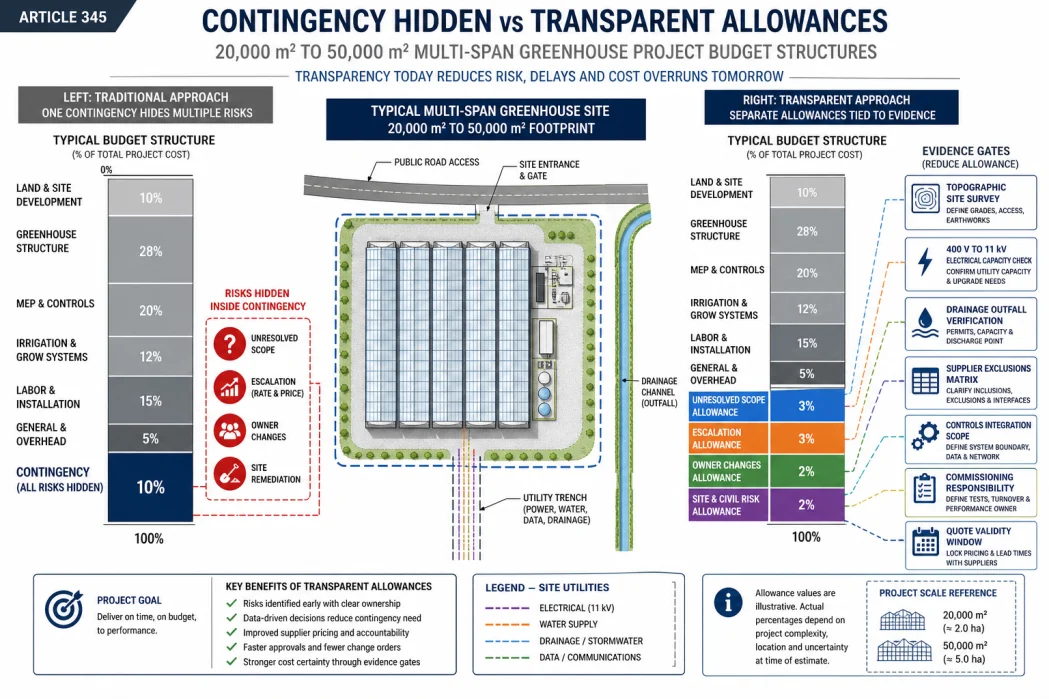
Separate unresolved scope, escalation, owner changes, and site remediation so one budget line does not hide four different risks.
Check what evidence is missing
Site survey, utility data, drainage conditions, and supplier exclusions usually do more to reduce contingency than adding a larger blanket reserve.
Decide whether the quote is finance-ready
If the scope matrix is incomplete or procurement is moving faster than validation, the budget is not ready for final approval yet.
Decision worksheet
Before you lock a greenhouse construction contingency into the budget, decide whether you are carrying one risk or four: unresolved scope, escalation timing, owner-driven changes, and site risk. A split allowance is better when those drivers are still moving; a single blended reserve is only defensible when the scope matrix, procurement timing, and site inputs are already stable enough to support final approval.
| Budget question | Better treatment | Decision test |
|---|---|---|
| Is scope still incomplete? | Keep a separate line for exclusions, interfaces, and unpriced work | If the supplier has not priced utility tie-ins, controls interfaces, or commissioning, that gap belongs outside the base quote |
| Is the market window moving? | Track escalation as its own allowance | If quote validity is shorter than your approval cycle, escalation risk needs visible control rather than a hidden cushion |
| Are owner decisions still open? | Freeze crop, technology, and phasing before release | If the design may still change, contingency will leak into rework instead of protecting the budget |
| Is the site package weak? | Hold a higher allowance until survey, drainage, and utility data are verified | If civil assumptions are provisional, site risk can dominate the budget even when equipment pricing looks firm |
- Blanket reserve vs split reserve: A single percentage is easy to approve, but it hides whether the problem is missing scope, time-based inflation, or site uncertainty. Split reserves take longer to set up, yet they make change control and finance review much clearer.
- Scope matrix: Check whether utility tie-ins, civil interfaces, controls, commissioning, and exclusions are written down. Missing scope belongs in the contingency bucket; known scope belongs in the base quote.
- Escalation timing: Compare quote validity, lead times, and tender timing. If the market window is the main issue, keep escalation separate so you can revise it without reopening the whole budget.
- Site evidence: Verify survey, drainage, and utility information before treating the quote as finance-ready. If the land package is weak, the allowance should stay higher until the gaps close.
For broader cost context, keep the commercial greenhouse cost framework in view while you normalize the budget inputs; for approval-stage assumptions and sensitivity testing, the greenhouse project budget framework is the better follow-up once the allowance is split. If you need a finance-stage check on downside exposure, the greenhouse investment guide helps frame the next decision.
FAQ
Frequently asked questions
What contingency should be carried before supplier quotes are final?+
Carry separate allowances for unresolved scopeescalation, and site risk before final quotes, rather than one blended buffer. If the scope matrix and exclusions are incomplete, the contingency is still covering information gaps, not just price movement. For the relevant greenhouse platform, see multi-span greenhouse scope and interface decisions.
Should escalation be part of contingency or a separate allowance?+
Escalation is usually better tracked as a separate escalation allowance when quote validity, lead times, or tender timing could move the budget. That keeps change control clear and stops market movement from being mistaken for design growth.
What evidence reduces greenhouse contingency most effectively?+
A current site survey, verified utility data, and a supplier scope matrix reduce the biggest pre-quote uncertainties most effectively. They each reduce a different risk bucket: ground conditions, utility tie-ins, and exclusions, so the allowance can shrink for the right reason instead of from guesswork.
When is a higher contingency justified?+
A higher contingency is justified when site data is weak scope evolution is still active, or fast-tracked procurement leaves little time to verify exclusions. In those cases, the reserve is protecting approval quality, not padding the budget.
When is greenhouse construction contingency the right fit for a greenhouse?+
Greenhouse construction contingency is the right fit before quotes are final when the project still has unfinished scope, open owner decisions, or unverified site conditions. Once those items are verified, the allowance should usually shrink or move into specific line items instead of staying as a broad contingency.
Before finance approval, verify the risk register
If your greenhouse budget is still moving, Aegis can review the assumptions, separate scope risk from escalation, and flag the items that should be verified before tender release.