Blog / 7 min read
What Should Be Included in a Greenhouse Supplier Commissioning Scope?
Use this checklist to define a greenhouse supplier commissioning scope with evidence, interface ownership, acceptance testing, and defect closeout requirements.
Published /Updated
Commercial greenhouse consulting for scope review, supplier coordination, handover planning, and commissioning acceptance support.
Decision support
Check the handover boundary
Confirm which deliverables belong to the supplier, which belong to the owner, and which require a named interface owner before acceptance.
Validate the evidence package
Use test records, as-builts, OEM manuals, and defect logs to decide whether commissioning is actually complete.
Close defects by rule, not memory
Require one owner, one deadline, and one closure standard for every unresolved item so handover does not drift into operations.

Introduction
A greenhouse supplier commissioning scope should answer four contract questions: what the supplier must hand over, what evidence proves it, who owns each interface, and how open defects are closed. That is the right frame for a new-build commercial greenhouse with climate controls, irrigation or fertigation, and utility interfaces, because handover should be measurable, not a verbal promise.
The answer changes with integration depth. A stand-alone equipment delivery can sometimes be accepted with a lighter handover note, but once the climate computer, irrigation controller, and utility meter must work together, the scope needs named deliverables, test records, and a defect pathway with dates and owners. In that scenario, conditional acceptance only makes sense when the open items are bounded enough that a procurement manager can see what still blocks sign-off. See high-wire tomato greenhouse project scenario for a scenario-level view of the decision.
There is also a difference between contract acceptance and operational readiness. Contract acceptance asks whether the supplier met the agreed scope; operational readiness asks whether the owner can start production safely with the current team, procedures, and spares. This article stays on the contract side of that line, while broader startup planning belongs in the commercial greenhouse operations readiness guide.
For a reference baseline, think of a 20,000-30,000 m2 commercial greenhouse with a climate computer, irrigation/fertigation, utility interfaces, and alarm and sensor commissioning. That framing matters because a high-wire tomato programme in a mid-size house usually carries more controls and utility-interface risk than a simple structure package, so the acceptance record needs to be more explicit. Buyers who want the contractual buying context can cross-check the greenhouse buying guide before signature.
Decision worksheet
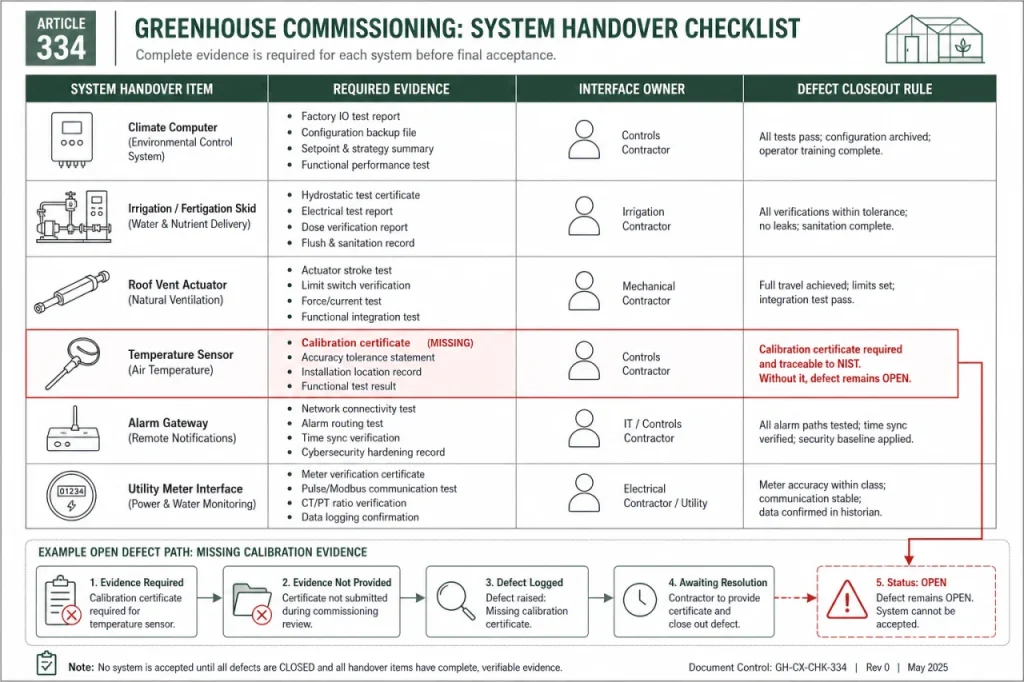
Use this worksheet to decide whether the greenhouse supplier commissioning scope is contract-ready or only operationally hopeful. A scope is fit for signature when it separates contract acceptance from startup support: the supplier names each handover item, attaches evidence to each item, assigns one interface owner, and defines how unresolved defects will close. If those four lines cannot be checked, ask for revision before sign-off. For broader buyer-side wording, cross-check the acceptance language in the greenhouse buying guide.
| Check | Contract-ready condition | What it avoids |
|---|---|---|
| Deliverables | Each system handover item is listed explicitly, with no reliance on “commissioning included.” | Scope gaps that shift equipment start-up into an acceptance dispute. |
| Evidence | Test records, as-builts, OEM manuals, and a defect log are tied to the relevant system. | Verbal acceptance with no auditable trail. |
| Interface owner | One named party owns utility, controls, and supplier-to-owner handoff points. | Shared responsibility that delays closure by 1-2 weeks or longer (Reference Baseline). |
| Defect closure | One owner, one deadline, and one evidence standard are defined for every unresolved defect. | Open items drifting into operations as “known issues.” |
Conditional acceptance can be reasonable when the only gaps are low-risk, non-critical items with a dated closeout plan; it is a poor choice when the gap affects utilities, controls logic, or a pass/fail test. For example, a missed sensor calibration or alarm check on a climate computer is a validation problem, not a paperwork issue, because it can change the response of the whole greenhouse system. Any item that depends on utilities or handover conditions should be checked against commercial greenhouse utility planning before final sign-off.
If you are deciding between accepting the scope now or holding signature until evidence is complete, use the worksheet above and then verify the missing artifacts against the commissioning evidence package the FAQ describes. If you are still separating commissioning deliverables from startup support, keep this worksheet beside your contract mark-up and verify the scope before handover. When the question moves from research into delivery scope, see greenhouse consulting.
Review the commissioning scope before handover
If the supplier scope still leaves evidence, interfaces, or defect closure unclear, request a commissioning evidence register review before contract signature or handover. For a mid-size commercial greenhouse handover, that review should be tied to the actual system list, not a generic greenhouse commissioning checklist.
Send the draft scope, the acceptance test list, and the unresolved defect log, and ask for a line-by-line check against deliverables, interface owners, and closure criteria. If you also want the handover boundary mapped against startup readiness, pair it with the commercial greenhouse operations readiness guide.
FAQ
Frequently asked questions
What is the minimum evidence package for greenhouse commissioning?+
The minimum evidence package is test records, as-builts, OEM manuals, the defect log, and the contract acceptance criteria that define pass or fail. For a 20,000-30,000 m2 commercial greenhouse with climate controls, irrigation or fertigation, and utility interfaces, missing any one of those items usually turns acceptance into conditional sign-off rather than full closeout. That matters because the buyer then has proof of what was delivered, not just a statement that the system ran. WBDG commissioning guidance treats documentation and unresolved issues as closeout items, not optional extras. A more focused explanation of this sub-question appears in handover spare-parts list.
Who should own unresolved commissioning defects?+
The party responsible for the cause should own the fix: the supplier for scope-caused defects, the owner for owner-caused changes, and a named interface owner for cross-boundary items. That structure is better than a shared queue because each issue then has one owner, one deadline, and one closure record; without it, defects drift into operations and become harder to separate from routine start-up noise. If two parties disagree on cause, the scope should require temporary containment plus a written decision, not an open-ended discussion.
How does controls commissioning differ?+
Controls commissioning differs because it verifies the control sequence, not just the equipment. The acceptance check should cover logic, alarms, sensor calibration, setpoint response, and live integration between the climate computer, sensor network, and actuator response. In a reference-baseline project, a 1°C sensor offset or a delayed alarm can change the acceptance result, so isolated power-up checks are not enough; the evidence has to show the system responded correctly under the intended operating sequence. Penn State Extension’s greenhouse environmental control guidance supports that system-level verification approach.
What if the scope is still unclear?+
If the scope is still unclear, do not treat silence as supplier responsibility. Pause signature, mark the missing deliverables as open assumptions, and separate them into four buckets: deliverables, interface ownership, acceptance evidence, and defect closeout language. If the project is already too far along to rewrite the whole scope, use a written evidence register and a named owner for each unresolved item so the handover boundary is explicit and any later change-order claim starts from a clear record.
Review the commissioning scope now
Before contract signature or handover, verify that supplier deliverables, acceptance evidence, interface owners, and defect closeout rules are written into the commissioning scope.