Blog / 7 min read
Greenhouse Thermal Screen or Double Film: Which Is Better for Cold Nights?
Compare greenhouse thermal screen vs double film for cold nights. Learn when continuous envelope insulation is enough, when a night screen is worth the added complexity, and what to verify before choosing.
By Aegis Greenhouse Systems consulting desk
Published /Updated
Consultative greenhouse planning support for comparing cold-night heat-loss strategies, coordinating supplier inputs, and framing site-specific decisions.
Decision support
Compare the operating case
Check whether your cold-night profile needs continuous envelope insulation, night-only insulation or a hybrid approach with a thermal screen and film.
Validate the project inputs
Confirm design temperature, fuel cost sensitivity, humidity tolerance and maintenance capacity before you lock the thermal strategy.
Frame the scope correctly
Use the right scope: comparison guidance for the decision, procurement questions for the screen package, or a project scenario when site conditions are driving the choice.
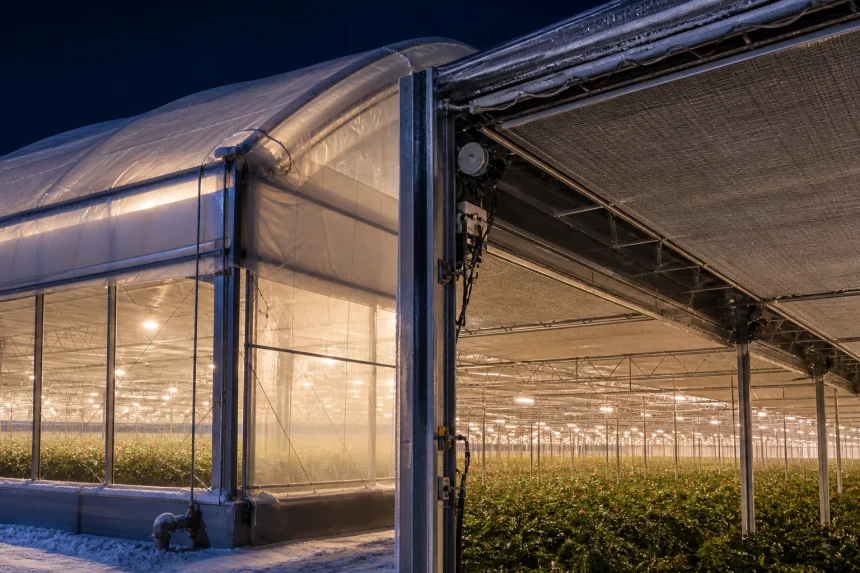
Decision worksheet
If you are choosing between greenhouse thermal screen vs double film for cold nights, use this section to sort the choice by operating need, not by insulation slogans. Double-layer inflatable film improves the envelope all day and all night; a woven thermal screen changes the heat-loss boundary only when it is closed, usually for about 8 to 14 night hours in a cold-season schedule. That makes the better option depend on whether your heat-loss problem is continuous, whether the crop can tolerate night-only deployment, and how much mechanical complexity your team can support.
For planning context, the timing and temperature values here are reference scenarios, not universal thresholds. Guidance from Michigan State University Extension and Penn State Extension points to the same decision rule: envelope heat loss, air leakage and operating strategy have to be evaluated together, because a good covering choice can still underperform if the greenhouse leaks air or the control logic is weak.
| Decision factor | Double film tends to fit better when | Thermal screen tends to fit better when | What to verify next |
|---|---|---|---|
| Cold-night pattern | The site sees repeated low temperatures near the local winter minimum and needs continuous envelope improvement, not only night deployment. | The main heat-loss penalty comes after sunset, and a controllable layer for a typical 10 to 12 hour dark period can address most of the problem. | Check local design temperature, production-season night length and the crop-zone heating setpoint you plan to hold, often in the 16 to 20 C range for planning. |
| Operating simplicity | You want fewer moving parts, with an inflation blower, cavity pressure and perimeter sealing to manage instead of a screen drive system. | Your team already runs a climate computer such as Priva or Hoogendoorn and can manage open-close logic, setback timing and alarms. | Confirm who will maintain motors, gearboxes, cables, end stops and control integration over a 12 month operating cycle. |
| Humidity tolerance | The crop is sensitive to condensation risk and you want to avoid adding a layer that can trap moist air near the canopy at night. | You can coordinate screen deployment with ventilation, horizontal air movement and moisture control, especially during long, cold nights. | Review night ventilation strategy, air movement pattern and where condensation is most likely to form on 2-layer film or screen surfaces. |
| Budget and scope | You need the simpler scope at the envelope level, with less dependence on automation and fewer commissioning steps. | The project can justify the added mechanism because the screen supports crop scheduling or fuel savings more effectively than envelope-only changes. | Compare installed scope, spare-parts responsibility and who owns commissioning, testing and operator training. |
In practice, double film is the safer default when the team wants a lower-complexity envelope upgrade and cannot support another moving system. A thermal screen is the stronger choice when night insulation is the real need, the crop programme rewards flexible deployment, and the project can absorb the extra control and maintenance burden. For the relevant greenhouse platform, see multi-span greenhouse.
If the choice is still unclear, compare the broader system path in the greenhouse technology comparison, then test the screen-specific procurement scope in a commercial greenhouse energy screen specification. For a cold-night execution example, the high-altitude vegetable greenhouse project shows why colder sites usually demand tighter temperature and control assumptions than mild-climate projects.
Before you choose the thermal strategy
If your team is still deciding between greenhouse thermal screen vs double film, the next step is to sanity-check the site inputs that actually move the answer: local design temperature, production months, heating fuel assumptions and crop programme. Those four inputs tell you whether you need continuous envelope insulation, a night-only thermal layer, or a hybrid approach.
If you want help pressure-testing that choice, review the project inputs with a greenhouse planner before you lock the specification, especially if the coldest months, humidity tolerance or operating schedule are changing the scope.
FAQ
Frequently asked questions
Is a thermal screen always better than double film for cold nights?+
No. A thermal screen is the better fit when you need a night-only insulation layer and can support screen drives, climate control and moisture management; double-layer inflatable film is better when continuous envelope insulation and simpler operation matter more. If cold nights are frequent and the crop needs tighter nighttime control, the screen usually gives you more operating leverage. If the cold period is shorter or the team wants fewer moving parts, double film is often the safer operating choice. For the crop-side implications, see tomato greenhouse.
Does double film reduce heating cost enough to skip a thermal screen?+
Sometimes, but only when the heating season is modest, the night load is not severe and the project can accept a simpler system. It is less likely to be enough when fuel exposure is high, the cold season is long or the design temperature pushes nighttime losses hard enough that envelope-only insulation still leaves too much heat demand. The practical check is whether double film covers the coldest operating hours on its own, or whether a thermal screen still earns its keep in the highest-loss nights. When the question moves from research into delivery scope, see greenhouse consulting.
What is the main risk of choosing a thermal screen?+
The main risk is condensation and humidity build-up after closure. A woven energy screen can trap warmer, wetter air below the fabric, so the climate computer, vent timing and horizontal airflow management have to work together. If they do not, the screen can reduce heat loss while increasing moisture on crop surfaces, trusses and gutter lines.
What should we verify before selecting the thermal strategy?+
Verify local design temperature, production months, heating fuel exposure and crop programme first. Those inputs tell you whether the site needs continuous envelope insulation, a night-only layer or a combined strategy. For the broader comparison framework, review the greenhouse technology comparison; if your team is moving toward a screen package, check the commercial greenhouse energy screen specification; and for a cold-night operating example, see the high-altitude vegetable greenhouse project.
Should buyers compare them as alternatives?+
Yes. Compare them first as alternative ways to reduce night heat loss, then check whether a hybrid approach makes more sense for your structure, crop and operating team. Double film is usually the cleaner answer when simplicity and always-on insulation matter more; a thermal screen is usually stronger when the project can absorb added controls and maintenance in exchange for more nighttime flexibility.
If you are still deciding, Aegis can help you review the site inputs that matter most: design temperature, production months, fuel assumptions and crop programme.
Validate the thermal strategy before you commit
Review your local design temperatures, production months, heating fuel assumptions, humidity tolerance, and crop programme before choosing between double film, a thermal screen, or a combined approach.