Blog / 30 min read
Greenhouse Dehumidification vs Ventilation: A Project Decision Guide
Learn when ventilation and heating may be sufficient, when active greenhouse dehumidification deserves evaluation, and which project inputs guide system selection.
Published /Updated
Project definition and delivery control desk
Decision support
Best for
Best for readers using this blog article to frame the next greenhouse decision.
Intent
Use this article to clarify the main greenhouse decision behind the topic and identify the next useful page.
Next step
After reading, continue into Request a Project Assessment if you need a deeper guide or a project-specific next move.
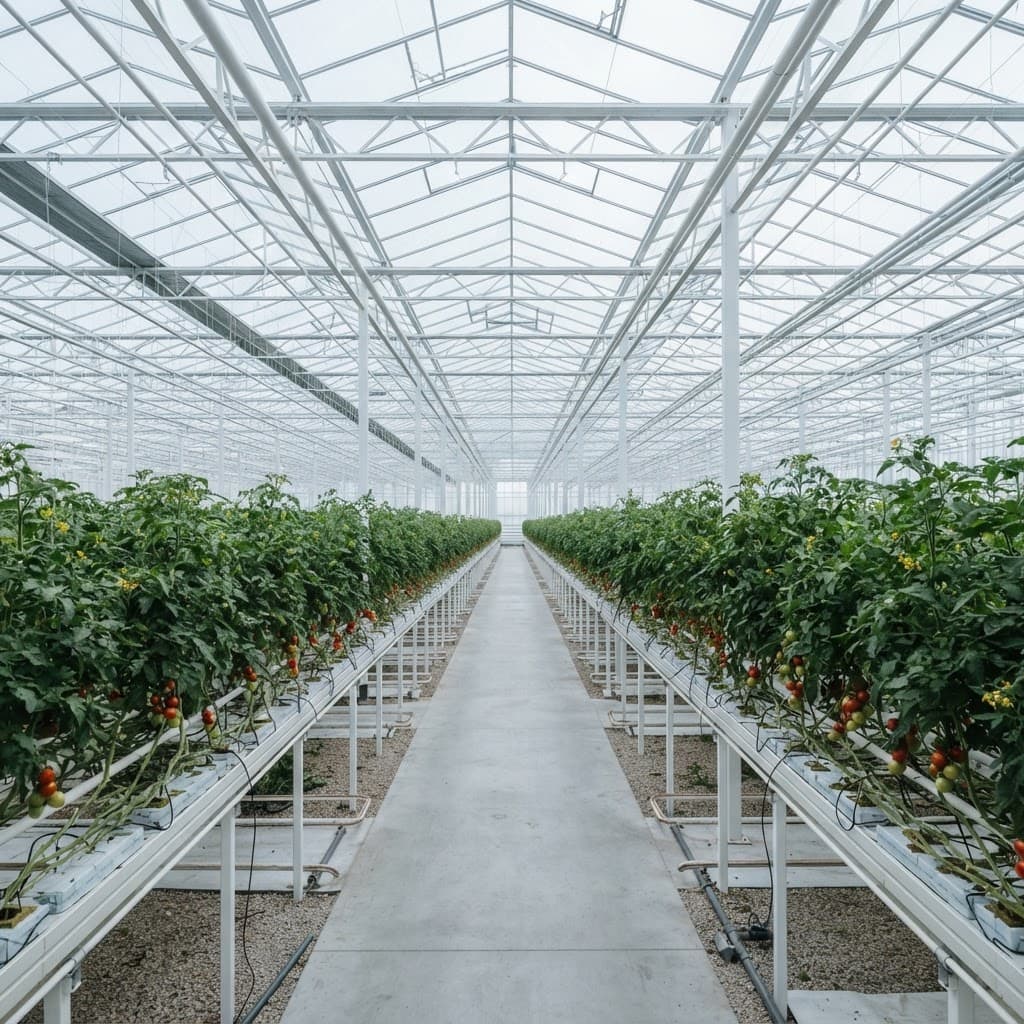
When Does a Commercial Greenhouse Need Active Dehumidification?
Short answer: Ventilation is often the first greenhouse humidity-control mechanism because it can exchange moist greenhouse air with outdoor air. University of Connecticut Extension guidance supports the operating principle that heating, ventilation, air circulation, wet-surface management, relative humidity, vapor pressure deficit, and condensation risk all affect greenhouse humidity management. UMass Extension guidance explains that natural ventilation depends on wind, buoyancy, vent arrangement, greenhouse design, and weather.
Professional judgment for project screening: active greenhouse dehumidification deserves evaluation when outdoor air is too cold or too moisture-laden for useful exchange, heat-and-vent operation creates material heating losses, thermal screens restrict air exchange, the greenhouse has limited uncontrolled leakage, crop moisture load is high, or the project requires tighter climate uniformity. These conditions justify evaluation; they do not prove that a particular dehumidification system is required.
The decision is project-specific. Crop type, canopy density, production schedule, outdoor climate, greenhouse structure, glazing, screen strategy, heating system, ventilation configuration, controls, maintenance capacity, and retrofit constraints all affect whether natural ventilation, heat-and-vent operation, mechanically controlled air movement, internal active moisture removal, or a combination should be assessed. These considerations should be evaluated as part of a complete greenhouse technology comparison, not as a standalone equipment choice.
The cited extension sources support humidity and ventilation principles; they do not provide a universal equipment selection, moisture-load calculation, or project specification. A preliminary humidity-control discussion should identify which project inputs are still needed before capacity, controls, energy implications, or retrofit feasibility can be evaluated.
Understand the Moisture Problem Before Choosing Equipment
Before comparing ventilation, heating, air distribution, or active greenhouse dehumidification, separate the moisture load from the climate indicators used to monitor it. Greenhouse moisture can come from crop transpiration, irrigation, evaporation from growing media, and wet surfaces such as floors, benches, glazing, and equipment. The University of Connecticut Extension guidance on reducing greenhouse humidity identifies plant transpiration, wet surfaces, condensation, and air circulation as practical humidity-management factors in greenhouse operation.
Wet surfaces and nighttime cooling can turn a manageable moisture load into a condensation problem. As air and greenhouse surfaces cool, the risk changes. If glazing, framing, crop tissue, benches, or other surfaces cool to or below the dew point of the surrounding air, water vapor can condense on those surfaces. That risk is not uniform across the greenhouse: surface temperature, local air movement, glazing or insulation characteristics, canopy density, irrigation timing, and moisture concentration can all vary by zone. A single air-temperature or relative-humidity reading cannot prove that every surface is safe from condensation.
Relative humidity is useful, but it is not the whole moisture picture. Relative humidity expresses how close the air is to saturation at a given air temperature. Because warmer air and cooler air have different saturation capacities, relative humidity can change when temperature changes even if the actual amount of water vapor in the air has not changed. For that reason, RH can help flag operating risk, but it does not by itself define crop stress, total moisture load, equipment capacity, or condensation risk on every surface.
Vapor pressure deficit adds another view of the same climate problem. VPD describes the difference between the saturation vapor pressure at a given temperature and the actual water-vapor pressure in the air. In practical terms, it is often used to understand the drying potential of the air around the crop. RH reports a percentage relative to saturation; VPD reports a vapor-pressure difference. The University of Connecticut Extension discussion of relative humidity and vapor pressure deficit provides background on why these indicators should be interpreted with temperature and crop conditions rather than treated as interchangeable setpoints.
VPD targets vary by crop, growth stage, greenhouse temperature strategy, and production objective, so this article is not prescribing a target range.
For a project assessment, review RH or VPD together with crop type, growth stage, canopy density, irrigation schedule, air temperature, crop temperature where available, relevant surface temperatures, airflow patterns, nighttime operation, thermal-screen strategy, and observed condensation locations. Do not apply a universal RH, VPD, temperature, or condensation-control threshold across crops and greenhouse designs. Operating targets and equipment capacity require project-specific crop and climate data; the supplied guidance does not establish a universal setpoint, moisture-load calculation, or dehumidification sizing method.
Compare the Four Main Greenhouse Moisture-Control Approaches
Commercial greenhouse moisture control usually combines one or more of four approaches: natural ventilation, mechanical heat-and-vent operation, mechanically controlled ventilation or air distribution, and internal active dehumidification. These approaches are related, but they are not interchangeable. Ventilation removes moisture only when greenhouse air is replaced with outdoor air that can accept that moisture under the operating conditions. Heating can change relative humidity by changing air temperature, but heating alone does not remove water vapor from the greenhouse. Air movement can improve mixing and reduce stagnant zones, but circulation alone does not lower the total moisture content of the greenhouse air.
| Approach | Moisture-removal mechanism | Dependence on outdoor conditions | Heating or electrical implications | Climate-uniformity considerations | Control and maintenance requirements | Situations that warrant evaluation | Important limitations |
|---|---|---|---|---|---|---|---|
| Natural ventilation | Moist greenhouse air leaves through roof vents, sidewall vents, or other openings and is replaced by outdoor air. Airflow is driven by wind and buoyancy effects. | High. Natural ventilation depends on weather, wind, buoyancy, vent arrangement, and greenhouse design, as UMass Extension explains. | Vent operation may use little or no fan electricity, depending on the installed vent system. However, exchanging warm greenhouse air with colder outdoor air can increase heating demand. The project impact requires local climate, heating-system, and operating data. | Air exchange may be uneven where wind exposure, vent layout, crop density, thermal screens, or internal obstructions affect airflow paths. | Requires review of vent area, vent placement, actuator condition, control logic, and operating strategy. Maintenance needs depend on the installed vent hardware. | When the greenhouse design supports useful air exchange and outdoor air conditions are suitable for moisture removal without unacceptable temperature or energy consequences. | Weather-dependent. General natural-ventilation guidance does not establish a project-specific moisture-removal rate, climate-uniformity result, or operating cost. |
| Mechanical heat-and-vent operation | Heating is coordinated with ventilation so moisture can leave through air exchange. The ventilation step removes moisture; heating supports temperature and relative-humidity management. | High. Moisture removal still depends on replacing greenhouse air with outdoor air. University of Connecticut Extension discusses heat-and-vent operation for reducing greenhouse humidity. | Can increase heating demand because conditioned greenhouse air is exhausted and replacement outdoor air must be warmed. The magnitude depends on outdoor conditions, heat source, controls, greenhouse leakage, and operating schedule. | Uniformity depends on how heat, exhaust, intake air, and circulation are distributed across compartments and crop zones. | Requires reliable coordination among heaters, vents or exhaust fans, sensors, and controls. Equipment condition and sensor placement should be verified before drawing conclusions. | When outdoor air can carry moisture away and the project can tolerate the heating-energy implications of replacing indoor air. | Heating alone does not remove water vapor. Heat-and-vent operation can be limited by cold weather, humid outdoor air, thermal-screen strategy, energy cost, or uneven airflow. |
| Mechanically controlled ventilation or air distribution | Mechanical ventilation removes moisture by exhausting greenhouse air and bringing in outdoor air. Air-distribution equipment moves air within the greenhouse; it supports mixing but does not remove moisture unless paired with air exchange or another removal process. | High for mechanical ventilation because replacement air comes from outdoors. Lower direct dependence for internal circulation, but circulation alone is not moisture removal. | Fans, actuators, sensors, and controls use electricity. Ventilation can also affect heating demand when outdoor air must be conditioned. Net energy impact requires project-specific assessment. | Air distribution can reduce stagnant areas and improve mixing, but results depend on fan placement, airflow paths, crop canopy, screens, bay geometry, and control integration. Wageningen University & Research considers air distribution and climate uniformity alongside moisture removal and energy demand. | Requires review of fan selection, placement, controls, sensor locations, maintenance access, and integration with heating, vents, screens, and humidity-control logic. | When natural ventilation is insufficiently controllable, when compartments need managed air exchange, or when uneven temperature and humidity patterns suggest an air-distribution review. | Fans do not automatically dehumidify the greenhouse. Without exhaust, outdoor-air exchange, condensation on a controlled surface, or another moisture-removal process, internal circulation mainly redistributes moisture. |
| Internal active dehumidification | Removes water vapor from greenhouse air inside the structure without relying entirely on outdoor-air exchange. Depending on the selected technology and operating conditions, the process may involve condensation and sensible heat effects; some approaches may allow latent heat recovery. | Less directly dependent on outdoor-air exchange than ventilation-based approaches, but feasibility still depends on greenhouse conditions, crop moisture load, envelope leakage, screens, air distribution, and control strategy. | Uses energy, and the heating or cooling effect depends on the selected approach and operating conditions. Wageningen University & Research discusses internal moisture removal, sensible heat loss, latent heat recovery, capacity selection, greenhouse conditions, and energy-cost dependence. | Capacity and air distribution must be evaluated together because moisture removal at one location does not automatically create uniform humidity across the crop. Research comparing greenhouse dehumidification approaches does not establish one universally best solution. | Requires project-specific capacity selection, condensate or moisture-management planning, control integration, service access, and supplier or manufacturer documentation for maintenance and operating requirements. | When outdoor air is too cold or humid for practical ventilation, heating losses are material, thermal screens restrict exchange, the greenhouse is relatively tight, crop moisture load is high, or the project requires tighter climate stability. | Suitability, energy use, maintenance burden, capacity, and economic value cannot be determined from general guidance alone. They require project data and relevant equipment documentation. |
Use this table as the article’s comparison point, not as a universal specification. The cited extension and research sources support operating principles and system interactions, but they do not prove that one approach is always best for every crop, climate, greenhouse design, or energy strategy. Capacity, energy use, control requirements, maintenance intervals, and operating costs should be verified with project data and supplier or manufacturer documentation.
When Can Ventilation and Heating Be Sufficient, and When Do They Reach Their Limits?
Ventilation and heating are often the practical baseline for greenhouse humidity control. They may be sufficient when the greenhouse can exchange moist indoor air for outdoor air during the periods that matter while still maintaining the crop’s required temperature range and reasonably uniform conditions in the production zone. That conclusion should be verified with project conditions rather than assumed from greenhouse size, one relative-humidity reading, or general ventilation guidance.
When natural ventilation may be sufficient
Natural ventilation removes moisture by moving greenhouse air out through vents and bringing outdoor air in. The driving forces are wind and buoyancy from temperature differences, and performance is affected by roof and side vent arrangement, vent area, height differences, greenhouse shape, nearby obstructions, and weather. UMass Extension describes natural ventilation as weather-dependent and influenced by wind, buoyancy, vent arrangement, and greenhouse design.
Natural ventilation may be a reasonable first approach when representative operating conditions show that available vents can provide enough air exchange, outdoor air is suitable for removing moisture, and the crop moisture load does not exceed what the ventilation strategy can practically remove. It is more likely to be workable when wind and buoyancy are adequate during the relevant periods, vent operation is not frequently restricted, and temperature and humidity readings are acceptable across the crop zone rather than only at one sensor location.
Those conditions should be checked during the periods that create risk: cool nights, humid weather, low wind, dense canopy conditions, and production stages with higher transpiration or wet surfaces. Favorable daytime conditions do not prove that natural ventilation will control humidity during the most difficult operating periods.
What heat-and-vent operation adds
Mechanical heat-and-vent operation uses heating and air exchange together. In practice, the greenhouse is warmed so the air can hold more moisture, then vents or fans exchange that moist indoor air with outdoor air. University of Connecticut Extension identifies heat-and-vent operation and air circulation as greenhouse humidity-management practices.
The trade-off is heating demand. When conditioned greenhouse air is exhausted and replaced with colder outdoor air, the heating system may need to replace lost sensible heat. The size and cost of that effect are project-specific. They depend on outdoor conditions, ventilation rate, greenhouse envelope, heat source, energy pricing, operating schedule, and control sequence. Without those inputs, it is appropriate to identify the trade-off, but not to claim a universal heating penalty, payback period, or operating cost.
Where ventilation and heating reach practical limits
Ventilation becomes less reliable when outdoor air is too cold for the crop strategy, already moisture-laden, or unsuitable for the intended temperature and condensation-risk conditions. Natural ventilation can also be limited by low wind, weak buoyancy, limited vent area, restricted vent opening, unfavorable vent placement, surrounding obstructions, or greenhouse geometry. A high crop or canopy moisture load can exceed the practical removal rate during nighttime or other high-risk periods, even if ventilation performs acceptably at other times.
Thermal screens can improve energy management. In professional judgment, screen operation can also change air movement and humidity patterns above and below the screen, so it should be assessed with project data. Restricted vent operation, shade or blackout strategies, weather limits, pest-management practices, or crop-protection requirements can also reduce the opportunities to exhaust moist air. These conditions do not automatically prove that active greenhouse dehumidification is required, but they are reasons to compare ventilation and heating against internal moisture removal, improved air distribution, or a combined strategy.
Climate uniformity is a separate test from average humidity. A system may show acceptable readings at one control sensor while cooler or more humid zones remain near dense canopy areas, perimeter bays, screens, gutters, or structural obstructions. Air circulation can improve mixing and reduce stagnant areas, but air movement alone does not remove water vapor unless moisture is exhausted from the greenhouse or captured by a moisture-removal system.
The practical verification step is to compare the existing or proposed ventilation and heating strategy against representative project conditions. Review location and outdoor climate data, crop and canopy moisture load, production schedule, greenhouse geometry, vent configuration, thermal-screen operation, heating system, control sequence, sensor placement, humidity logs, condensation observations, and operator constraints. Historical fuel-price examples or general extension guidance should not be reused as current project cost evidence; heating-energy conclusions require current project data or modeling.
What Active Dehumidification Adds to the Climate-Control Strategy
Active greenhouse dehumidification adds an internal moisture-removal option to the climate-control strategy. Instead of relying entirely on exchanging greenhouse air with outdoor air, the project team evaluates whether an active system can remove water vapor inside the greenhouse during periods when ventilation, heating, thermal screens, or outdoor conditions make humidity control difficult. This role should be assessed alongside ventilation, heating, air movement, and controls, not treated as a universal replacement for them.
The engineering effect depends on the dehumidification process and the greenhouse operating conditions. Some approaches can add sensible heat to the greenhouse air, and some may recover part of the latent heat associated with water vapor removal. Wageningen University & Research discusses internal moisture removal, sensible heat loss, latent heat recovery, capacity selection, greenhouse conditions, and energy-cost dependence. Those research findings are useful for understanding the engineering principles, but they should not be converted into a universal commercial savings claim, payback period, performance promise, or equipment-capacity rule.
Capacity selection needs project-specific inputs. A credible evaluation should document the expected crop and canopy moisture load, production schedule, greenhouse dimensions and compartments, glazing, thermal-screen coverage and timing, outdoor temperature and moisture conditions, ventilation strategy, heating system, and the periods when condensation or high humidity are most difficult to control. Without those inputs, any stated capacity, electrical load, heat contribution, energy use, operating cost, or performance result should be treated as an assumption that requires verification with project data or supplier documentation.
Air distribution is also part of the feasibility question. Removing moisture at one point in a greenhouse does not automatically create uniform conditions across benches, gutters, aisles, compartments, or sensitive production zones. Wageningen doctoral research compares greenhouse dehumidification approaches in relation to moisture removal, air distribution, energy demand, and climate uniformity, but it does not establish one universally best solution for every crop, structure, or climate. A project review should consider airflow paths, obstructions, screen position, sensor placement, existing circulation fans, heating distribution, vent operation, and how controls will coordinate those systems.
Professional judgment: active dehumidification deserves evaluation when the project team needs to know whether internal moisture removal can help meet the target climate more reliably than ventilation and heating alone under the project’s actual constraints. The feasibility review should include greenhouse airtightness, outdoor climate, thermal-screen strategy, heating-energy implications, required climate uniformity, available electrical or thermal services, control-system capability, maintenance resources, operator capacity, and retrofit constraints.
Feasibility and performance cannot be established from general research alone. Before specifying equipment, request a project-specific assessment that identifies the moisture-load basis, design conditions, proposed capacity, expected sensible-heat effect, energy assumptions, air-distribution approach, control-integration requirements, maintenance requirements, and the limits of the available data. Until those items are documented, claims about suitability, efficiency, savings, payback, operating cost, or final equipment selection should remain conditional.
Use These Project Factors to Decide What Deserves Further Evaluation
Use the following framework as a professional-judgment screening tool for deciding whether ventilation, heating, air distribution, active greenhouse dehumidification, or a combined strategy deserves further evaluation. It is not an equipment-sizing method and it does not establish energy savings, payback, final capacity, or expected performance. Those conclusions require measured project data, engineering analysis, and supplier or manufacturer documentation.
- Start with crop and canopy moisture load. Record the crop or crops, production schedule, crop stage, canopy density, irrigation method, drainage practices, wet-surface conditions, and sensitive production zones. Note when humidity, condensation, or disease-related concerns occur, especially at night, early in the morning, after irrigation, or during periods of high canopy density. University of Connecticut Extension identifies plant transpiration, wet surfaces, condensation, air circulation, ventilation, and heating as important parts of greenhouse humidity management. Review the University of Connecticut Extension guidance on reducing greenhouse humidity.
- Characterize outdoor temperature and moisture conditions. Gather representative outdoor temperature, humidity or moisture, wind, and seasonal operating data for the periods when humidity control is most difficult. Natural ventilation is affected by weather, wind, buoyancy, vent arrangement, and greenhouse design, so its moisture-removal contribution can vary over time. UMass Extension explains natural ventilation factors in greenhouses.
- Review heating-energy implications. Document the heat source, available heating-capacity information, operating schedule, energy constraints, and periods when ventilation requires heated replacement air. Heat-and-vent operation can support moisture management, but the energy effect depends on outdoor conditions, greenhouse operation, energy pricing, and the control strategy. Compare options with current project information rather than assumed costs.
- Document the thermal-screen strategy. Record screen type, coverage, compartment arrangement, operating schedule, control logic, and the conditions under which screens remain closed or partially open. Note humidity and condensation observations during screened periods. Screen operation can change the practical value of ventilation, heating, air distribution, and internal moisture removal, but the direction and magnitude of that effect are project-specific.
- Verify greenhouse airtightness, glazing, and layout. Collect drawings and field observations for greenhouse dimensions, compartments, height, glazing, orientation, doors, vents, seals, known leakage paths, and adjacent spaces. Treat airtightness as a condition to verify rather than assume. Leakage, compartment layout, and glazing conditions can affect ventilation behavior, pressure relationships, moisture movement, heating demand, and climate uniformity.
- Define the required level of climate uniformity. Identify zones where crop sensitivity, condensation observations, production requirements, or local operating conditions make temperature and moisture differences important. Review sensor locations, data history, and the number of monitored zones instead of relying on one relative-humidity reading. Air distribution may support mixing and reduce local differences, but air movement by itself does not remove water vapor. Wageningen University & Research considers moisture removal, air distribution, energy demand, and climate uniformity together; the research should not be treated as proof that one approach is universally best. Review the Wageningen research on greenhouse dehumidification approaches.
- Check existing controls and equipment. List natural and mechanical ventilation equipment, heating equipment, fans, air-distribution devices, thermal screens, sensors, alarms, data logging, and control-system interfaces. Record which systems can exchange data or coordinate operation. Confirm whether measurements cover the zones of concern and whether the control system can respond to changing outdoor conditions, crop load, screen position, heating operation, vents, and any active moisture-removal equipment.
- Assess maintenance capacity and operator capacity. Identify who will operate, inspect, clean, adjust, and troubleshoot the humidity-control system. Record access limitations, service arrangements, spare-parts expectations, training needs, planned operating hours, and available labor. Confirm equipment-specific maintenance requirements with the relevant supplier or manufacturer before treating an option as operationally suitable.
- Identify retrofit constraints and available services. For an existing greenhouse, document available floor or overhead space, installation access, electrical service, heat sources, drainage, equipment routes, structural limitations, compartment phasing, and acceptable production downtime. Confirm whether the greenhouse can accommodate the proposed airflow paths and service access. These constraints may determine which options are practical to investigate, but they do not establish feasibility without site and equipment review.
- Include expansion plans and operating priorities. Record planned greenhouse expansion, possible crop changes, production-continuity requirements, labor availability, and priorities such as climate uniformity, flexibility, energy use, simplicity, and resilience. For a new project, evaluate humidity control within the wider greenhouse technology package rather than as an isolated equipment decision.
| Decision factor | Information to gather | What can be screened | What still requires verification |
|---|---|---|---|
| Crop and canopy moisture load | Crop, production schedule, crop stage, canopy density, irrigation, drainage, wet surfaces, humidity and condensation records | Whether the project likely needs a moisture-load assessment before selecting a control approach | Measured or calculated moisture load and equipment capacity |
| Outdoor temperature and moisture | Representative outdoor temperature, humidity or moisture, wind, seasonal patterns, and difficult operating periods | Whether natural or mechanically controlled ventilation may be useful during key periods | Project-specific ventilation performance and weather-based operating limits |
| Heating-energy implications | Heat source, heating schedule, energy constraints, ventilation periods, current energy information | Whether heat-and-vent operation should be compared with internal moisture removal or a combined approach | Energy model, operating cost, and economic comparison |
| Thermal-screen strategy | Screen type, coverage, schedule, control logic, partial-opening strategy, humidity observations during screened periods | Whether screen operation may limit air exchange or require coordinated humidity-control logic | Screen-specific airflow, condensation, and control effects |
| Airtightness, glazing, and layout | Drawings, compartment layout, glazing, vents, doors, seals, leakage observations, adjacent spaces | Whether leakage, compartmentalization, or glazing conditions may affect moisture movement and uniformity | Field verification of leakage, pressure behavior, and retrofit practicality |
| Climate uniformity requirements | Sensor map, logged temperature and humidity data, condensation locations, sensitive production zones | Whether air distribution, additional sensing, or integrated controls deserve evaluation | Airflow review, climate mapping, and control-response assessment |
| Existing controls and equipment | Ventilation, heating, fans, screens, sensors, alarms, data logging, control interfaces | Whether current systems can coordinate heating, screens, vents, air movement, and moisture removal | Control integration review and supplier documentation |
| Maintenance and operator capacity | Labor availability, service access, cleaning expectations, troubleshooting ability, spare parts, training needs | Whether the operating team can realistically support the option | Manufacturer maintenance requirements and service plan |
| Retrofit constraints and available services | Space, installation access, electrical service, heat sources, drainage, structural limits, equipment routes, downtime limits | Which approaches are practical to investigate at the site | Site review, utility confirmation, structural review where applicable, and installation planning |
| Expansion plans and operating priorities | Future compartments, crop changes, labor plans, production-continuity needs, priorities for uniformity, energy use, flexibility, and simplicity | Whether the preferred approach should emphasize flexibility, staged installation, or future capacity | Long-term design assumptions and supplier-supported expansion strategy |
Professional-judgment screening conclusion: active greenhouse dehumidification may deserve further evaluation when the crop moisture load is substantial, outdoor air is frequently unsuitable for moisture removal, heated ventilation creates an important energy trade-off, thermal screens restrict air exchange, the greenhouse is relatively airtight, climate uniformity requirements are demanding, or existing controls and ventilation cannot address observed conditions. These factors identify a reason to investigate; they do not prove that active dehumidification will be more efficient, economical, or effective for a particular project.
Before selecting equipment, confirm the screening conclusion with representative measurements, a project-specific moisture-load and capacity review, energy analysis, control-integration assessment, airflow and uniformity review, retrofit review, and maintenance evaluation. Wageningen University & Research discusses internal moisture removal, sensible heat effects, latent heat recovery, capacity selection, greenhouse conditions, and energy dependence, but it does not provide a universal commercial design rule or guaranteed result. Review the Wageningen research on energy-conserving dehumidification.
Prepare These Inputs Before Speaking With a Supplier
A useful supplier discussion starts with project records and operating observations, not assumed equipment capacity or performance. Prepare the following information so the assessment can distinguish between a moisture-load issue, a ventilation or heating limitation, a control-integration need, and a retrofit constraint.
Project and climate information
- Location: Provide the site location and representative outdoor temperature and moisture conditions for relevant operating periods.
- Crop and production: Identify the crop, production schedule, canopy density, growing method, irrigation approach, and any known moisture-load information. If the moisture load is not known, provide the crop, canopy, irrigation, and production data a supplier would need to estimate or calculate it.
- Greenhouse geometry: Document dimensions, compartments, height, orientation, glazing, and available drawings.
Existing systems and controls
- Thermal screens: Record screen type, coverage, separation between zones, and typical operating strategy.
- Heating: List the heating system, heat source, distribution arrangement, operating constraints, and relevant energy considerations.
- Ventilation and air movement: Describe natural vents, mechanical ventilation, fans, air-distribution equipment, openings, and any known airflow limitations.
- Controls and sensors: Identify the current climate-control system, sensors, control sequences, data-logging capability, and whether heating, screens, vents, fans, and moisture removal can be coordinated.
Operating evidence and constraints
- Observed conditions: Provide environmental logs where available, along with humidity observations, condensation locations and timing, wet-surface issues, and disease-related operating concerns.
- Uniformity requirements: Identify sensitive production zones and the required level of climate consistency across compartments or growing areas.
- Maintenance capacity: Describe available maintenance resources, operator skills, service access, and routine inspection capacity.
- Retrofit limits: Note available space, electrical or heating constraints, structural limitations, installation access, production downtime limits, and expansion plans.
Mark missing information clearly. A supplier should not fill those gaps with assumed moisture loads, equipment capacities, energy costs, payback periods, or performance claims. Project-specific moisture-load analysis, capacity selection, energy evaluation, and control-integration review remain assessment tasks that require suitable project data and supporting documentation.
What a Preliminary Greenhouse Humidity Assessment Can Establish
A preliminary assessment can compare whether ventilation, heating, air distribution, active dehumidification, or a combination deserves further evaluation. It should treat humidity control as part of the wider greenhouse technology package, rather than selecting moisture-removal equipment in isolation. For broader context on how greenhouse systems should be evaluated together, see this greenhouse technology comparison resource. For project-specific climate analysis, equipment comparison, and preliminary specification support, see Aegis greenhouse consulting.
Depending on the project information available, the assessment may identify the need for a project-specific moisture-load analysis, capacity selection, energy evaluation, control integration, airflow and climate-uniformity review, and maintenance review. These are evaluation requirements, not conclusions that can be established from general guidance alone.
An initial discussion cannot establish guaranteed energy savings, payback, crop-yield improvements, final equipment selection, or a complete design without adequate project data. The supplied evidence does not provide a universal moisture-load calculation, sizing procedure, economic model, or validated commercial performance data for every greenhouse.
To make the assessment useful, provide the project location, crop and production schedule, greenhouse dimensions and glazing, thermal-screen strategy, heating and ventilation systems, existing controls, humidity observations, operating constraints, and retrofit limitations. Missing inputs should be identified for verification rather than replaced with assumed capacities, costs, or performance values.
Greenhouse Dehumidification and Ventilation FAQs
Does ventilation always remove greenhouse humidity?
No. Ventilation can exchange moist greenhouse air with outdoor air, but its usefulness depends on outdoor temperature, moisture conditions, wind, buoyancy, vent arrangement, and greenhouse design. If outside air is already humid, or if cold conditions make ventilation costly to the heating system, ventilation may not provide the required moisture control. UMass Extension explains the weather dependence of natural ventilation, while University of Connecticut Extension discusses heat-and-vent operation for reducing greenhouse humidity.
Can heating replace active dehumidification?
Heating can reduce relative humidity temporarily and may support a heat-and-vent strategy, but heating alone does not remove the water vapor. Moisture must ultimately leave through ventilation or another removal process. The practical choice depends on crop moisture load, outdoor conditions, heat-source constraints, operating schedule, and the required climate stability; it should not be based on a universal rule. University of Connecticut Extension describes heat-and-vent operation as a humidity-reduction practice.
How do thermal screens affect moisture control?
Professional judgment: thermal screens can change the timing and effectiveness of ventilation, heating, air movement, and condensation control. Their coverage, position, permeability, and operating strategy should therefore be assessed alongside vent operation, heating, greenhouse airtightness, and the crop’s moisture load. This requires project-specific operating data rather than an assumed screen rule.
Do fans alone dehumidify a greenhouse?
Usually, no. Fans can mix air, reduce stagnant zones, and help distribute temperature and humidity more evenly, but air movement is not the same as moisture removal. Moisture leaves only when the system exchanges air with drier suitable outdoor air or uses an active removal process. University of Connecticut Extension addresses air circulation and humidity management.
How does VPD relate to relative humidity?
Relative humidity describes how close air is to saturation at its current temperature. Vapor pressure deficit, or VPD, describes the difference between the moisture the air could hold at saturation and the moisture it actually contains. Because temperature affects both measures, neither relative humidity nor VPD should be treated as a universal standalone setpoint. Crop, temperature, surface conditions, and production objectives must be considered together. University of Connecticut Extension distinguishes relative humidity from VPD and discusses condensation risk.
What information does a supplier need before evaluating active dehumidification?
A useful preliminary review normally requires:
- Project location and representative outdoor climate conditions
- Crop, production schedule, canopy density, and expected moisture load
- Greenhouse dimensions, compartments, height, glazing, and orientation
- Thermal-screen coverage and operating strategy
- Heating system, heat source, ventilation configuration, fans, and air-distribution equipment
- Sensors, control-system capability, and available environmental records
- Observed humidity, condensation, or disease-related operating issues
- Required climate uniformity, sensitive production zones, maintenance resources, and retrofit constraints
These inputs support a comparison of ventilation, heating, air distribution, active dehumidification, or a combination. Capacity, energy use, control integration, and economics still require project-specific analysis and supplier documentation. Wageningen research compares dehumidification approaches as interacting system choices, but it does not establish one universally best solution. Wageningen research on energy-conserving dehumidification also indicates that feasibility depends on capacity selection, greenhouse conditions, and energy-cost context rather than a universal performance rule.
Discuss the Right Humidity-Control Approach for Your Project
A preliminary project discussion can help determine whether ventilation, heating, air distribution, active dehumidification, or a combination deserves further evaluation. The discussion should use real project conditions and identify which questions require additional analysis, supplier documentation, or engineering review.
Prepare the following information where available:
- Project location and representative outdoor climate conditions
- Crop, production schedule, canopy density, and expected moisture load
- Greenhouse dimensions, compartments, height, glazing, and orientation
- Thermal-screen type, coverage, and operating strategy
- Heating system, heat source, and energy constraints
- Natural and mechanical ventilation configuration
- Fans, air-distribution equipment, sensors, and control-system capability
- Observed humidity, condensation, or disease-related operating issues
- Required climate uniformity and sensitive production zones
- Maintenance resources, operator capacity, retrofit constraints, and expansion plans
These inputs can support a more focused comparison of available approaches. They do not, by themselves, establish final equipment selection, capacity, energy use, payback, or performance. Those conclusions require project-specific moisture-load analysis, climate and energy evaluation, control-integration review, and relevant supplier or engineering documentation.
Discuss your greenhouse humidity-control project using the information available and outline the operating constraints that matter most.
Want help deciding what this means for your greenhouse?
Talk with Aegis and we will help you compare the option in this article against the alternatives your crop, water and operating setup can actually support.