Skip to content
AEGIS Greenhouse Systems

Blog / 17 min read

Greenhouse Fertigation Tank Sizing: How Much Mixing and Stock Capacity Is Enough?

Estimate day tank, A/B stock tank, acid tank and drain capacity for a 20,000 m2 greenhouse reference scenario. Practical planning guidance before supplier scope is fixed.

By Aegis Editorial Desk

Published /Updated

Decision support

Compare tank roles before comparing tank sizes

A 20 m3 day tank, two 3 m3 stock tanks and a 0.8 m3 acid tank may all be reasonable in one scheme, but they are not interchangeable because each serves a different control and buffering function.

Judge scenario fit by refill rate, not just storage volume

A lean design can work when refill flow is closer to 20-25 m3/h and operators are present, while a slower 6-10 m3/h refill path often pushes the project toward larger buffer volume.

Prepare supplier inputs before asking for proposals

Suppliers need crop type, 24-hour irrigation demand range, concentration ratio, recirculation intent, drain handling method, filtration duty and room footprint to quote comparable capacity and interfaces.

Greenhouse Fertigation Tank Sizing: How Much Mixing and Stock Capacity Is Enough?

Overview

If you need a first-pass benchmark before requesting quotes, start here. For a reference 20,000 m2 tomato or cucumber facility, a workable planning baseline is often a 15-40 m3 day tanktwo 1-5 m3 A/B stock tanks at a 50x-120x concentration ratio, an acid tank of 0.3-1.5 m3, a 10-40 m3 drain collection buffer, and a 10-30 m3/h filtration or transfer path. Those ranges are only a starting point: a stronger refill line such as 20-25 m3/h can justify a smaller day tank, while a slower refill path closer to 6-10 m3/h, tighter staffing coverage, or recirculation buffering can push capacity upward. This benchmark stops being sufficient when the project has unusual peak-hour irrigation clustering, aggressive drain recovery, or uncertain upstream water and utility constraints that can change tank duty.

  • Day tank working volume: 15-40 m3 (Reference Baseline)
  • A/B stock tank capacity: 1-5 m3 each at 50x-120x concentration ratio (Reference Baseline)
  • Acid tank capacity: 0.3-1.5 m3 (Reference Baseline)
  • Drain collection buffer: 10-40 m3 (Reference Baseline)
  • Filtration or transfer capacity: 10-30 m3/h (Reference Baseline)

Tank roles: day tank vs A/B stock tanks vs acid vs drain buffer

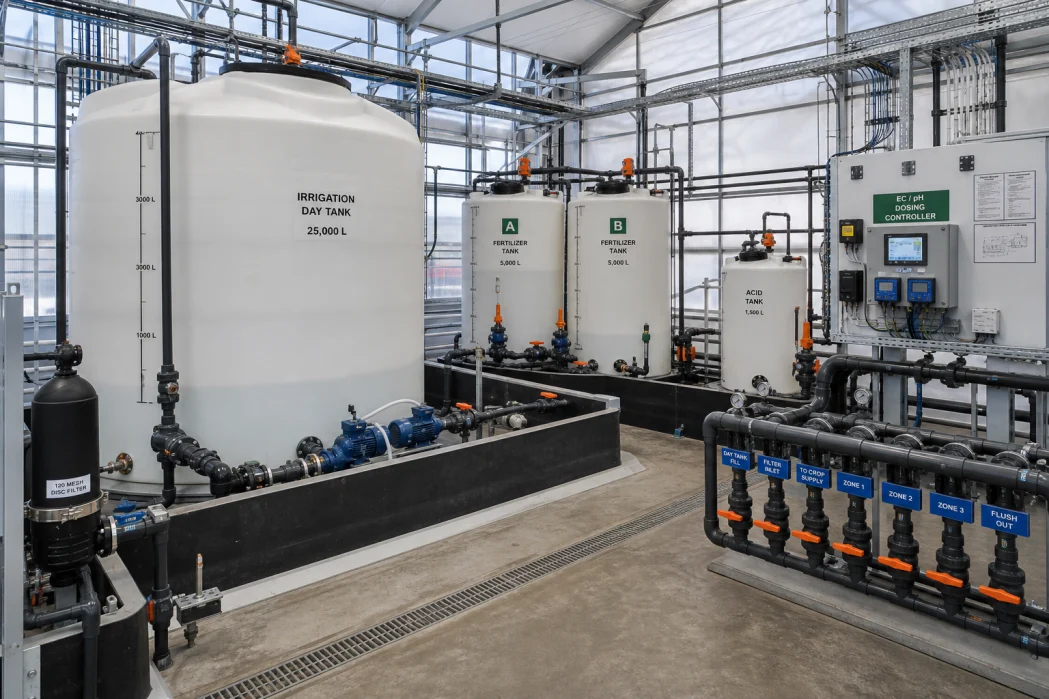
The first mistake is treating all fertigation tanks as if they store the same thing. They do not. In a commercial greenhouse fertilizer mixing tank room, one vessel holds ready-to-irrigate solution, others hold concentrated inputs, and another may only exist to catch and transfer drain water. If those duties get blurred, suppliers can quote similar nominal volumes while delivering very different operating behavior through the EC/pH automatic dosing controller, transfer pumps, and filtration loop.

Tank or vessel What it actually stores Operational job Key sizing or specification point
Irrigation day tank Finished nutrient solution at near-application strength, typically after dilution and controller adjustment Acts as the ready-to-apply buffer feeding the irrigation manifold during pulse events Judge by working volume, not label volume. Freeboard, mixer clearance, and suction dead volume can remove 10% to 20% of nominal capacity.
A/B stock tanks Concentrated fertilizer stock, commonly prepared at 50x to 120x concentration ratio Supply separate concentrates to the dosing skid so incompatible salts are not mixed in one tank These are concentration-storage vessels, not irrigation buffers. Their useful size depends on turnover, solubility, and how often operators can mix fresh batches.
Acid tank Acid solution for pH correction, typically dosed through the pH control channel of the fertigation controller Provides stable acid feed for pH adjustment when source water alkalinity or recipe logic requires it Capacity should reflect expected dosing frequency and handling routine, but material compatibility such as PE or PP construction matters as much as liters.
Drain buffer tank Collected drain or return water before transfer, filtration, sterilization, reuse, or disposal Decouples greenhouse return flow from the downstream transfer and treatment path This is a collection and transfer volume, not a fertilizer stock tank. Its adequacy depends on return spikes, pump duty in m3/h, and whether a sand media filter, disc filter, or UV sterilization loop sits downstream.

The practical distinction that buyers often miss is nominal volume versus usable working volume. A tank sold as 3 m3 may deliver materially less once you account for bottom outlet geometry, unpumpable residue, agitation requirements, and minimum level protection on the dosing pump. That is why quote reviews should ask for both values separately instead of accepting one headline number. The broader evaluation context sits in commercial greenhouse project budget planning.

Reference case: how tomato and cucumber demand changes the answer

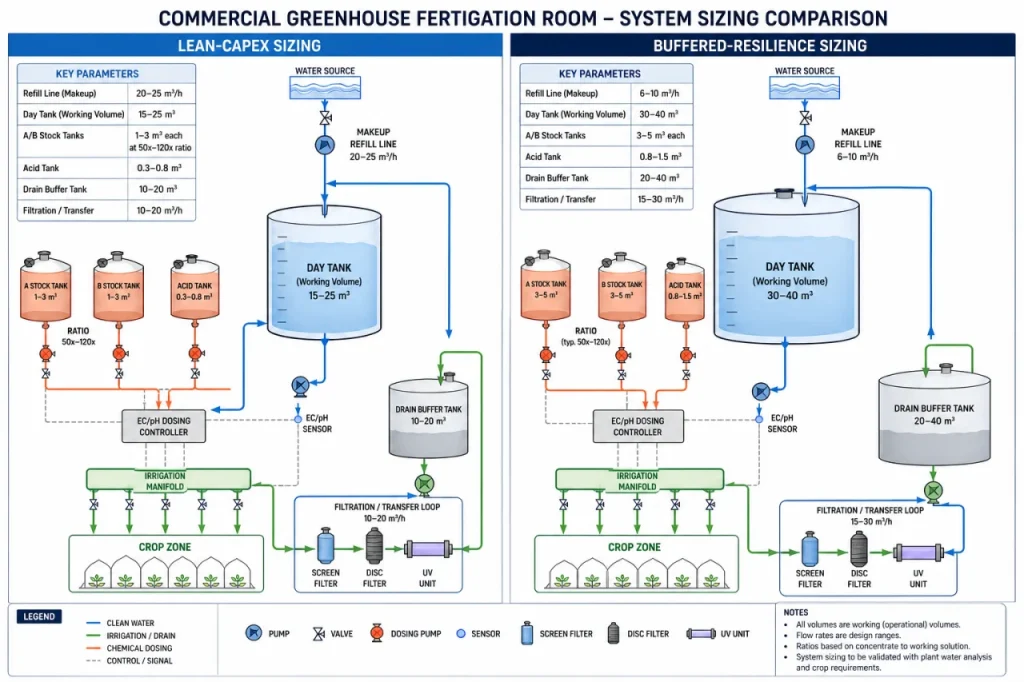
Annotated fertigation tank sizing diagram comparing day tank, A/B stock tanks, acid tank and drain buffer with refill-rate scenarios
Nominal tank volume is only part of the decision; refill rate, working volume and drain-transfer capacity often determine whether a fertigation room is resilient or fragile.

Area alone does not size a fertigation room; irrigation rhythm does. In a 20,000 m2 reference facility, total irrigation demand may land in a broad 120-220 m3/day range, but two crops with similar daily totals can still push different day-tank needs. The reason is peak-hour clustering. If irrigation is spread more evenly across a 10-12 hour window, a smaller working buffer can often recover between events. If a larger share of that same daily volume is concentrated into a 4-6 hour high-radiation block, the day tank and refill path have less time to recover before the next pulse. If the decision now depends on platform type multi-span greenhouse layout is the next useful reference.

Scenario What changes the buffer logic
Tomato program Tomato irrigation often follows a steadier pulse pattern, with demand distributed across more of the daylight period. A greenhouse running 140-190 m3/day for tomato may tolerate a leaner day-tank strategy if refill intervals are short and operators are available during peak hours. The key advantage is recovery time between pulses.
Cucumber program Cucumber demand often spikes faster under high radiation, especially when the crop is pushing heavier transpiration and tighter pulse frequency. A similar facility at 160-220 m3/day can require more working buffer not because the daily total is dramatically higher, but because more of the volume may be pulled in fewer hours. That compresses refill opportunity and increases interruption risk if the refill line or transfer pump is undersized.

What usually gets missed is that peak-hour demand matters more than the daily average when sizing the irrigation day tank. A system using 180 m3/day with relatively even delivery may perform well on a smaller buffer than a system using 170 m3/day with aggressive midday clustering. Before tightening the estimate, verify four inputs: expected m3/day by crop stage, the likely irrigation share delivered in the busiest 3-5 hours, refill interval or refill rate between pulses, and whether staffing coverage is active only during business hours or across the full irrigation window. If the crop program is still being finalized, a tomato greenhouse planning baseline or a climate-sensitive scenario such as this tomato and cucumber greenhouse planning reference can help frame the right buffer questions before supplier scope is fixed.

The right capacity is not one number; it is a strategy choice.

For the same 20,000 m2 facility, two tank layouts can both be reasonable if they match operating conditions. The practical decision is whether you want to lean on refill performance and tighter working volumes, or buy more buffer against refill interruptions, shorter staffing coverage, and slower drain handling. That choice affects floor area, cleaning frequency, idle chemical age, and how much disruption a single pump or supply issue can cause during a high-demand irrigation window. For the relevant greenhouse platform, see hydroponic greenhouse systems.

Strategy Best fit Advantages Limitations Risks What to verify next
Option A: Lean-capex sizing Best when refill flow is reliably 20-25 m3/h, operators are present during irrigation hours, and the fertigation room has tight footprint limits such as 60-100 m2. Lower tank capex, less floor-space consumption, faster stock turnover in 50x-120x A/B tanks, and lower standing volume to clean or drain during maintenance. Needs tighter control of working volume versus nominal volume, more dependence on refill reliability, and less tolerance if a transfer pump, valve set, or EC/pH dosing controller is offline. A 15-25 m3 day tank can become operationally thin if refill drops below target flow, and a smaller 10-20 m3 drain buffer can force rushed drain transfer decisions. Can the refill source actually sustain 20-25 m3/h at the greenhouse connection, not just at the upstream pump curve? Ask for confirmed duty point, usable day-tank volume, and minimum operator coverage by hour.
Option B: Buffered-resilience sizing Best when refill flow is only 6-10 m3/h, staffing is limited to one shift, or the operation wants more tolerance for maintenance delays and drain equalization. More protection against irrigation interruption, more time to respond to a refill fault, and better operating margin when drain return or filtration throughput is uneven across the day. Higher capex, larger room requirement such as 100-160 m2, more dead volume risk, slower turnover in concentrated stock tanks, and more washdown time during changeovers. A 30-40 m3 day tank and 20-40 m3 drain buffer can solve uptime risk but create chemical aging, sediment, or cleaning burden if stock concentration and agitation logic are weak. Will the larger buffer actually reduce risk, or are you compensating for an interface problem that should be fixed elsewhere? Verify tank material, agitation method, suction dead volume, and whether the drain-transfer path can keep pace with stored volume.

The lean path is usually the better commercial choice when utilities are dependable and operations are actively managed. The buffered path earns its cost when refill uncertainty, labor coverage, or recirculation timing would otherwise make a smaller system fragile. If a supplier recommends a large nominal tank without separating usable working volume, freeboard, and pump dead volume, the proposal is not decision-ready yet. If this question is turning into a specification decision greenhouse technology comparison gives the fuller framework.

The hidden bottlenecks: refill, filtration and drain transfer

A nominally large tank set can still underperform if flow paths are weak. In practice, the limiting factor is often not whether the room has 20 m3 or 35 m3 of storage, but whether the refill line, transfer pump and filtration path can keep up with irrigation pulses. For a 20,000 m2 tomato or cucumber block, a refill path closer to 20-25 m3/h can support a smaller working buffer, while a slower line at 6-10 m3/h may leave a larger tank partially unusable during peak demand because recovery is too slow between irrigation windows. When the discussion needs a live-planning example, desert cucumber water planning scenario is the closest match.

A simple comparison shows why. A 20 m3 day tank paired with a reliable 25 m3/h refill line can recover roughly 10-12 m3 in about 25-30 minutes, which is often enough to stay ahead of clustered daytime irrigation. A larger 30 m3 day tank on a 6 m3/h refill line needs roughly 100 minutes to recover the same 10 m3. On paper the second layout looks safer because the tank is bigger; operationally it can be less stable because the system cannot rebuild buffer fast enough once demand accelerates. When the question moves from research into delivery scope, see greenhouse consulting for fertigation interface review.

The same logic applies to drain-return and filtration. If recirculated drain is expected to re-enter the fertigation process, the transfer and filter path often needs to sit in a practical planning band of about 10-30 m3/h, depending on how much drain is collected in each cycle and whether treatment steps such as a UV sterilization loopdisc filter are installed in series. If that path is too small, returned water lingers longer in the drain tank, temperature can drift above the preferred root-zone range by 2-4°C, suspended fines can settle, and hygiene control becomes harder even before storage volume is technically exhausted. A more focused explanation of this sub-question appears in when to budget greenhouse water treatment.

  • Refill warning: Ask for confirmed refill duty in m3/h at the actual inlet pressure, not just pipe size or pump nameplate.
  • Filtration warning: Verify whether the stated 10-30 m3/h filter duty is gross flow or net usable flow after backflush losses.
  • Drain warning: If drain is held for recirculation, check residence time, transfer pump turnover and whether the return path bypasses or includes sanitation equipment.
  • Working-volume warning: Nominal tank volume is less useful than usable volume after freeboard, mixer clearance and suction dead volume are deducted.
What suppliers need from you before quoting tank capacity

Most bad quotes start with incomplete inputs, not bad equipment. If one supplier prices a 25 m 3 nominal day tank and another prices 25 m 3 usable working volume after freeboard and suction dead volume, the comparison is already distorted. The goal of this checklist is to define the same basis for tank duty, pump duty and control responsibility before scope is frozen.

  • Crop and production style: State tomato or cucumber, open drain or recirculating system, and substrate or hydroponic program. A tomato greenhouse with frequent daytime pulses may justify a different buffer than a lower-frequency irrigation program.
  • Peak and average irrigation demand: Give both average daily demand and peak-day planning demand in m 3/day, plus the busiest irrigation window in hours. A supplier cannot size a commercial greenhouse fertilizer mixing tank correctly from area alone.
  • Refill source and refill rate: Define whether refill comes from raw water storage, treated water, or a transfer tank, and state available refill flow in m 3/h. A 20-25 m 3/h refill path supports a leaner design than a 6-10 m 3/h path.
  • Concentration ratio: Specify the intended stock concentration, typically within a 50x-120x range, and whether the dosing skid, Venturi fertigation unit, or EC/pH automatic dosing controller has any injector limitation at that ratio.
  • Desired operating buffer: Tell suppliers whether you want roughly 1-3 hours of day-tank coverage, a half-day buffer, or resilience for overnight unattended operation. This changes usable volume more than nominal tank labeling suggests.
  • Recirculation or disposal path: State whether drain return goes to a collection sump, buffer tank, UV sterilization loop, or disposal line, and what temporary hold volume is acceptable in m 3.
  • Filtration duty: Provide required filtration or transfer capacity in m 3/h and the intended filter type, such as sand media filter or disc filter. This prevents a tank quote that ignores the real throughput limit.
  • Room footprint and access: Give the fertigation room length, width and clear height in m, plus door width, service aisle target, and whether future tank expansion must fit in the same room.
  • Controls interface: Clarify whether tank supply includes only vessels or also level sensors, dosing integration, EC/pH control signals, alarm logic, and communication with the irrigation controller.
  • Material compatibility: Ask for tank and fitting material assumptions up front, such as PE tank body, PP fittings, EPDM gaskets, and acid-compatible suction assemblies, especially where nitric or phosphoric acid storage is planned.
  • Installation and commissioning boundaries: Require each bidder to state who owns civil pads, anchors, transfer pumps, pipework, electrical terminations, calibration, wet testing, operator training, and commissioning sign-off.

If your team wants a practical way to standardize these inputs, use this section as a supplier quote checklist and then align it with upstream constraints such as greenhouse water quality requirementscommercial greenhouse utility planning before comparing proposals.

FAQ

Frequently asked questions

What is the difference between an irrigation day tank and A/B stock tanks?+

The day tank holds diluted, ready-to-irrigate solution that feeds the irrigation network in real time, so its job is short-term operating buffer. A/B stock tanks hold concentrated fertilizer solution, commonly at a 50x-120x stock ratio, and feed an EC/pH automatic dosing controller or fertigation skid that meters small doses into the irrigation stream. If a quote blurs those functions, verify whether the supplier is pricing usable mixed-solution volume, concentrated stock storage, or both, because that changes pump sizing, agitation duty, and refill frequency. A practical planning scenario for this issue appears in greenhouse retrofit and phased expansion planning scenario.

How can I estimate day tank size from daily irrigation demand?+

Start with peak irrigation demand in m3/day, then convert it into the amount you may need to buffer during the busiest refill window rather than across the full day. For example, if demand is 160-200 m3/day but most irrigation is concentrated into 8-10 high-radiation hours, the key question is whether the day tank plus refill line can cover that clustered load. A smaller tank can work if refill is reliable at about 20-25 m3/h; if refill is slower or intermittent, you need more working volume. Before accepting a tank size, ask the supplier to show the assumed hourly drawdown, not just the daily total.

When does acid tank capacity become a real planning issue?+

It becomes material when source water alkalinity drives frequent pH correction, when refill deliveries are infrequent, or when the fertigation room is expected to run through weekends with limited staffing. In those cases, the acid tank is not just a chemical container; it becomes an uptime constraint on the pH control loop. The right check is not only liters stored, but expected acid consumption per m3 of irrigation water, compatible tank material such as PEPP, bunding approach, and whether the dosing pump suction geometry leaves unusable dead volume near the tank bottom.

How much drain collection capacity is enough in a recirculating greenhouse?+

Judge drain capacity by transfer stability, not by storage alone. In a recirculating system, the drain buffer has to absorb return surges and still feed the treatment or filtration path at a workable rate, often around 10-30 m3/h depending on layout and recovery strategy. If drain arrives faster than the transfer pump or filter train can handle, the weak point is throughput, not nominal tank volume. That is why a modest buffer tied to a stable disc filtersand media filter, or UV loop can outperform a larger tank with a weak return path.

What inputs should I give suppliers before comparing fertigation room proposals?+

Give them crop type, average and peak irrigation demand in m3/day, expected refill rate in m3/h, preferred stock concentration ratio such as 80x or 100x, recirculation or disposal intent, filtration duty in m3/h, room footprint, and the required controls interface with the EC/pH controller. Also require each supplier to state nominal volume versus usable working volume, freeboard allowance, tank material, agitation method, pump duty, and commissioning boundaries. If upstream water chemistry is still unresolved, align that first with greenhouse water quality requirements; if refill flow or electrical service is still uncertain, check commercial greenhouse utility planning before freezing capacity assumptions.

What should be checked before turning this into a supplier decision?+

The right answer depends on crop, climate, operating goals, utility reliability, maintenance capability and budget. Use this article to narrow the decision, then talk through the remaining site-specific variables before locking scope, supplier direction or budget.

Validate tank capacity before irrigation scope is frozen

If your team is still aligning crop demand, water source behavior, refill rate and fertigation interfaces, request a planning review before finalizing supplier scope. This helps expose whether the real bottleneck is day tank volume, stock turnover, drain handling or upstream utility limits.