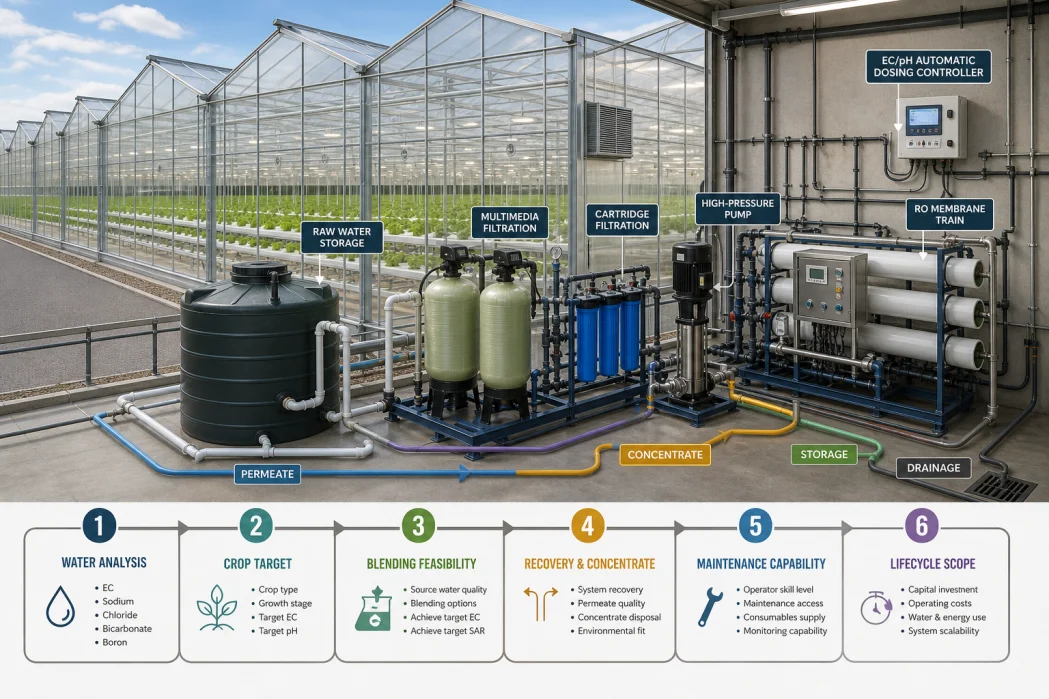
Use the following gates in sequence. The decision is not “Is RO technically available?” but “Does RO solve the verified crop-water constraint with an acceptable concentrate route, operating burden and lifecycle scope?” Organize the laboratory results using the greenhouse water-quality requirements guide before requesting membrane proposals.
Gate 1: Can blending meet the crop and fertigation target?
Evaluate greenhouse irrigation water blending before full RO when a dependable lower-EC source, such as rainwater storage or a second borehole, is available. For example, blending equal volumes of 1.0 mS/cm and 3.0 mS/cm water gives an illustrative combined EC near 2.0 mS/cm; the result still requires confirmation of sodium, chloride, bicarbonate and boron because EC alone does not prove suitability. A practical planning scenario appears in hydroponic leafy-greens planning scenario.
- Blending fits: seasonal source availability, storage volume, ion balance and automated proportioning can be verified.
- Blending becomes weak: the lower-salinity source fails during the dry season, storage covers fewer than 2 to 3 irrigation days, or one source contains a limiting ion despite acceptable EC.
- Verify next: source analyses from wet and dry periods, peak irrigation demand, tank capacity and the control strategy for an EC/pH dosing controller.
Gate 2: Does RO address the limiting chemistry?
RO is more defensible when dissolved salts remain outside the crop and fertigation programme’s acceptable envelope after blending or source management. A multimedia filter or 5-micron cartridge filter can protect a membrane from suspended solids, while antiscalant dosing may address a scaling risk; neither substitute automatically for RO when sodium or chloride remains the controlling constraint.
| Observed constraint |
Decision implication |
Validation before selection |
| High EC with elevated sodium or chloride |
RO may be relevant; filtration alone does not remove dissolved ions. |
Laboratory analysis, crop programme and permeate target. |
| Iron or manganese above the supplier’s feed-water design basis |
Pretreatment may determine membrane reliability and maintenance burden. |
Oxidation or media-filtration concept, cartridge loading and cleaning scope. |
| High bicarbonate or alkalinity |
Acid dosing, RO, blending or a combined train may be considered; pH control affects fertigation stability. |
Alkalinity analysis, chemical-storage interface and EC/pH controller calibration. |
| Biological contamination in recirculating water |
UV sterilization or another disinfection step addresses a different risk from desalination. |
Recirculation layout, UV dose basis and water-transparency assumptions. |
Gate 3: Is the concentrate route workable?
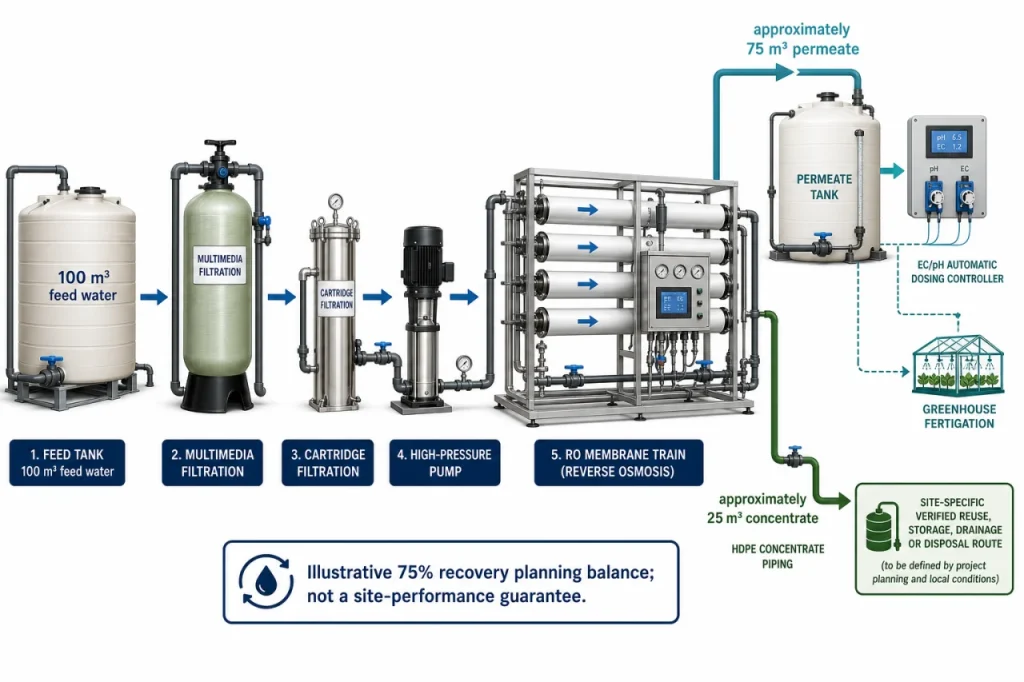
Treat recovery as a site-specific design variable, not a universal performance promise. As an illustrative planning balance, 75% recovery converts 100 m3 of feed water into approximately 75 m3 of permeate and 25 m3 of concentrate. The remaining stream may require storage, controlled reuse, evaporation or an approved discharge route, subject to local verification. When the question moves from research to delivery scope, the next step is commercial greenhouse project planning support.
A higher recovery target can reduce source-water demand and concentrate volume, but it can also increase scaling exposure, cleaning frequency and membrane-risk sensitivity. Before procurement, define concentrate piping, drainage capacity, overflow protection and responsibility for local discharge review. The commercial greenhouse utility-planning resource helps connect these interfaces with storage, drainage and electrical planning.
Gate 4: Can the operating team sustain the system?
RO is a poor fit when no responsible operator can review feed pressure, differential pressure and permeate conductivity, replace cartridges, maintain chemical supplies or coordinate clean-in-place work. A technically correct membrane train can still produce unstable irrigation water if conductivity logging and EC/pH controller calibration are treated as optional commissioning details.
- High-capability operation: RO can suit hydroponic or high-value crops where water consistency justifies monitoring, consumables and planned maintenance.
- Limited-capability operation: blending or source substitution may carry less operational risk if reliable water and adequate storage are available.
- Verify next: staffing coverage, alarm response, spare membranes and cartridges, calibration ownership, training, warranty exclusions and supplier response time.
Use the scenario, not a universal answer
| Project condition |
First pathway to evaluate |
Reason and caution |
| Reliable low-EC secondary source with 3 to 7 days of storage |
Blending before RO |
May reduce high-pressure pumping and concentrate volume; verify seasonal ion balance. |
| Single saline borehole and salt-sensitive hydroponic crop |
RO with defined pretreatment and concentrate routing |
Potentially stronger water-quality control; lifecycle power, chemicals and reject handling must be scoped. |
| Acceptable EC but suspended solids or biological risk |
Filtration or UV sterilization |
RO may add unnecessary complexity because the primary constraint is not dissolved salinity. |
| Unresolved drainage or discharge route |
Pause RO specification |
A membrane quotation is incomplete until the concentrate interface is technically and locally reviewed. |
For a water-constrained planning comparison, review the desert cucumber greenhouse water scenario. If the decision is moving toward supplier coordination, a greenhouse consulting review can help normalize pretreatment, controls, storage, power, commissioning and reject-water responsibilities before quotations are compared.