Skip to content
AEGIS Greenhouse Systems

Year-round hydroponic reference scenario / Central Anatolian Plateau, Turkey

Hydroponic Leafy Greens Greenhouse Planning Scenario: A Commercial Feasibility Framework

Explore a modelled commercial hydroponic leafy-greens greenhouse scenario covering facility scale, NFT systems, climate loads, budget drivers, supplier scope and validation priorities.

12,000-15,000 m2

Facility area

EUR 3.5-5.5 million excluding land and financing

Integrated budget

30-45 kg/m2/year

Saleable-output planning range

8-15 L/kg

Recirculating-water planning range

By Aegis Greenhouse Systems Project Planning Desk

Published /Updated

Planning support

Check Scenario Fit

This reference model suits a lettuce-led, recirculating production programme with sufficient market volume, reliable utilities and a planned packhouse route. Smaller, seasonal or weak-utility sites may need a phased or lower-complexity concept.

Validate the Inputs First

Confirm monthly climate conditions, structural loads, water chemistry, electrical capacity, drainage and cold-chain access before fixing greenhouse cladding, heating capacity, NFT layout or water-treatment scope.

Define Supplier Boundaries

Normalize quotations for the structure, screens, climate controls, NFT channels, dosing, UV treatment, utilities, commissioning, training, spares and exclusions before judging total project cost.

Hydroponic Leafy Greens Greenhouse Planning Scenario: A Commercial Feasibility Framework

Confidentiality and scenario basis

This page is a modelled reference planning scenario developed to show the decisions, assumptions and supplier interfaces involved in a commercial hydroponic leafy-greens greenhouse. It does not identify a client, represent a completed Aegis project or claim verified operational results. Final design, costs, loads, crop performance, permits and safety provisions depend on site-specific investigation, supplier documentation and qualified professional review.

Assumptions: Reference scenario assumes a Central Anatolian continental climate, 12,000-15,000 m2 usable production area, lettuce-led leafy-greens demand, year-round production intent, recirculating NFT channels, on-site water treatment, reliable three-phase electrical service, hot-water heating evaluation, and packhouse-cold-chain access. Budget, yield and water figures are conservative planning estimates for feasibility discussion, not delivered outcomes or guarantees.

Hydroponic Leafy Greens Greenhouse Planning: Scenario Overview

Reference scenario and confidentiality note: This is a modelled commercial planning scenario, not a named client project, completed installation or record of verified results. It is designed to help a development team decide whether a lettuce-led hydroponic concept is ready for site-specific feasibility work, supplier engagement and qualified professional review. Final design, costs, operating performance, permits and safety provisions depend on verified site data, supplier documentation and locally qualified review.

The decision is not simply whether leafy greens can be grown hydroponically. A commercial hydroponic leafy greens greenhouse must reliably connect crop consistency, harvest timing, water availability, utility resilience and dispatch capacity. If one of those constraints is assessed after quotations arrive, the team can end up comparing attractive equipment prices against incomplete operating requirements. The specification logic behind this scenario is outlined in commercial greenhouse utility planning.

What this scenario helps a project team decide

  • Concept fit: whether the intended market, operating team and cold-chain route support a recirculating leafy-greens model before equipment selection begins.
  • Validation order: which site, climate, water and utility inputs need confirmation before a concept can be used as the basis for supplier pricing.
  • System direction: whether an NFT-led baseline deserves further evaluation or whether the production format should be reconsidered around the operator’s maintenance and interruption-response capability.
  • Commercial readiness: whether production, packing and dispatch assumptions are aligned closely enough to proceed with a scoped feasibility exercise.
  • Quotation readiness: whether the project team can define connected responsibilities rather than accept isolated greenhouse and hydroponic equipment offers.

This page is useful for hydroponic leafy greens greenhouse planning because it answers the facility-fit, validation-sequence and scope-boundary questions that a generic case study usually leaves unresolved. Teams moving from concept to supplier discussions can also use Aegis support for greenhouse consulting when those decisions need to be translated into a coordinated planning brief.

Location and Crop Assumptions

For this Central Anatolian reference scenario, the starting point is a lettuce-led programme of whole-head lettuce, baby leaf and other short-cycle leafy greens within a 12,000–15,000 m² commercial footprint. That mix matters because it creates two different operating rhythms: whole heads need consistent spacing and harvest timing, while baby leaf concentrates cutting, wash and cold-chain demand into shorter peaks. A concept that only matches the growing area can still fail operationally if the harvest and dispatch pattern does not match the intended market. The specification logic behind this scenario is outlined in commercial greenhouse project budget.

Use the site as a filter, not a backdrop

Central Anatolian conditions can combine cold winter periods with strong solar gain and site-to-site variation in elevation, wind and snowfall. A 17–22°C crop-zone planning range is a useful crop brief, but it is not a design condition. Before fixing a Gothic multi-span concept, obtain coordinates, elevation and nearest-station weather records, then have qualified local professionals verify applicable structural, mechanical and permitting criteria. A copied 4.5 m-bay layout may remain suitable at one site yet need a different load brief or heating approach at another. A comparable reference scenario is available in high-altitude vegetable greenhouse project.

Water and dispatch access should be screened alongside climate. Recirculating leafy-greens production is sensitive to source-water EC, alkalinity, sodium, chloride and bicarbonate; a laboratory report should therefore precede any final nutrient or treatment specification. Likewise, a lettuce programme with a 24–48 hour post-harvest freshness expectation needs a credible route from harvest to pre-cooling and delivery. Readers comparing crop options can review the commercial considerations for a lettuce greenhouse before setting volume targets.

Choose the crop mix around market tolerance

  • Whole-head lettuce: fits buyers that value uniform presentation and predictable unit packs; it becomes less attractive where orders fluctuate sharply because unsold heads have limited recovery options.
  • Baby leaf: can broaden the sales mix, but raises the consequence of wash-line capacity, hygiene discipline and chilled packing throughput during harvest peaks.
  • Mixed leafy greens: can reduce dependence on one SKU, but each cultivar may need a different harvest interval, EC target within the 1.2–1.8 mS/cm planning band, and pack format.

The next decision is not to select equipment; it is to confirm weekly offtake, required pack formats and maximum delivery distance. If those inputs are uncertain, phase the crop programme rather than assume that a larger crop assortment will automatically reduce commercial risk. A comparable reference scenario is available in commercial greenhouse energy screen specification.

Technical System Breakdown

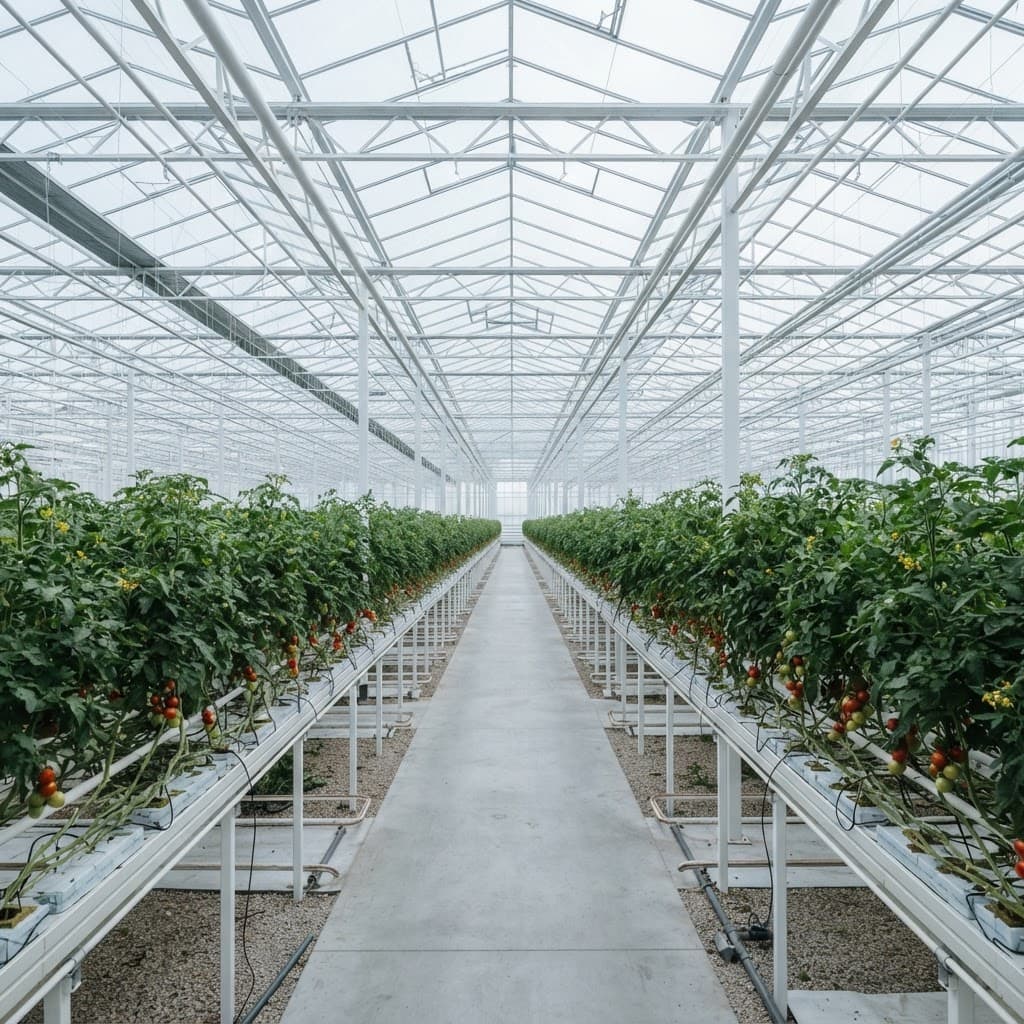
A commercial greenhouse hydroponic system should be specified as one operating chain: structure, cladding, climate control, water treatment, fertigation and crop channels must exchange reliable data and flow capacity. In this reference concept, a Gothic multi-span frame with 4.5 m bays and a 5.5–6.0 m ridge height provides the physical envelope for a lettuce-led hydroponic greenhouse; it does not make the production system resilient on its own.

Envelope and climate-control package

A 200-micron diffuse anti-drip polyethylene cover is a practical baseline where lower initial envelope cost and periodic film replacement are acceptable. A 4 mm tempered-glass envelope can offer longer service life and higher rigidity, but raises structure, sealing and capital requirements. Either choice should be assessed alongside a woven thermal screen, because retaining heat overnight and controlling condensation are linked decisions rather than separate add-ons. The specification logic behind this scenario is outlined in commercial greenhouse operations readiness guide.

The climate package combines a Priva or HortiMaX climate computer, HAF fans and a hot-water heating loop sized from verified local weather data. The control objective is a 17–22 C crop-zone range, but the final heating duty, vent area and screen strategy depend on coordinates, elevation, local wind exposure and qualified mechanical and structural review. Specifying the computer without confirming sensor locations, actuator feedback and alarm escalation commonly produces a greenhouse that can measure conditions but cannot correct them consistently.

Recirculating NFT, fertigation and water treatment

For a lettuce-led programme, NFT channels are the starting configuration because they keep standing nutrient-solution volume lower than deep-water basins and suit frequent harvest cycles. They also require disciplined hydraulic design: channel fall, return-line capacity, pump duty and alarm response must sustain continuous flow. Reference nutrient targets of EC 1.2–1.8 mS/cm and pH 5.5–6.5 are operating starting points, not a final crop recipe; cultivar, source-water alkalinity and water temperature can change the dosing approach.

The fertigation skid should connect reservoirs, filtration, EC/pH dosing, UV sterilization and a nutrient-solution buffer sized for approximately 24 hours of planned circulation demand. UV treatment can reduce recirculation-pathogen exposure, but it does not correct high sodium, bicarbonate or suspended solids; those results determine whether filtration, acid dosing or reverse-osmosis evaluation is warranted. Before fixing equipment capacity, obtain a laboratory water analysis and compare it with each equipment supplier’s documented limits.

Where deep-water culture changes the decision

System choice Operational advantage Trade-off to resolve Best-fit question
NFT channels Lower standing solution volume and straightforward bench-level harvest access. Higher sensitivity to pump failure, blocked returns and incorrect channel slope. Can the team respond rapidly to a circulation alarm and maintain channel cleaning?
Deep-water culture basins Greater water mass can provide hydraulic and thermal buffering during short disturbances. More water mass, basin-cleaning downtime and sanitation-control burden. Does the labour model justify basin management and a larger water-treatment scope?

For a lettuce greenhouse, neither format should be selected on yield claims alone. The better fit follows outage tolerance, sanitation workflow, maintenance coverage and packhouse rhythm. Use a greenhouse technology comparison to document those operating assumptions before the system layout is frozen.

Modelled Assumptions and Metrics

These planning metrics test whether a 12,000–15,000 m² lettuce-led facility has a credible operating envelope before detailed crop modelling. They are not targets to promise to an investor: each depends on cultivar, light availability, harvest specification, water chemistry, labour workflow and packhouse throughput.

Planning metric Reference range Decision it informs What must be verified
Usable production area 12,000–15,000 m² Whether the operation can justify dedicated hygiene, harvest and cold-chain routines rather than a lightly staffed seasonal model. Net growing area after headlands, reservoirs, access aisles and service corridors in the 4.5 m-bay Gothic multi-span layout.
Saleable leafy-greens output 30–45 kg/m²/year Whether weekly customer demand and packing capacity can absorb production peaks. Crop mix, planting density, losses, light levels, harvest cadence and product specification; this is a planning range, not a production guarantee.
Recirculating water use 8–15 L/kg Water-source, storage, treatment and discharge capacity. Source EC, sodium, bicarbonate, UV sterilization performance, reject streams and non-crop water use. A greenhouse water-quality review should precede final treatment selection.
Crop-zone temperature 17–22°C Heating, ventilation and thermal-screen control priorities for lettuce and baby-leaf consistency. Hourly climate data, solar gain, humidity setpoints and the hot-water loop duty calculated for the selected coordinates.
Nutrient solution EC 1.2–1.8 mS/cm; pH 5.5–6.5 Fertilizer dosing range and source-water correction needs for NFT channels. Laboratory water analysis, cultivar recipe, solution temperature and drainage or recirculation-management protocol.

Read the metrics as connected constraints

A 30–45 kg/m²/year output range is only useful if the packhouse can cool, grade and dispatch the corresponding harvest rhythm. For example, increasing planting density in an NFT layout may lift weekly harvest volume, but it also tightens labour windows and makes a delayed cold-room transfer more consequential. Validate the crop plan against buyer call-offs and packhouse line capacity, not against area alone.

Likewise, 8–15 L/kg is not evidence that recirculation will solve a weak water source. High bicarbonate or sodium can alter acid-dosing, filtration and possible reverse-osmosis scope; a 24-hour nutrient-solution buffer improves response time after a supply interruption but does not replace backup pumping or a tested alarm procedure. Use the ranges to identify what data changes the concept, then compare options through a greenhouse technology comparison rather than treating one baseline as universally suitable.

Budget and Cost Drivers

For this 12,000–15,000 m² year-round reference concept, an integrated planning allowance of EUR 3.5–5.5 million, excluding land and financing, is a useful feasibility screen rather than a quotation or final project price. The range reflects a Gothic multi-span envelope, recirculating NFT, hot-water heating evaluation, thermal screening, climate controls and packhouse interfaces. A concept that cannot support this order of investment under conservative selling-price and operating-cost assumptions should be resized or phased before detailed design begins.

Cost driver Why it moves the allowance Decision consequence
Climate envelope and heating A 4.5 m-bay Gothic structure with a woven thermal screen and hot-water loop has materially more winter-resilience scope than a seasonal film house. Local snow, wind and minimum-temperature records may change the frame, boiler and distribution requirements. Year-round contracts can justify the added resilience; seasonal supply may favour a simpler envelope if market timing permits.
Hydroponic water architecture NFT channels, reservoirs, EC/pH dosing and UV sterilization must be sized around the required circulation volume and water chemistry. Reverse-osmosis treatment, if source-water sodium or bicarbonate requires it, adds both capital cost and reject-water management. Complete laboratory water analysis before fixing treatment scope; do not price UV or filtration as interchangeable line items.
Controls and resilience A Priva or HortiMaX climate computer, alarm logic, HAF fans and backup power for circulation pumps protect a 17–22°C crop zone, but redundancy adds cost beyond basic automation. Sites without a credible after-hours response or power-contingency plan should budget for greater resilience or reconsider an NFT-led operating model.
Packhouse and cold chain Wash, packing, pre-cooling and dispatch capacity must absorb harvest peaks. Under-sizing these interfaces can turn production capacity into downgraded product or delayed shipments. Set the packhouse throughput from harvest and dispatch windows, not as a residual percentage of the greenhouse budget.

The largest commercial mistake is treating the lowest initial figure as the lowest project cost. A lower-capex seasonal facility can be appropriate where sales are concentrated in warmer months and cold-chain commitments are limited. A year-round lettuce programme typically needs a more complete thermal, power and handling strategy; its case depends on dependable offtake and an operating model that can carry higher energy exposure. For broader cost-category definitions, use the commercial greenhouse cost guide alongside site-specific energy, civil and utility checks.

Before advancing, test two cases: a base case with the intended heating, water-treatment and packing scope, and a constrained case with higher energy cost or reduced winter dispatch. If the concept remains viable only when exclusions are assumed away, the next decision is not to seek a cheaper system—it is to revise the production season, area or market commitment.

Risk Matrix: Validation Priorities Before Detailed Design

For a 12,000–15,000 m2 NFT facility, the most consequential risks are the ones that stop circulation, compromise crop hygiene or force a late redesign of the Gothic multi-span envelope. Treat this matrix as a pre-design validation tool: final structural, electrical, water-treatment and safety provisions remain subject to site records, supplier documentation and qualified local review.

Risk Potential consequence Control to evaluate Evidence before commitment
Source-water variability and pathogen carryover High sodium, bicarbonate or microbial loading can destabilize an EC 1.2–1.8 mS/cm recipe and spread problems through recirculating NFT channels. Match filtration, UV sterilization, acid dosing and, where analysis supports it, reverse-osmosis capacity to the actual source water and reject-water route. Seasonal laboratory analysis covering EC, alkalinity, sodium, chloride, bicarbonate and microbiological indicators; supplier operating limits.
Power loss to circulation and controls With low standing solution volume, NFT channels can dry or warm quickly when pumps, dosing or the Priva climate computer lose power. Provide monitored standby power for circulation pumps, dosing controls and alarms; test the transfer sequence under the intended electrical load. Utility reliability record, one-line electrical concept, generator duty calculation and documented alarm-response procedure.
Winter heat loss, condensation and snow loading A 4.5 m-bay Gothic multi-span concept may need different heating, screen and structural scope when local minimum temperatures, wind or snow conditions differ from the reference context. Assess hot-water loop capacity, woven thermal-screen duty, HAF fan air movement and cladding selection together—not as separate equipment lines. Nearest-station climate records, applicable local load criteria, structural calculations and mechanical design review by qualified professionals.
Humidity control during low-ventilation periods Persistent leaf wetness can reduce crop consistency and increase sanitation pressure even when the crop-zone target is 17–22 C. Confirm ventilation geometry, HAF fan layout, heating-pipe placement and climate-control set-point logic for night and shoulder-season operation. Crop-density plan, climate model assumptions, OEM fan curves and a reviewed condensation-management sequence.
Labour and packhouse bottlenecks Harvest can exceed wash, packing or cold-room throughput, leaving a technically sound hydroponic lettuce greenhouse design unable to protect shelf life. Balance NFT harvest zones against hourly packing capacity, cold-room pull-down capacity and dispatch cut-off times; phase production blocks if throughput is uncertain. Harvest calendar, labour roster, packhouse line-rate test and cold-chain dispatch plan.
Control-interface and commissioning gaps Uncoordinated EC/pH dosing, UV treatment, pumps, sensors and Priva alarms can create faults that no single supplier accepts at handover. Define point-to-point signals, sensor calibration responsibility, alarm ownership and wet-test acceptance criteria before equipment is ordered. Controls interface schedule, OEM documentation, commissioning protocol and named responsibility matrix.

The practical priority is to close water, power and climate-load evidence first. These inputs determine whether the commercial greenhouse hydroponic system needs more treatment capacity, redundancy or envelope performance; changing them after layout release usually disrupts both programme and operating reliability.

Supplier, Procurement and Implementation Roadmap

A supplier comparison becomes useful only when every bidder prices the same handoff points. For this Gothic multi-span, NFT-led concept, a low headline figure can exclude the Priva controls interface, 400 V electrical distribution, UV treatment commissioning or packhouse connections; those omissions change both programme responsibility and the final delivered scope.

Issue a Normalized Scope Schedule Before Requesting Quotations

Scope package Define in the RFQ Verification before comparison
Greenhouse envelope 4.5 m bay Gothic structure, cladding, roof ventilation, thermal screen drives and foundations boundary Confirm whether structural calculations, civil works and installation are included or assigned locally.
Hydroponics and water NFT channels, reservoirs, pumps, filtration, EC/pH dosing, UV sterilization and 24-hour solution-buffer basis Match pump duty, standby arrangements, water-treatment limits and drainage responsibility to the water analysis.
Climate and controls Hot-water loop, HAF fans, sensors, Priva or HortiMaX controls, alarms and control-panel interfaces Identify who supplies wiring, field cabling, software setup, testing and alarm-response training.
Commissioning and aftercare Calibration, functional testing, operator training, critical spares, warranty start point and remote-support terms Set acceptance criteria and the responsible party for unresolved integration faults before purchase-order release.

Do not assume one supplier must carry every package. A split award can suit teams with proven electrical and mechanical coordination capacity, but it increases interface management. A single integrated package can simplify accountability, while potentially narrowing technology choice. A commercial greenhouse projects planning process should record these boundaries in one reconciled matrix, rather than relying on proposal notes.

Decision Gates From Concept to Order Release

  1. Validate the concept: collect site coordinates, elevation, usable area, water laboratory report, 400 V capacity and market dispatch requirements. Confirm that the proposed multi span greenhouse configuration is compatible with site-specific structural and local approval review.
  2. Freeze the operating brief: define lettuce and baby-leaf formats, daily harvest rhythm, packhouse throughput and the planned 17-22 C crop-zone range. This step prevents an NFT layout from being selected before the handling workflow is known.
  3. Issue the normalized RFQ: send identical drawings, equipment schedules, exclusions and acceptance requirements to each bidder. Use the greenhouse technology comparison resource to keep cladding, controls and water-treatment alternatives visible rather than buried in exclusions.
  4. Conduct technical reconciliation: compare deviations line by line, including cable routes, heating source, standby power, installation access, OEM documentation and training. Any scope change should be costed and assigned before an order is authorized.
  5. Release procurement after review: proceed only when supplier interfaces, programme milestones and site responsibilities are documented. Final structural, electrical, mechanical and permitting decisions remain subject to qualified local professional review and applicable jurisdictional requirements.

For a hydroponic lettuce greenhouse design, the experienced follow-up question is not simply which supplier offers NFT channels; it is who proves the channels, dosing skid, UV unit and climate computer operate together during commissioning. Aegis can support the scope definition, technology-selection review, supplier coordination and project-management assistance needed to make that responsibility explicit.

Test This Scenario Against Your Site and Crop Plan

Submit your site coordinates, elevation, usable production area, leafy-greens mix, water-analysis status, three-phase electrical capacity, budget range and target launch date. Aegis can use these inputs to frame a project-specific technology path, including NFT versus deep-water culture review, Priva control interfaces and a supplier-ready scope for commercial greenhouse projects.

Before committing to detailed engineering or a purchase order, the proposed direction should be checked against nearest-station climate records, water laboratory results, utility confirmation, supplier OEM documentation and applicable local approvals. Aegis provides consulting, planning, technology-selection support, supplier coordination and project-management assistance; final structural, electrical and regulatory decisions remain subject to qualified site-specific review.

Request a greenhouse project assessment when those core inputs are available and the next decision is whether to proceed, phase the facility, or revise the operating concept.

FAQ

Project scenario questions

What facility size is practical for a commercial hydroponic leafy greens greenhouse?+

A 12,000-15,000 m² facility can support dedicated crop, packing and maintenance workflows, but it is not a universal minimum. A smaller phased build may be the stronger choice where weekly offtake, cold-chain throughput or three-phase power resilience is still unproven. The key test is whether harvest peaks can be packed and dispatched without compromising a 17-22°C crop-zone programme.

Is NFT or deep-water culture better for a hydroponic lettuce greenhouse design?+

NFT is often a sensible lettuce-led baseline when operators can protect pump continuity, maintain channel slope and respond quickly to alarms; its EC target is commonly planned at 1.2-1.8 mS/cm. Deep-water culture merits comparison when greater solution-volume buffering and a different labour workflow outweigh basin-cleaning and sanitation demands. See the wider hydroponic greenhouse context before fixing either format.

What water tests should be completed before selecting a recirculating system?+

Use a laboratory report covering source EC, pH, alkalinity, sodium, chloride, bicarbonate, iron, manganese and microbiological condition. These results affect filtration, acid dosing, reverse-osmosis evaluation and UV sterilization scope; a 24-hour nutrient-solution buffer does not correct unsuitable source water. Review greenhouse water quality requirements before issuing a treatment specification.

Which systems most affect year-round leafy-greens reliability?+

Reliability depends on connected equipment: a Gothic multi-span structure, thermal screen, hot-water loop, HAF fans, climate computer, circulation pumps and backup power must operate as one control sequence. For a lettuce programme, a failed pump or humidity-control gap can be more consequential than a marginal difference in channel price. Confirm alarm routing, generator transfer capability and OEM operating limits during technical review.

What should a commercial greenhouse hydroponic system quotation include?+

Ask suppliers to separate NFT channels, reservoirs, pumps, EC/pH dosing, UV unit, controls integration, electrical distribution, installation, commissioning, training, critical spares and warranty terms. A quotation that lists a Priva or HortiMaX controller but excludes sensor installation, control programming or handover testing is not directly comparable. The greenhouse technology comparison resource can help frame the connected-system questions.

Which inputs are needed to scope a leafy greens greenhouse feasibility study?+

Provide site coordinates and elevation, usable area, crop mix, water-analysis status, electrical capacity, heating-fuel options, target market, packhouse route, budget range and launch date. These inputs allow a feasibility scope to test whether a lettuce-led programme and 4.5 m bay multi-span concept are appropriate; they do not replace local permitting, structural calculations or qualified engineering review. For crop-specific context, see the lettuce greenhouse planning page.

Test This Scenario Against Your Site and Crop Plan

Provide site coordinates, elevation, usable area, leafy-greens programme, water-analysis status, electrical capacity, budget range and target launch date for a project-specific technology path and supplier-scope review.