By Aegis Greenhouse Systems Technical Planning Desk
Published /Updated
Decision support
Prioritize Crop Protection
List the systems that prevent crop loss first: climate computer, alarm path, circulation or ventilation equipment, and the boiler or cooling components required for the actual weather risk.
Test the Restart Sequence
Confirm which motors start first, whether VFDs or soft starters are included, and how ATS/AMF logic prevents pumps and fan banks from starting together.
Clarify the Quote Boundary
Ask who supplies the generator, ATS, load shedding, distribution modifications, controls signals, load-bank test, commissioning, training, and ongoing maintenance.
Overview
Greenhouse backup generator sizing should begin with the loads that protect the crop during an outage—not the combined nameplate kVA of the entire site. Build a staged emergency schedule for climate survival, irrigation continuity, controls and alarm visibility; then test its running kW, motor-starting demand, power factor and ATS/AMF restart sequence. A final generator, alternator, protection, earthing, fuel-storage and transfer design requires verified site data and competent electrical-engineering review.
For example, a 400 V greenhouse may need a Priva or HortiMaX climate computer, communications router and selected boiler circulation pumps or pad-and-fan equipment online first, while packhouse equipment, supplementary lighting and non-urgent ventilation zones restart later. That distinction matters because a 15 kW irrigation pump or fan bank started direct-on-line can create a transient demand that the same load’s running kW does not show. Before seeking quotes, separate the equipment that prevents immediate crop exposure from equipment that can tolerate a managed pause.
This article focuses on that outage-time hierarchy and restart logic. If the decision also involves incoming supply, transformer capacity or main distribution, use our commercial greenhouse utility-planning guide to frame the wider electrical scope.
What Buyers Need to Know About Greenhouse Backup Generator Sizing
Start with the crop consequence of each outage-time load, not the whole-site nameplate total. A Priva or HortiMaX climate computer, alarm router and the equipment that prevents immediate heat, humidity or water stress usually belong ahead of packhouse equipment, supplemental lighting and other production loads. This creates a defensible emergency schedule before anyone quotes a generator.
Load group
Typical emergency role
When it becomes critical
What to verify
Crop-survival climate loads
Boiler circulation pump, heat-buffer pump, exhaust fan bank, pad-and-fan water pump, thermal-screen drive
A heated house facing cold exposure or a mechanically cooled house facing high temperature and humidity
Which single failure causes crop conditions to move outside the operating setpoint first, and whether each 400 V motor can restart in sequence
Irrigation-continuity loads
Borehole or booster pump, irrigation pump, EC/pH dosing controller
Low substrate water buffer, no gravity-fed storage, or a crop stage with limited tolerance for a missed cycle
Available stored water, source-water dependency and whether dosing or UV treatment must be live for water to remain usable
Controls and visibility
Priva or HortiMaX controller, network switch, alarm panel, communications gateway
Always; a running pump or fan is of limited value if the operator cannot see an alarm or control its fail state
Packhouse refrigeration, lighting, non-essential fan zones, workshop loads
Only where their interruption creates a separate commercial loss that exceeds the added emergency-power cost
Whether they can reconnect after climate and irrigation loads have stabilized
This hierarchy changes with the operating model. In a Venlo greenhouse growing high-wire tomatoes, boiler circulation and climate control may outrank irrigation during a cold event; in a pad-and-fan facility, exhaust airflow and cooling-water delivery may move to the first tier. Assigning every installed load to backup power can inflate capital and fuel demand without improving crop protection. Assigning too few can leave a nominally sized generator unable to protect the crop.
Before requesting a kVA figure, ask each system owner one practical question: if this load stays off for the credible outage window, what fails first? Record the answer alongside the motor nameplate, starting method and required companion load—for example, a pad-and-fan pump without exhaust fans, or an irrigation pump without its water source, does not provide meaningful continuity. If the question extends to incoming service capacity, transformer scope or main distribution, use the broader commercial greenhouse utility planning guide before treating the generator quote as a complete electrical plan.
Technical considerations for greenhouse backup generator sizing
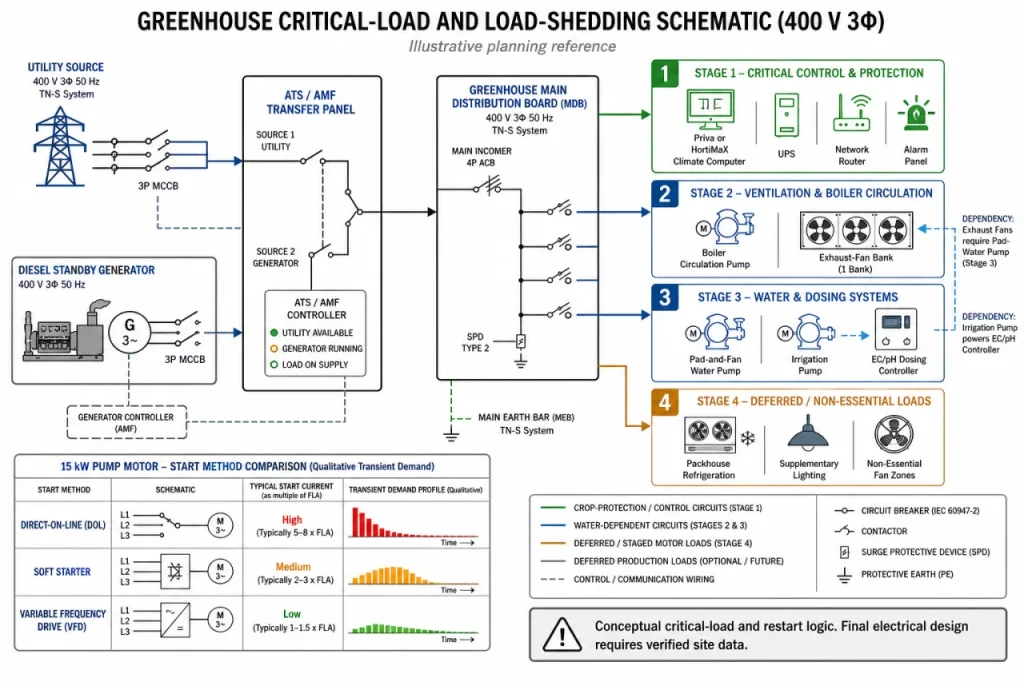
Conceptual planning logic: restore controls and alarms first, then stage climate and water-dependent loads before deferred production circuits.
Once outage loads have been prioritised, the technical question is whether they can start and operate together without collapsing generator voltage. On a 400 V distribution system, a 15 kW irrigation pump can create a much larger short-duration demand at direct-on-line start than its running kW suggests. A generator quote based only on connected running load can therefore look adequate on paper yet trip when an ATS/AMF panel restores fan banks, pumps and climate controls at the same time. For the decision framework behind this point, review greenhouse technology comparison resource.
Motor-starting method changes the emergency-power requirement
Starting method
Emergency-power implication
Controls trade-off
Verify before quotation
Direct-on-line motor starting
Highest transient demand; a 15 kW pump or several exhaust fans may require strict staged starting or a larger alternator.
Simple equipment arrangement, but simultaneous restart can cause voltage dip and nuisance trips.
Motor nameplate data, locked-rotor information, contactor sequence and permitted voltage dip.
Soft starter
Can reduce starting current compared with direct-on-line operation, helping an ATS/AMF sequence accommodate larger pump motors.
Adds configuration and bypass-contactor considerations; it does not provide speed control after start.
Starter ramp settings, bypass arrangement, pump duty point and generator-controller compatibility.
VFD
Usually enables a gentler start for HAF fans, exhaust fans and pumps, allowing more deliberate load staging.
Requires control integration and harmonic review; a VFD fault mode must not prevent a crop-protection load from restarting.
VFD input characteristics, harmonic limits, Priva or HortiMaX restart commands and generator manufacturer guidance.
A practical restart order is normally more valuable than adding indiscriminate kVA: restore the Priva or HortiMaX climate computer and communications path, confirm generator-ready status, start one boiler circulation pump or one exhaust-fan group, then add irrigation or secondary fan groups after voltage and frequency stabilise. The exact delays and load groups require manufacturer data and electrical-engineering review, but the operating principle is clear: no control system should issue a simultaneous restart to every motor-fed load. A practical planning scenario appears in cold-climate vegetable greenhouse planning scenario.
Climate equipment is critical only when its supporting dependency is live
In a heated glass structure during cold exposure, a boiler circulation pump, heat-buffer pump, thermal-screen drive and climate computer may be more consequential than lighting or packhouse equipment. In a hot pad-and-fan greenhouse, exhaust fans are not a complete survival measure if the cooling-water pump is offline; likewise, 70-bar fogging is not a substitute for ventilation if airflow cannot restart. For a Venlo greenhouse producing high-wire crops, assess each seasonal mode against the actual crop setpoints and available manual response rather than treating one equipment list as critical all year.
The common error is to back up a device but not the chain it depends on. An EC/pH dosing controller may be live while the borehole pump, booster set, UV unit or source-water valve remains unpowered. For drip irrigation rated at 4 L/h per emitter, the right question is not whether fertigation is always essential; it is whether substrate volume, current crop stage and confirmed water storage permit a managed pause without creating avoidable root-zone stress. This distinction is especially important for a commercial tomato greenhouse, where crop load and climate demand can make a generic irrigation rule misleading.
Make control recovery and alarm visibility part of the electrical scope
A generator that starts successfully still fails the crop-protection objective if the ATS/AMF panel does not provide a generator-ready signal, the climate computer does not complete its boot sequence, or remote alarms have no route through the outage. Define whether the router, cellular gateway, alarm panel and operator notification path remain live on UPS power during the transfer interval. Alarm ownership, test drills and response authority should match the site’s greenhouse operations-readiness procedures, rather than being left as an informal assumption between the electrician and grower.
Return-to-mains logic deserves the same attention as transfer to generator. If utility restoration releases several direct-on-line fan motors and a 15 kW pump simultaneously, protective devices may trip and create a second interruption. Require a controlled reconnection sequence, documented fail states for VFDs and contactors, and a witnessed functional test of the ATS/AMF panel with the actual greenhouse control signals. Wider questions about transformer capacity, service resilience and main distribution belong in commercial greenhouse utility planning; this check is specifically about making the outage-time load schedule work in operation.
Decision framework: turn outage risk into a generator brief
Use this sequence before asking for a generator quotation. The output is not a single kVA request; it is a signed-off emergency-load schedule that tells each bidder what must transfer, what may wait, and what conditions make the sequence acceptable. For a high-wire tomato greenhouse, for example, the priority can shift sharply between a cold night that depends on boiler circulation and a hot afternoon that depends on exhaust airflow and pad-water pumping.
Define the credible outage event: compare the site’s actual outage history with the seasonal exposure that creates crop risk. Record whether the limiting condition is heating at an illustrative -5 °C outside event, cooling during high solar gain, or irrigation after a 2–4 hour interruption. A short outage with trained staff may support a survival-mode schedule; an unmanned remote site generally needs more automatic continuity and clearer alarm escalation.
Assign every load an outcome, not just a priority number: classify each 400 V load as “must run,” “must restart after a delay,” or “remain off.” State the consequence of non-operation: loss of boiler circulation, rising canopy temperature, missed irrigation pulse, loss of Priva or HortiMaX visibility, or merely delayed packing. This prevents packhouse refrigeration, lighting, and other production loads from being added by default when they do not protect the crop during the credible event.
Test dependencies before approving a load: an exhaust fan without pad-water supply, or a borehole pump without an EC/pH dosing controller, may not deliver the protection assumed. For drip lines rated at 4 L/h per emitter, confirm reservoir volume, pump duty, treatment equipment, and the crop’s substrate buffer before deciding whether irrigation needs immediate transfer or a managed pause.
Specify the restart order: identify the first load, the delay between groups, and the release condition. A 15 kW irrigation pump using direct-on-line starting should not be assumed to restart alongside fan banks; record whether a VFD, soft starter, or ATS/AMF load-shedding output controls the event. The electrical engineer should validate motor data, alternator response, protection, harmonics, and earthing from the actual nameplates and one-line diagram.
Set an acceptance test: require a witnessed mains-loss and return-to-mains test that proves the climate computer boots, alarms reach an accountable person, and deferred loads remain inhibited until the essential sequence is stable. A generator that starts but does not restore the intended control logic has not met the crop-protection objective.
Climate setpoints, fan and pump motor list, pad-water dependency, and local design-weather basis.
Can irrigation wait?
Substrate volume, crop stage, water-storage head, source-water availability, and dosing or UV interlocks.
Irrigation schedule, pump curve, emitter flow rate, reservoir capacity, and EC/pH control fail state.
What generator capacity is actually usable?
Running kW, power factor, direct-on-line versus VFD starting, and the permitted sequence of 5–30 second delays.
Connected-load schedule, motor nameplates, starting method, ATS/AMF logic, and manufacturer alternator data.
How much autonomy is justified?
Outage history, staffing gap, refuelling access, and the expected 50–75% operating-load band used for planning.
Generator-specific fuel curve, usable tank volume, delivery access, and escalation contact list.
If the question expands into transformer capacity, incoming service, or main-distribution resilience, use the commercial greenhouse utility planning resource rather than stretching this outage-load brief into a whole-site electrical design. For bid-ready responsibility boundaries between the generator vendor, electrical contractor, controls integrator, and greenhouse supplier, the greenhouse buying guide provides the appropriate procurement context.
Validate the Load Hierarchy Before Electrical Scope Is Fixed
A generator quotation becomes comparable only when it is tied to the loads that must survive an outage, their motor-starting method, and the ATS/AMF restart order. Before selecting a generator or electrical package, assemble the one-line diagram, connected-load schedule, motor nameplates, VFD or direct-on-line starting details, climate-control dependencies, irrigation water source, outage history, alarm route, and planned expansion load.
Aegis can support a focused utility-interface and critical-load review to turn those inputs into a clear brief for the generator vendor, electrical contractor, greenhouse equipment supplier, and controls integrator. The aim is not to replace final electrical engineering; it is to expose missing load-shedding, control-signal, commissioning, and handover responsibilities before they become change orders.
Validate the Load Hierarchy Before Electrical Scope Is Fixed
Bring the connected-load schedule, motor-starting details, climate and irrigation systems, outage history, and planned expansion path into one interface review before comparing generator and electrical-package offers.