Skip to content
AEGIS Greenhouse Systems

Blog / 10 min read

How to Compare Greenhouse Quotes When Wind and Snow Loads Differ

Learn how to compare greenhouse quotes fairly when wind and snow load assumptions differ. Use a five-check workflow, document request list, and next-step review.

By Aegis Greenhouse Systems

Published /Updated

Decision support

Is this quote truly comparable?

Check whether the wind load, snow load, frame type, bay spacing, and cladding basis match. A 0.60 kN/m² versus 1.00 kN/m² snow-load basis is not equivalent.

What should I ask the supplier for next?

Request the design-basis sheet, exclusions list, lead time, warranty terms, and change-order assumptions before negotiating price.

When is a heavier structure worth it?

On exposed, high-altitude, or snow-prone sites, a stronger frame can cost more upfront but reduce redesign risk and delivery delays.

How to Compare Greenhouse Quotes When Wind and Snow Loads Differ

Why greenhouse quotes are not comparable at face value

n

Two greenhouse quotes can show the same 2.0-hectare footprint and still represent very different structures if one is priced on a 0.60 kN/m² snow-load basis and the other on 1.00 kN/m². In greenhouse quote comparison, that gap is not a small technical detail; it changes steel demand, connection design, and sometimes the entire cost floor, so the lower number may simply be the weaker design basis.

n

This is why the first question is not “which quote is cheapest?” but “which quote is built on the same site load assumptions and code basis?” On an exposed site, a greenhouse wind load quote with a higher design basis may be the safer commercial choice even when it looks expensive at first glance. For the decision framework behind this point, review greenhouse investment guide.

n

Caution: a price gap is only meaningful after the applicable code edition, wind exposure, and snow-load assumptions are verified against the project location and engineer review. The crop-specific production context is covered in tomato greenhouse.

Check 1: Verify the design-basis loads on every quote

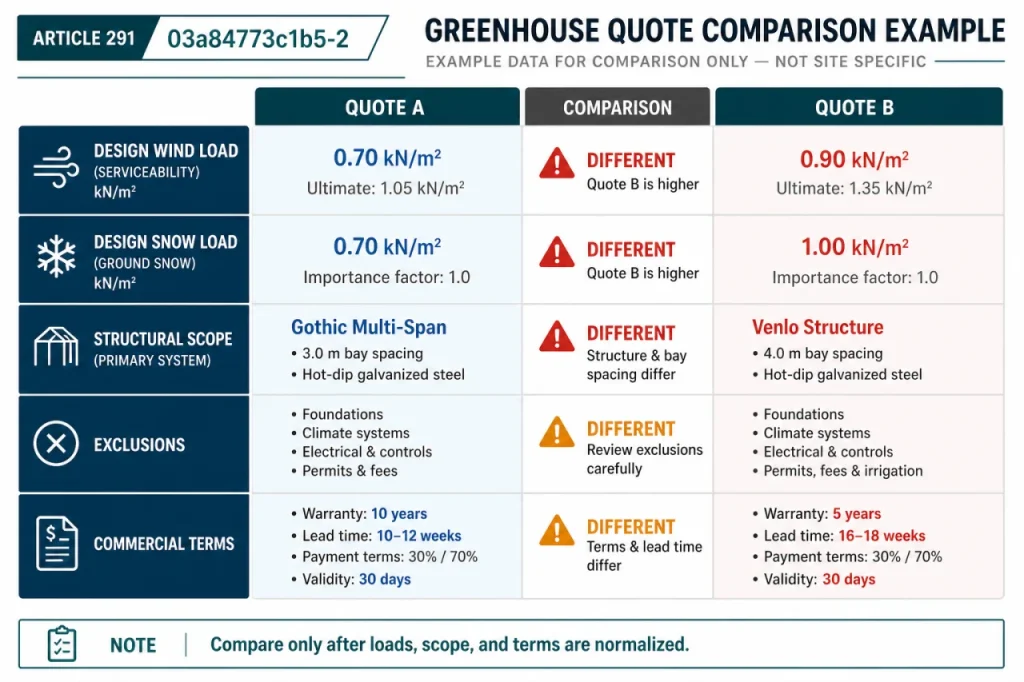
Side-by-side greenhouse quote normalization diagram for wind load, snow load, scope, exclusions, and terms
Normalize the quote fields before you compare price.

n

Before you compare price, confirm that each supplier is quoting the same design wind loaddesign snow load, unit set, and code basis. A quote built on 0.60 kN/m² snow load is not comparable with one built on 1.00 kN/m² unless the site, exposure, and governing standard are also aligned; otherwise the lower number may only reflect a lighter duty basis, not better value. The structural option referenced here is explained in multi span greenhouse.

n

  • Wind load: state the quoted value and unit, for example kN/m² or mph-based basis, and ask which exposure category was used.
  • n

  • Snow load: confirm the quoted roof snow load in kN/m² and whether drift or unbalanced loading was included.
  • n

  • Exposure category: require the site exposure assumption, because an open-field site and a sheltered site can drive different load cases.
  • n

  • Code edition: record the adopted standard and edition, such as ASCE 7 or the locally adopted building code, before treating the quote as comparable.
  • n

  • Units: make sure every bid uses the same unit basis; a unit mismatch can hide a 20%+ comparison error even when the numbers look close.
  • n

If one supplier will not state these fields clearly, the bid is not ready for price ranking. Ask for the design-basis sheet first, then compare the numbers using the same load basis and the same location assumptions. When the question moves from research to delivery scope, the next step is turnkey greenhouse solutions.

n

For a field-by-field template, use the commercial greenhouse structural specification guide; if you need the broader tender and acceptance framework, the greenhouse buying guide helps position the quote in the full procurement process.

Check 2: Align the structural scope and frame specification

n

Once the load basis is aligned, the next comparison is whether you are really pricing the same structure. A Gothic multi-span frame with 4.0 m bays, lighter bracing, and a different cladding package can land in a very different cost band from a Venlo structure with 5.0 m bays and heavier members, even if both quotes claim the same design wind and snow loads. That matters because price differences may come from geometry and steel quantity, not supplier margin. The structural option referenced here is explained in Venlo greenhouse.

n

Ask each supplier to state the bay spacing, frame form steel grade, bracing layout, gutter arrangement, and cladding type in plain terms, then compare those fields line by line. A quote using S235 steel and a simpler bracing pattern is not directly interchangeable with one using S355 members and reinforced cross-bracing, because the second option usually carries more material and fabrication cost but can deliver more stiffness for exposed sites.

n

The trade-off is straightforward: a heavier frame can improve robustness, but it is poor value if it is simply oversized for a sheltered site. If the geometry or material spec is different, do not negotiate on price alone; normalize the structure first, then decide whether the added rigidity is worth the premium.

n

If you need the supplier wording to compare these fields cleanly, use the commercial greenhouse structural specification guide alongside the high-wind greenhouse project scenario for context on exposed-site structure choices.

Check 3: Separate base scope from optional extras and exclusions

n

A greenhouse quote can look 8% to 15% cheaper simply because it leaves out items the next supplier treated as base scope. Before you compare price, mark each bid for whether it includes screens, heating interface, controls, gutters, foundations, delivery, installation, and commissioning; those line items often move the total more than a small structural discount.

n

  • Included in base price: structural frame, cladding, gutters, and any stated bracing package.
  • n

  • Sometimes optional: screens, heating, controls, delivery, installation, and commissioning.
  • n

  • Often excluded unless stated: foundations, utility tie-ins, and owner-side civil works.
  • n

This is where turnkey and supply-only bids must be normalized differently: a supply-only quote with a 12-week lead time may still be the stronger offer if installation and commissioning are already covered elsewhere, while a turnkey bid with more exclusions can trigger change orders later. If the quote does not state exclusions clearly, treat the headline price as provisional, not comparable.

Check 4: Test the hidden assumptions behind the number

n

A quote can look complete while still relying on unstated assumptions about site exposure, climate target, utility capacity, local code basis, or who is carrying the responsibility boundary. That matters because a supplier who assumed a sheltered inland site and a 75% heating/utilities interface can price very differently from one working on an exposed site with a 95% design target and fuller coordination scope, even before you get to steel or cladding. A good assumption is one that is written down and easy to verify; a warning sign is a quote that only makes sense if the buyer quietly absorbs the missing site work, code interpretation, or interface risk.

n

  • Acceptable assumption: the supplier states the project is priced to a clearly named local code basis and a defined exposure category.
  • n

  • Warning sign: the quote says only “standard conditions” while leaving wind exposure, snow drift basis, and utility interface undefined.
  • n

  • Acceptable assumption: climate targets are tied to a stated crop profile and operating range, such as 18-22 C and 70-85% RH.
  • n

  • Warning sign: responsibility boundaries for permits, utility tie-ins, or engineering sign-off are not assigned to one party.
  • n

That is the point where a greenhouse buying guide for tender review or an owner-side quotation normalization review becomes useful, because the problem is no longer price alone but missing context.

Check 5: Normalize commercial terms before comparing final price

n

Once the technical basis is aligned, the remaining spread often comes from lead time, warranty, payment terms, and change-order rules. A quote at 12 weeks with a 12-month warranty and strict progress payments can be more expensive in practice than a slightly higher bid at 18 weeks with a 24-month warranty and clearer acceptance terms, especially if delay pushes planting by one cycle.

n

Ask each supplier to state the same commercial fields in plain language: delivery window, warranty start date, payment schedule, retention, and how extras are priced after award. If those terms are not comparable, the lowest greenhouse quote may only be the cheapest on paper. For a structured request list, use the greenhouse buying guide for tender and acceptance terms; when the bid still looks inconsistent, a quotation normalization review is the safer next step.

FAQ and next-step decision path

n

What wind and snow load values should appear on a greenhouse quote? Ask for the design wind load and design snow load with units, code edition, and exposure basis, not just a headline number. A quote that states 0.60 kN/m² snow load and one that states 1.00 kN/m² are not comparable unless the governing basis is the same and project location has been verified.

n

Why do two greenhouse quotes with the same size differ so much? In practice, the price gap often comes from 1.0 m vs 1.2 m bay spacing, Gothic multi-span versus Venlo framing, steel grade, cladding, or excluded items such as foundations and commissioning. If one bid is lighter on structure or narrower on scope, it may look cheaper while carrying more change-order risk later.

n

What documents should I request before comparing bids? Request the design-basis sheet, structural outline, exclusions list, lead time, warranty terms, and change-order assumptions. If you also have a greenhouse buying guide for tender and acceptance checks, use it to confirm that scope, responsibility boundaries, and handover items are captured before award.

n

Is the cheapest greenhouse quote ever the best option? Yes, but only when the load basis, structure, scope, and commercial terms are already aligned. On an exposed or high-altitude site, a slightly higher bid can be the better commercial choice if it reduces redesign risk, delay risk, or structural under-specification.

n

When should I request an owner-side quotation normalization review? Do it after you have the supplier documents but before shortlist or award, especially if the bids mix different snow-load assumptions, frame types, or exclusions. Download the structural quote-comparison worksheet first, then use it to support a owner-side quotation normalization review; if you need the design basis behind the bids, the commercial greenhouse structural specification guide is the right reference point.

n

For site-specific context, exposed sites are better judged against a high-wind greenhouse project scenario, while elevation-driven load questions are easier to sanity-check against a high-altitude greenhouse project scenario. This is procurement and planning guidance, not structural design approval.
FAQ

Frequently asked questions

What wind and snow load values should appear on a greenhouse quote?+

Cost depends on scope, performance targets, utility conditions and how much risk is being carried in the supplier quote. Treat early figures as planning ranges until the specification, interfaces and assumptions are normalized.

Why do two greenhouse quotes with the same size differ so much?+

Cost depends on scope, performance targets, utility conditions and how much risk is being carried in the supplier quote. Treat early figures as planning ranges until the specification, interfaces and assumptions are normalized.

What documents should I request before comparing bids?+

It is worth doing when how to compare greenhouse quotes when wind and snow loads differ materially reduces operational risk or protects the crop under your real operating conditions. It is often unnecessary when the same objective can be met through a simpler operating, equipment or maintenance change.

Need a second set of eyes on the quotation set?

Request an owner-side quotation normalization review if the bids still do not align after the worksheet is completed.