Does Insect Screen Reduce Greenhouse Ventilation? How to Evaluate the Trade-Off
Yes, insect screens can restrict natural ventilation. Learn how pest target, mesh free area, vent geometry, climate and fans determine whether the trade-off works.
Ask for aperture, free-area percentage, thread geometry and pressure-drop performance at stated air velocities. A fine screen with lower free area may improve exclusion but impose a larger ventilation penalty than a higher-free-area alternative.
Judge Fit by Climate and Vent Layout
A screen decision that works with generous roof vents and pad-and-fan cooling can become high risk in a humid site with limited roof opening area. Review hourly heat, humidity and wind conditions alongside the vent drawings.
Prepare a Supplier-Comparable Brief
Provide the crop, target pest, production period, greenhouse dimensions, vent geometry, candidate mesh data and available fan capacity. This allows screen options to be compared on operational consequence, not pest claims alone.
Overview
Yes—an insect screen can reduce greenhouse ventilation because every mesh adds resistance to air moving through a roof vent or side opening. The important question is not whether airflow falls, but whether the proposed screen, vent geometry and climate-control equipment can still protect the crop during the hottest and most humid operating hours.
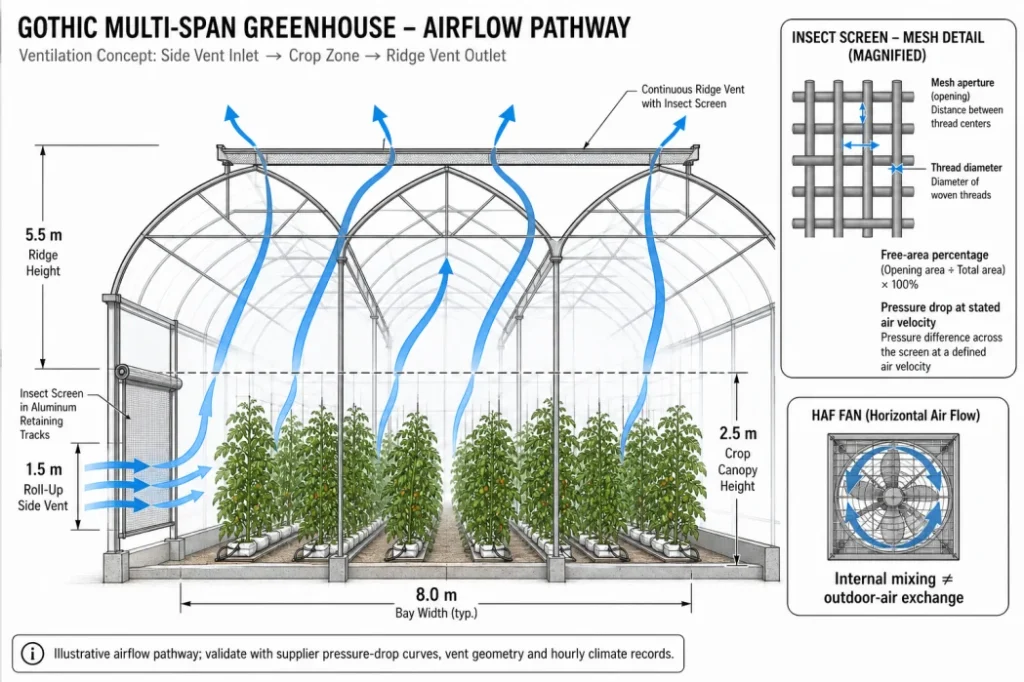
Do not choose between pest exclusion and ventilation as though they were separate specifications. A screen with a smaller mesh aperture, thicker yarn or lower free-area percentage can impose a higher pressure drop; a Gothic multi-span greenhouse with generous roof openings and mechanical support may carry that penalty, while the same screen can create heat or moisture risk in a naturally ventilated structure with restricted vents.
The practical evaluation starts with five inputs: the target pest or virus-vector concern, supplier data for aperture and free area, pressure-drop curves at a stated air velocity, roof and side-vent dimensions, and hourly temperature, relative-humidity and wind records for the critical crop period. Mesh labels alone cannot answer the greenhouse insect screen ventilation trade-off.
This is especially consequential for crop programmes where insect pressure and moisture control collide. The crop’s production window changes both the pest-exclusion requirement and the tolerance for a reduced ventilation margin; use the greenhouse crop selection guide to place the screen decision in that production context.
What buyers need to know
The useful question is not simply whether insect netting reduces airflow—it does. The decision is whether the proposed pest-exclusion requirement can be carried by the available Gothic multi-span roof vents, roll-up side vents and any mechanical cooling without removing too much temperature or moisture-control margin. A screen chosen on mesh label alone can be biologically appropriate yet operationally restrictive.
Make the decision in the right order
Define the pest consequence: Identify the target insect, whether it is a virus-vector concern, and the crop period at risk. A high-value tomato or pepper programme may justify a finer exclusion strategy; a lower-pressure situation may not justify the added resistance of a lower-free-area screen. Crop exposure and production timing should be considered alongside the wider greenhouse crop selection process.
Test the greenhouse pathway: Record roof-vent and side-vent opening dimensions, ridge height and prevailing-wind exposure before comparing screens. In a commercial multi-span greenhouse, a generous roof opening can make a screened concept more workable than the same screen installed on a structure with restricted ridge ventilation.
Identify the governing climate risk: Hot, dry conditions usually make peak-temperature control the immediate concern; hot, humid conditions can make moisture removal the limiting factor. For crop- and growth-stage-dependent planning, a 75% to 85% relative-humidity band can be used as an operating reference—not as a universal target—to reveal how little margin a screened vent arrangement may leave during humid periods.
Do not accept “high airflow” as a selection criterion. Ask whether the supplier can state the screen’s aperture, thread geometry, free-area percentage and pressure-drop curve at a declared air velocity and mounting condition. Those inputs allow competing screens to be compared against the actual ventilation pathway; an unsupported airflow-loss percentage does not. For the decision framework behind this point, review greenhouse feasibility and procurement planning guide.
Internal air movement also needs to be separated from air exchange. HAF fans can improve canopy mixing and reduce stratification, but they recirculate air rather than restore outdoor-air exchange through a screened roof vent. If the concern is heat or humidity removal, the follow-up question is whether the vent layout, exhaust capacity or pad-and-fan inlet path can perform with the screen in place—not merely whether circulation fans are included. The crop-specific production context is covered in tomato greenhouse production programme.
Technical Considerations
Compare candidate screens using supplier pressure-drop data at a stated air velocity, then test that resistance against the actual roof and side-vent pathway.
Screen-related airflow loss is governed by pressure drop, not by the mesh label alone. As air passes through an insect screen at a Gothic multi-span roof vent or roll-up side vent, the mesh aperture, thread diameter and free-area percentage create resistance. Two products described as insect screens can therefore produce materially different air-exchange constraints even when both are marketed for the same pest class. A practical planning scenario appears in humid-climate bell pepper reference scenario.
Compare pressure-drop evidence, not mesh count
For a defensible comparison, request each supplier’s pressure-drop curve at a stated air velocity, along with aperture in microns, free-area percentage, thread geometry and the test mounting condition. A curve measured on a clean, flat sample at 1 m/s is not directly equivalent to a screen installed in an aluminum retention profile, partially loaded with dust, across a roof vent. The practical question is whether the candidate screen’s resistance can be carried by the available vent pathway, rather than whether it is described as high-airflow.
Screen data to compare
Why it changes the decision
What to verify
Aperture and declared pest target
A finer aperture can improve exclusion for a smaller target insect but commonly increases resistance.
The supplier’s pest-exclusion basis and the target pest or virus-vector concern.
Free-area percentage and thread diameter
Free area indicates open passage, while thicker yarn can raise drag even where nominal aperture appears similar.
Values stated on the same product data sheet, not across unrelated screen ranges.
Pressure-drop curve at stated air velocity
This is the useful aerodynamic comparison when evaluating insect net airflow in a greenhouse.
Test velocity, clean or aged screen condition, units and mounting configuration.
Installed vent configuration
A 1.5 m roll-up side vent and a roof vent with insect screen do not experience the same wind-driven flow path.
Actual opening dimensions, actuator travel, retention profiles and unsealed bypasses.
Air movement is not outdoor-air exchange
HAF fans can improve canopy uniformity and reduce temperature stratification by recirculating air, but they do not replace fresh-air exchange through a screened roof vent or exhaust inlet. In a Priva or HortiMaX climate-control strategy, treat HAF fan staging, roof-vent position and exhaust-fan capacity as separate control functions. Assuming that internal circulation compensates for screen pressure drop is a common specification error because it leaves humidity and heat without a sufficient path out of the structure.
Screen condition changes the original calculation
A clean screen’s declared free area is only the starting condition. Dust, mineral deposits, biofilm and loose tension can alter the effective flow path, especially at side vents exposed to field dust or irrigation overspray. Require cleaning access, a stated cleaning method, replacement-panel availability and an inspection point at door frames, fan inlets and cable penetrations. A fine screen that cannot be maintained or sealed at these interfaces may add airflow resistance without delivering the intended exclusion benefit.
These checks keep greenhouse pest screen selection tied to measurable screen and vent evidence. The next step is to apply that evidence to the crop, pest pressure and operating scenario rather than selecting the finest available mesh by default.
Decision Framework: Match Pest Exclusion to the Ventilation Pathway
Make the screen decision in this order: define the pest consequence, compare supplier airflow evidence, then test the chosen screen against the actual roof and side-vent pathway. For a multi-span greenhouse, the relevant pathway includes Gothic roof-vent opening area, roll-up side-vent height, ridge configuration and wind exposure—not the mesh label alone. This prevents a biologically cautious specification from creating an unmanageable heat or moisture constraint.
Condition
Implication of screen pressure drop
Option to evaluate
Main trade-off
Input to verify
Hot-dry site with pad-and-fan cooling
Screen resistance can still limit passive exchange, but evaporative cooling may provide a separate heat-control path.
Higher-free-area screen with pad-and-fan inlet and exhaust layout.
More cooling capacity can increase water demand and electrical duty.
Supplier curve at the declared air velocity, fan curve, inlet area and seasonal dry-bulb temperature.
Hot-humid site
Reduced exchange can narrow the margin for removing crop moisture, especially near dawn and after irrigation.
Maximise usable roof-vent and side-vent area before choosing a finer screen.
A finer aperture may improve vector control while increasing condensation exposure.
HAF fans mix internal air; they do not restore outdoor-air exchange through a screened vent.
Separate HAF circulation from exhaust, inlet or dehumidification requirements.
Better canopy uniformity does not automatically reduce absolute humidity.
HAF fan layout, exhaust capacity, inlet path and Priva or HortiMaX control sequence.
Use a supplier-comparable screen brief
Before requesting quotations, require every candidate screen to be described under the same test conditions. A stated aperture without free-area percentage, thread diameter and a pressure-drop curve at a named air velocity is not enough to compare greenhouse insect screen ventilation trade-offs. Also ask whether the curve applies to clean material in a laboratory frame or to the proposed roof-vent installation, where fastening profile and accumulated dust can alter resistance.
Pest basis: target insect, virus-vector concern, production months and the supplier’s stated exclusion-test basis.
Airflow basis: aperture, free-area percentage, thread geometry, pressure-drop curve and stated test air velocity.
Interface basis: roof vents, roll-up side vents, doors, fan inlets and cable penetrations; a fine mesh cannot compensate for unsealed bypasses.
Operating basis: cleaning access, panel tensioning, replacement-panel availability and the effect of screen condition on the declared pressure-drop data.
The crop programme changes how much restriction is commercially acceptable. A crop with high virus-vector exposure may justify a finer screen, while a programme with lower exposure may benefit more from a higher-free-area alternative. Use the greenhouse crop selection guide to connect crop timing and value exposure with pest-risk tolerance rather than assuming one screen is suitable for every crop.
Do not freeze a greenhouse pest screen selection until the supplier data, critical-period climate records and vent drawings agree. If those inputs point in different directions—for example, fine exclusion is needed but roof ventilation is limited—the decision is not “screen or no screen”; it is whether vent capacity, mechanical exchange or the crop-risk strategy must change first.
Validate Pest Exclusion Against Your Ventilation Concept
Before committing to a screen, compare each candidate against the same input set: crop and production period, target pest or virus-vector concern, hourly temperature and relative-humidity records, Gothic multi-span roof-vent and roll-up side-vent drawings, aperture, free-area percentage, and the supplier pressure-drop curve at its stated air velocity. Include available HAF fans, pad-and-fan equipment, and Priva or HortiMaX control capability. This keeps the decision focused on the operating consequence of the installed screen, rather than a mesh label or pest claim in isolation.
Aegis can provide a ventilation and pest-risk concept review to identify the questions that candidate suppliers and the project team must resolve before specification. The review is planning support, not detailed mechanical, electrical, controls, or crop-climate design sign-off.
Validate Pest Exclusion Against Your Ventilation Concept
Aegis can help frame a ventilation-and-pest-risk concept review around your crop, pest pressure, local climate records, proposed vent geometry and available cooling or fan capacity. The purpose is to identify the trade-offs and supplier questions before a screen specification is committed.