Skip to content
AEGIS Greenhouse Systems

Blog / 20 min read

What Should Be Included in a Greenhouse Commissioning and Acceptance Test Plan?

Learn what a greenhouse acceptance test plan should include: system demonstrations, alarm tests, punch-list rules, training evidence and sign-off boundaries before handover.

By Aegis Greenhouse Systems

Published /Updated

Decision support

Does this fit your project?

Best for projects where final payment, warranty start or operational takeover depends on witnessed proof that systems function as intended; less critical for very small low-tech houses with minimal automation.

What must be ready before testing?

Have the point list, alarm list, control logic, sensor calibration records, utility interfaces and responsibility matrix aligned before commissioning starts.

What should be reviewed first?

Start with pass/fail criteria, open-item rules, training evidence and who owns defects found after handover.

What Should Be Included in a Greenhouse Commissioning and Acceptance Test Plan?

Overview

A greenhouse acceptance test plan is an owner-side proof-of-readiness document: it should show that the installed greenhouse can be safely handed over, operated and supported with defined evidence, not just that major equipment has been mounted and powered on.

That distinction matters because installation completion and final acceptance are not the same event. A Venlo greenhouse or multi-span greenhouse can be mechanically complete at 100% structure and utility connection, yet still be unready for owner sign-off if the Priva or HortiMaX control logic, alarm routing, irrigation response or backup interface has not been demonstrated against the approved point list. In commissioning practice, turnover is supposed to verify intended operation, issue resolution and usable records, which is why owners should treat acceptance as a decision gate rather than a paperwork milestone.

Weak sign-off creates a commercial problem before it becomes a crop problem. If final acceptance is granted without defined pass/fail evidence, the owner may lose leverage on retention, warranty-start timing, supplier demobilization and defect ownership, especially where unresolved controls, heating at a 70/50 degrees C design condition example, or irrigation pressure behavior in a 2.5-4.0 bar example range only show faults under live operation. If your project team is still aligning broader startup readiness, the commercial greenhouse operations readiness guide helps frame that bigger transition, but the acceptance plan itself should stay tightly focused on proving readiness for handover.

Set the acceptance boundary before anyone starts testing

A greenhouse acceptance test plan fails early when the team starts testing equipment before agreeing what is actually in scope. The owner should define the acceptance boundary from the contract scope, approved submittals and OEM interface requirements so commissioning handover does not turn into a dispute over who was supposed to prove what. This matters even more on a 2,000-5,000 m² Venlo or glass greenhouse with integrated controls, where a Priva or HortiMaX platform may depend on multiple third-party devices, field sensors and utility connections that were not supplied by one vendor.

Included in the acceptance boundary

  • Controls and integration: Climate computer such as Priva Connext or HortiMaX, field I/O panels, networked sensors, point list mapping, time schedules, screen logic, vent sequencing and interface signals to pumps, boilers or generator transfer contacts.
  • Irrigation and fertigation: EC/pH dosing controller, irrigation zones, solenoid valves, filtration skid, line flushing, pressure stability in the project operating range such as 2.5-4.0 bar where applicable, and communication between dosing, irrigation start commands and alarm outputs.
  • Heating: Hot-water loop, mixing valve control, circulation pumps, pipe circuits, temperature sensor feedback and interface to heat source control logic, with project-specific operating conditions such as 70/50 degrees C only if the approved design uses that regime.
  • Ventilation and air movement: Roof vent motors, side vent actuators, gearbox synchronization, end-stop logic, wind interlock and any HAF or circulation fans tied into climate control sequences.
  • Thermal screens and shading: Screen drive motors, open-close position feedback, travel limits, temperature or radiation-based commands, and obstruction or fault alarms where the selected screen system supports them.
  • Alarms and notifications: High/low temperature alarms, irrigation failure alarms, tank low-level alarms, communication loss, sensor fault signals and escalation routing to local HMI, SMS, email or BMS gateway if those functions were contracted.
  • Backup functions: UPS support for controls, backup generator interface, automatic transfer signal logic, restart behavior after power loss and safe-state positions for vents, screens or pumps after a blackout event.

Usually excluded unless the contract says otherwise

  • Utility performance outside the greenhouse scope: Incoming power quality at 400 V, unstable water supply pressure below the agreed minimum, gas quality or external internet service if these are owner-provided utilities.
  • Crop-performance outcomes: Yield, water-use efficiency, disease pressure or climate uniformity beyond the contracted sensor and control functionality. If you need broader startup readiness, that belongs in an operations readiness plan, not only in system acceptance.
  • Uncontracted integration work: Extra PLC links, third-party software dashboards, remote access setup, additional alarm recipients or future expansion points not shown on the approved point list.

Responsibility boundaries to write down explicitly

Supplier responsibility: Demonstrate the supplied systems as installed, configured and connected according to approved submittals, including each named interface that sits inside their scope. Owner responsibility: Provide utilities, witness the defined systems and confirm who has authority to accept interfaces crossing between packages. Specialist responsibility: Qualified electrical, gas, boiler, CO2 or generator personnel must handle safety-critical work and any energized or moving-equipment procedures. If these boundaries are vague before SAT or handover, the team often discovers too late that a control point was never assigned, a transfer contact was never wired, or a sensor was installed but never integrated into the live sequence. That is also why contract-stage scope review in a greenhouse buying guide context should happen before mobilization, not after commissioning starts.

Build a witnessed test matrix owners can actually use

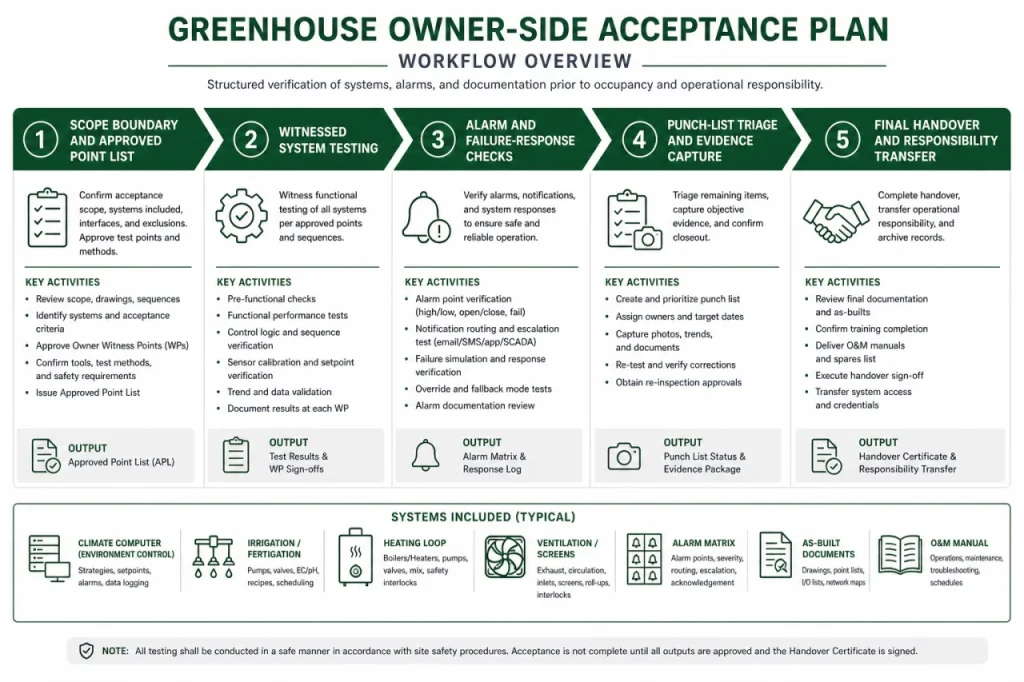
Workflow diagram showing the five steps of a greenhouse acceptance test plan
A greenhouse acceptance test plan should move from scope definition to witnessed testing, issue closure and formal handover.

A greenhouse acceptance test plan becomes defensible when every check is recorded in the same structure. That means no vague notes such as “irrigation tested” or “controls OK.” For a 2,000-5,000 m² project with a Priva or HortiMaX platform, the owner needs a row-by-row matrix that shows what was demonstrated, what result was expected, who witnessed it, and what evidence supports sign-off. This is what turns greenhouse system testing from a verbal walkthrough into a usable handover record. For the decision framework behind this point, review greenhouse technology comparison.

Column What it should contain Why it matters
System Named asset or subsystem: Priva climate computer, EC/pH dosing controller, hot-water loop, thermal screen drive, roof vent actuator, backup generator transfer interface Prevents test rows from being too broad. If one subsystem fails, the dispute stays contained to that asset instead of the whole package.
Test point One observable function per row: sensor reading comparison within an illustrative ±0.5°C band, irrigation zone pressure verification at an example 2.5-4.0 bar, screen open-close travel, boiler enable command, alarm routing to operator device Owners often lose leverage when several functions are grouped into one line item. A single-function row makes deficiencies traceable.
Expected result The exact demonstrated outcome: valve opens within the approved sequence, vent reaches commanded position, dosing skid holds target EC range from the approved recipe, alarm appears on HMI and remote notification path This avoids the common problem of “it ran” being treated as acceptance even though the sequence, feedback, or displayed value was wrong.
Pass/fail rule Project-specific acceptance basis: approved point list, OEM procedure, submittal logic, calibrated instrument reading, timed response example under 60 seconds where the contract requires response verification Without a rule, the test becomes opinion. The pass/fail basis should be tied to approved documents, not memory from site meetings. If your broader readiness inputs are still unclear, align them first in the commercial greenhouse operations readiness guide.
Responsible party Clear role split: supplier demonstrates, owner witnesses, controls integrator adjusts logic, qualified electrician verifies 400 V transfer interface, irrigation specialist confirms hydraulic performance This keeps the matrix from turning into an argument about who was supposed to act. Safety-critical work should never be assigned informally during live testing.
Evidence record Dated proof: signed witness sheet, trend export, alarm screenshot, calibration certificate, pressure gauge photo, controller event log, revised issue number If a defect returns 7-30 days later, evidence is what protects the owner. A witnessed test without records is weak support for payment, warranty, or defect claims.

Keep the matrix compact enough to use live on site, but specific enough that each failed row can move straight into an issue log with a target closeout date. For integrated glass greenhouse projects, that usually means separating command, feedback, alarm, and manual-override checks into different rows rather than collapsing them into one “system operational” statement.

Test the systems that create the most handover risk first

If time is limited, start with the systems that can stop crop loading or create hidden defects after handover: the climate computer, irrigation/fertigation, heating, ventilation, thermal screens, sensors and backup power interface. In a high-tech house, a Priva or HortiMaX sequence that looks fine in a calm demo can still fail when one input drops, so the first priority is not “does it run?” but “does it recover predictably under the approved control logic?”. For the decision framework behind this point, review greenhouse utility planning.

  • Climate computer: verify setpoint changes, mode changes and trend visibility against the approved point list; a 1-step logic error here can affect every connected system.
  • Irrigation/fertigation: confirm dosing ratio, zone switching and EC/pH controller response; even a small control drift can matter more than a clean mechanical start-up.
  • Heating loop: check circulation, valve response and temperature control on the hot-water loop; where applicable, a 70/50 degrees C reference check is useful only as a planning example, not a universal rule.
  • Ventilation and screens: prove opening direction, travel limits and sequence timing; a delayed screen drive can create heat or light stress before it becomes visible on a site walk.
  • Sensors and backup power interface: compare key sensors to the approved calibration record and confirm the generator or transfer interface restores the intended control state after loss of mains.

When the schedule is tight, this order protects you from the failures most likely to become warranty disputes later. For a broader planning view that sits upstream of handover, align the draft against the commercial greenhouse operations readiness guide; if the project is still being evaluated commercially, the greenhouse buying guide is the better next stop. For a system-level planning example, a Venlo greenhouse or tomato greenhouse usually justifies tighter controls verification than a low-tech naturally ventilated house.

Alarm and failure-response testing

A greenhouse acceptance test plan should not stop at proving that equipment runs in normal mode. Hidden handover risk usually appears when the team forces abnormal conditions and confirms that the control platform, alarm routing and operator response chain behave correctly. In practical terms, that means testing how a Priva or HortiMaX sequence reacts when a value goes out of range, a sensor drops offline, or utility power is interrupted for even 5-15 seconds. If those events are not witnessed before crop loading, the owner may only discover weak escalation logic, wrong alarm recipients or unsafe restart behavior during a live production event. For the decision framework behind this point, review greenhouse water quality requirements.

Forced alarms should be selected from the approved point list and tested one by one against a clear expected result. Useful examples include a high-temperature alarm at an illustrative threshold such as 32-35 degrees C in a warm-zone compartment, low irrigation pressure on a main line at an example 2.5-4.0 bar operating band, high EC deviation on the dosing skid, screen travel fault on a thermal screen drive, and communication loss between field I/O and the climate computer. The point is not to prove a universal setpoint; it is to confirm that the correct alarm appears, the timestamp is recorded, the right person receives it, and the commanded fallback action actually occurs. A practical planning scenario appears in high-wire tomato greenhouse project.

Sensor disconnect testing is especially valuable because many commissioning demonstrations only show stable readings. A more defensible greenhouse handover checklist should include deliberate loss-of-signal tests for at least one air temperature sensor, one RH sensor, one irrigation pressure transmitter or flow meter, and any critical EC/pH dosing feedback loop. If a temperature sensor with an expected planning tolerance of around plus or minus 0.5 degrees C goes offline, the owner should verify whether the control platform holds last value, substitutes a backup sensor, shifts to manual mode or triggers an immediate alarm. That decision affects crop risk directly, especially in a Venlo greenhouse or other integrated high-tech facility where ventilation, heating pipe temperature and screen position are all linked through the same logic stack.

Power-loss logic deserves separate attention because a clean restart is not the same as a safe restart. The acceptance team should verify what happens after a brief outage of 5-30 seconds versus a longer outage that requires backup generator or transfer-switch action, if those systems are in scope. At minimum, confirm which devices auto-recover, which stay latched out, whether alarm history is retained, and whether pumps, vent motors, boiler enable signals or dosing commands restart in the correct order. For projects with integrated utilities or complex controls, it is often worth cross-checking the acceptance logic against the broader commercial greenhouse operations readiness guide so restart behavior matches actual operating responsibility, not just installation completion.

Escalation-path testing is where many owners find gaps that a supplier demo does not reveal. A greenhouse system testing plan should verify not only that an alarm exists, but that it reaches the first operator, then escalates to a second contact if no acknowledgement occurs within an illustrative window such as under 60 seconds for a high-priority event. That matters more than it sounds: an unacknowledged boiler fault, fertigation failure or ventilation stop can become a crop-loss event long before the handover debate is resolved. If the project uses outsourced operations, remote supervision or split day-night staffing, the escalation chain should be tested with the actual phone numbers, user permissions and notification channels that will exist after sign-off. A practical planning scenario appears in greenhouse retrofit and phased expansion planning scenario.

Because these tests can involve electrical panels, moving vent drives, pressurized hot-water loops, gas-fired equipment or CO2-linked interlocks, the method should stay project-specific and follow safe-work controls. Abnormal-condition simulations may require lockout or controlled isolation before work begins, especially where unexpected startup, stored thermal energy above 70 degrees C, or motorized movement across spans of 2-4 m could expose personnel. The owner’s role is to witness and record the result; the qualified contractor, integrator or specialist should control the test method and any reset procedure. If your contract still treats alarm checks as an informal SAT demonstration, this is usually the point to tighten the acceptance language before demobilization or final handover.
Punch-list closure: what can stay open and what cannot

. When the question moves from research to delivery scope, the next step is greenhouse consulting.

Owners should treat the punch list as an acceptance control tool, not a parking lot for unresolved system risk. A defect should block acceptance if it affects safe operation, crop protection, automated control, utility continuity, or the owner’s ability to run the greenhouse on day 1. It may remain open only if the item is genuinely non-critical, clearly documented, and tied to a dated closeout commitment with a responsible party. A supporting article on this narrower question is greenhouse handover spare parts list.

Item type Typical example Acceptance impact Closeout rule
Critical defect Priva or HortiMaX control point not responding, irrigation zone pressure below 2.5-4.0 bar design check range, hot-water loop failing commanded 70/50 degrees C verification condition where applicable, roof vent actuator not reaching full stroke Block acceptance Correct, retest, and record pass result before sign-off
Functional reliability gap Sensor reading drift greater than plus or minus 0.5 degrees C planning tolerance, EC/pH dosing controller instability, backup generator transfer logic not completed Block acceptance Close only after witnessed retest and updated issue log entry
Minor non-critical item Labeling touch-up, small sealant correction outside active weather line, non-essential cosmetic panel alignment May stay open List with owner approval, responsible contractor, and closeout date such as within 7-21 days
Deferred improvement Optional report formatting change, non-operational interface preference, future optimization note Do not block acceptance Move to a separate post-handover action list, not the core defect list

What usually goes wrong is vague wording such as “to be adjusted later” or “works with minor issues.” That language weakens the owner’s position because it does not say whether the item affects operation, whether payment can proceed, or whether warranty timing has started. A better greenhouse handover checklist uses an issue log with at least these fields: defect description, affected system, operational consequence, temporary mitigation, responsible party, required retest, and target closeout date. A practical planning scenario appears in cold-climate tomato and cucumber greenhouse planning.

Scenario matters. In a naturally ventilated multi span greenhouse with no climate computer, a bent cover flashing or missing non-critical tag may be manageable as an open item. In an integrated Venlo greenhouse with dosing, heating, and centralized controls, even one unresolved interface fault can create crop risk across 2,000-5,000 m², so the threshold for open items should be much tighter. If your team has not yet defined those acceptance boundaries contractually, align them with the greenhouse buying guide principles before final sign-off terms harden in the field.

Training, documents and data the owner should receive

A greenhouse should not be treated as operationally handed over just because the equipment ran during witnessed testing. The owner also needs evidence that operators can run the facility on day 1, recover after a fault, and maintain key systems such as a Priva or HortiMaX controls platform, EC/pH dosing skid, hot-water loop and thermal screen drive without depending on informal supplier memory. If those records are missing, control settings, calibration history and maintenance responsibility usually become unclear within the first 30-90 days.

  • Training attendance records: Keep a signed register showing who attended, their role, the training date, the system covered and the training duration, such as a 4-hour climate-control session and a 2-hour irrigation/fertigation session. This matters because a handover claim is weak if no named operator was trained on alarm acknowledgement, setpoint changes or manual override procedures.
  • As-built drawings: Require final as-builts for electrical single-line layouts, irrigation zone routing, valve schedules, heating circuit identification and sensor locations. A 1-line power diagram and tagged field-device map are especially important where backup transfer, 24 V control circuits or multiple pump stations are involved. Without as-builts, fault finding and later modifications become slower and more expensive.
  • OEM manuals and operating instructions: Collect the current manuals for the climate computer, dosing controller, pumps, filters, boilers or unit heaters, screen motors and ventilation actuators. The owner should verify that the manual version matches the installed model, because a controller manual for the wrong firmware revision or actuator type can mislead settings and troubleshooting.
  • Setpoint backups and control data: Ask for an export or backup of active settings, including temperature bands, irrigation start logic, EC and pH targets, alarm thresholds, screen strategy and time schedules. On an integrated greenhouse, that may mean a full Priva or HortiMaX database backup plus a plain-language settings summary. This protects the owner if a controller is reset, replaced or altered after handover.
  • Calibration and commissioning records: Retain documented calibration status for temperature, humidity, radiation, EC, pH and pressure instruments, with the date, method and acceptable deviation noted. A practical example is a temperature-sensor check within an agreed tolerance such as ±0.5 degrees C, but the binding acceptance value must come from project documents and OEM guidance. These records matter because unexplained sensor drift can look like a process problem when it is really an instrumentation problem.
  • Maintenance handover files: The owner should receive preventive maintenance schedules, lubrication points, filter replacement intervals, belt or drive inspection guidance, recommended consumables and startup-shutdown procedures. For projects with moving equipment or hazardous energy exposure, the file should also point to safe isolation requirements and qualified-person tasks. If your team is still aligning staffing, this is where broader commercial greenhouse operations readiness planning becomes more important than another round of system demonstration.

One useful owner check is simple: can a newly assigned supervisor locate the right drawing, identify the installed device, restore the approved setpoint file and follow the maintenance interval without calling the supplier? If not, the greenhouse handover checklist is still incomplete, even if the hardware itself has already passed demonstration.

FAQ

Frequently asked questions

What is the difference between greenhouse commissioning and final acceptance?+

Maintenance needs depend on the chosen system, operating hours, water or energy profile and staff capability. Include service access, consumables, failure response and commissioning responsibilities in the comparison before you decide.

What should a greenhouse commissioning checklist include before handover?+

It is worth doing when what should be included in a greenhouse commissioning and acceptance test plan? materially reduces operational risk or protects the crop under your real operating conditions. It is often unnecessary when the same objective can be met through a simpler operating, equipment or maintenance change.

Which greenhouse alarms should be tested before sign-off?+

It is worth doing when what should be included in a greenhouse commissioning and acceptance test plan? materially reduces operational risk or protects the crop under your real operating conditions. It is often unnecessary when the same objective can be met through a simpler operating, equipment or maintenance change.

Need a Second Set of Eyes on the Handover Plan?

Aegis can review your acceptance criteria, responsibility boundaries and test matrix so the team signs off on evidence, not assumptions.